Concept
The imagery of Yoshitomo Nara—the girl with large eyes and the dogs—has long existed in popular culture divorced from its original context. This exhibition returns those images to their foundations, demonstrating how the artist’s personal experience transforms into a language accessible to others.
The exhibition does not follow a chronological narrative, so as not to reduce the imagery to the artist’s biography. Instead, it guides the viewer from the specific to the universal.
First, the sources of the language are examined: childhood in northern Japan, music, and years spent in Germany (1988–1994). Then, the ambiguous character—whose facial expression permits multiple interpretations—is presented, and the viewer defines the nature of the encounter. Next, the personal evolves into the public: protest, an anti-war stance, and the turning point following the 2011 disaster. Finally, the individual motifs coalesce into a cohesive environment.
The main thesis is that Nara’s art functions as a shared experience. A work is incomplete without the viewer, and the visitor becomes not an observer, but a participant.
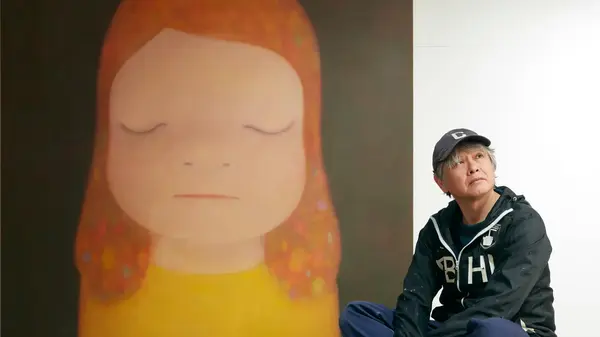

Exhibition Title Justification
Yoshitomo Nara: I See You Too
The characters in the artist’s work look directly at the viewer—there is no plea, nor is there accusation. It is the gaze of a being that notices who has arrived.
The word «too» transforms the line into a response. It sounds like an acknowledgment: the visitor recognized their own experience in the image, and the image sees them in return. Thus, the title expresses the main idea of the exhibition: Nara’s art functions as a shared experience, where the viewer participates, rather than merely observes.
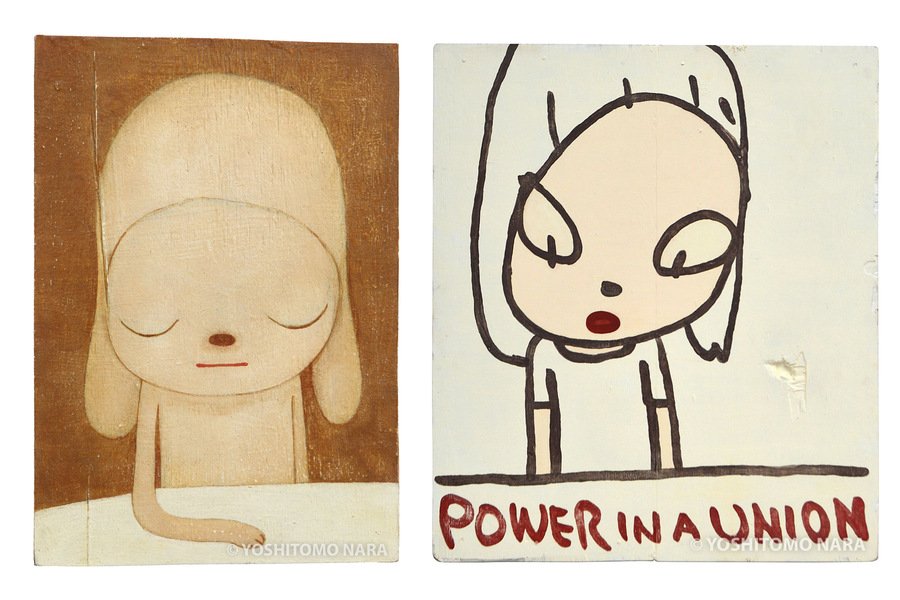
Stay, 2011, Acrylic on wood, 25,0×17,8×1.2 Power in a Union, 2024, Acrylic on wood, 104,5×90,7×6.0
Venue Selection
Музей современного искусства «Гараж»
The building was constructed in 1968 as the Soviet restaurant «Seasons» and stood abandoned for many years. In 2015, it was transformed into a museum by the firm OMA (Rem Koolhaas): the original structures were preserved, the facade received a translucent polycarbonate shell, and the total area is approximately 5,400 m². The museum showcases contemporary art and regularly hosts monograph exhibitions.
Main Thesis. «Garage» is suitable for the exhibition because its core concept—the audience meeting the artwork on equal terms—functions best in an environment devoid of the hierarchy of an «art sanctuary.» The building is composed of a repurposed Soviet structure, and visitors enter it simply, without formality. The hall’s flexible layout allows for an exhibition to be conceived as an environment where works of varying scales interact without rigid boundaries.
Advantage of Outdoor Space. In addition to the building itself, the exhibition has access to the area near the entrance and the open park grounds. For large-scale installations and sculptures, this provides something a closed hall cannot: unrestricted placement regarding height, weight, and dimensions, natural lighting, and the ability to view the work from all angles.
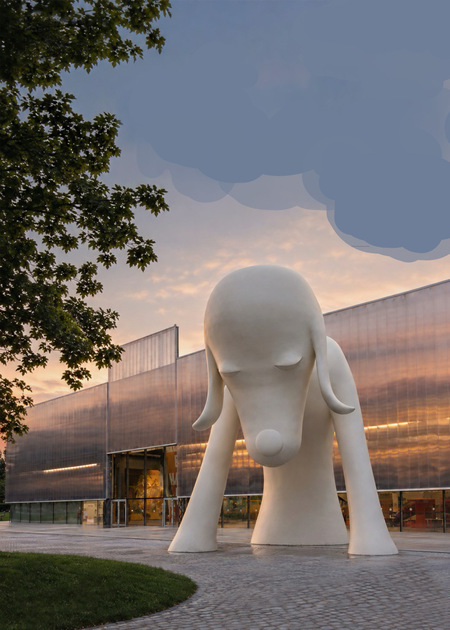
Monumental sculptures by Nara, such as «Aomori-ken Dog, 2005, ” which stands about 9 meters tall, take on a scale akin to the urban environment when displayed outdoors. The outdoor area also functions as an „entry“ to the exhibition—it greets the visitor even before the ticket booths and invites everyone walking through the park into the artist’s world.
Museum «Garage» Model
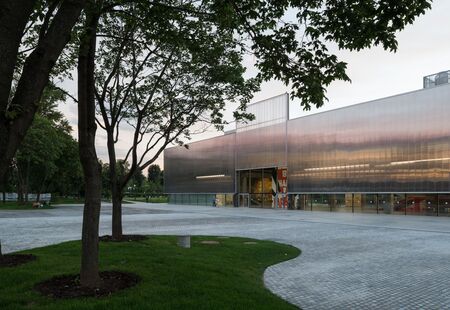
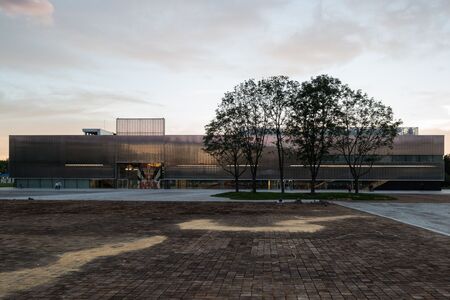
Photo: Yuri PALMIN
Exhibition Plan
The exhibition is located in the hall on the second level of the Garage building. The entrance and exit are shared: visitors traverse the exposition in a circuit along the walls, finishing in the center before returning to the door.
The route begins with the section «Memory with an Address, ” featuring early works from the 1980s, and continues with the „Between Memory and Image“ section, showcasing painting from the Düsseldorf period.
Next, the viewer proceeds to the Characters hall, where large canvases and objects from Nara are displayed along extensive walls, giving each piece ample space. This section concludes with a small block dedicated to the post-2011 earthquake period. It is separated from the adjacent areas and arranged around the sculpture „Miss Forest, ” enveloped in quietude.
The following section, „The Right to Be Inconvenient, ” is organized around the central installation „Box Rooms in Iceland.“ The protest works are positioned along the perimeter, allowing visitors to walk around the installation and view it from various angles. The route culminates in the center of the hall, in the „Internal Territory“ section: here, freestanding sculptures and installations of various scales create a unified environment into which the visitor steps, ceasing to be merely an observer.
Section texts are placed on the walls at the entrance to each zone. Large installations have been moved to the open area in front of the museum, where the room dimensions do not impede them.
Explanation