Concept
Adornment is one of the oldest forms of material culture. People decorated their bodies with natural materials long before the invention of writing and complex artistic systems. They created objects from shells, teeth, bones, mammoth tusks, and stones that served not only for beauty but also fulfilled symbolic and social functions. Therefore, studying Paleolithic adornment is crucial for understanding how artistic thought and aesthetic perception originated.
The chosen topic is timely because it allows us to trace the earliest manifestations of humanity’s desire for beauty and visual self-presentation. Paleolithic adornments are independent artistic objects, not merely archaeological finds. They demonstrate an understanding of composition, rhythm, repetition, the combination of forms, and the manipulation of texture and color. Even a simple pendant carved from an animal tooth shows that humans consciously altered a natural object, gave it a new form, and integrated it into their own system of visual imagery.
The study examines Upper Paleolithic ornaments, as well as evidence of personal adornment in the Middle Stone Age of Africa and the Eurasian Upper Paleolithic. This temporal scope helps to understand that the tradition of body ornamentation developed long before its flourishing in the Upper Paleolithic. Particular attention is paid to finds from the Blombos Cave in Southern Africa, the Denisova Cave, and the Sungir site, as well as European monuments from the Upper Paleolithic era.
The selection of visual material is based on its historical accuracy, archaeological value, and artistic expressiveness. The study includes authentic archaeological objects, museum photographs, scientific reconstructions, and images demonstrating the specific methods of fabrication and application of ornaments. Special focus is given to objects with clearly traceable form, material, surface texture, manufacturing technique, decorative elements, and compositional structure. It is important to showcase not only the most complex, expressive pieces but also the simple ornaments, as comparing them allows us to trace the evolution of decorative techniques.
The structure of the research progresses from the material aspects of jewelry to its artistic and symbolic content. First, the origins of ornamentation and the primary materials are examined, followed by an analysis of the forms of the artifacts, processing technologies, and decorative methods. Next, the focus shifts to the ornament, color, texture, and the potential symbolic meanings of the jewelry. The concluding section summarizes the observations and considers the jewelry as evidence of the formation of early human artistic language.
When selecting textual sources, primary attention is given to scholarly publications in archaeology, anthropology, and the history of prehistoric art, as well as studies of specific archaeological sites and museum institutional materials. A critical criterion is the presence of verified archaeological information: dating, discovery location, material descriptions, and manufacturing techniques. Museum catalogs are used to study the external appearance and specific characteristics of individual pieces, while academic articles are utilized to interpret their functions and cultural significance. Moreover, the symbolic content of the jewelry is treated with caution, as the precise meaning of many ancient objects cannot be definitively established.
Key research question: What artistic characteristics did Paleolithic ornaments possess, and how was the aesthetic and symbolic thought of ancient humans expressed through form, material, color, and decoration?
The research hypothesis posits that Paleolithic ornaments were not the random use of natural objects, but rather a conscious artistic activity. Their expressiveness is determined by the choice of unconventional materials, surface treatment, the creation of perforations, the repetition of elements, the combination of various forms, and the application of natural pigments. Gradually, the ornaments developed a more complex compositional organization and became a means of visual communication, conveying information about an individual’s group affiliation, identity, and social status.
This study aims to identify the artistic characteristics of the earliest ornaments and to understand their role in the formation of visual culture. An analysis of archaeological artifacts shows that humanity’s desire for decorative self-expression has deep historical roots, and Paleolithic ornaments represent one of the earliest forms of art.
Chapter 1.1 Origins of Ornamentation
The first adornments appeared long before the emergence of conventional jewelry. People selected natural objects with expressive forms, unusual coloring, or distinct textures. Shells, teeth, claws, and stones gradually became elements of personal decoration.
The choice of a specific material testifies to humanity’s ability to perceive the aesthetic qualities of the environment and utilize them to form one’s own image.
Eagle’s Claws from Nettle
Eight talons belonging to a white-tailed eagle were discovered in Krapina, showing clear signs of human modification. Wear marks visible on their surfaces indicate they were used. Scientists hypothesize that these talons were connected and worn as ornaments. They were given a distinct curved silhouette and a contrasting texture.
Of particular interest is the connection of these findings to Neanderthals. This proves that humans utilized natural objects as symbols long before Homo sapiens widely spread across Europe.
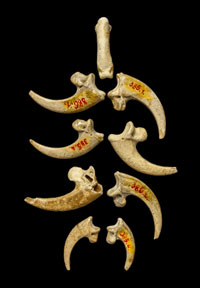
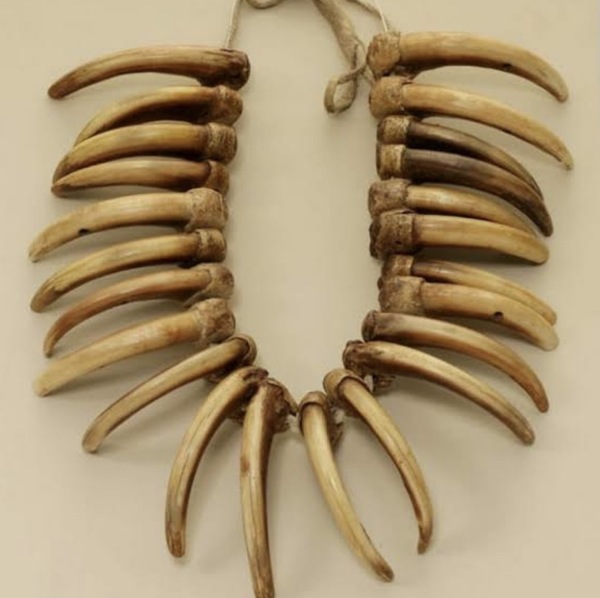
Talons of a white-bellied sea eagle from Krapina. Approximately 130,000 years ago.
Basins from the Blombos Cave
One of the earliest evidence of personal ornamentation is perforated seashells. Their natural shape, small size, and variety of hues made them a suitable material for crafting beads and pendants. Seashells were not merely collected; some were specifically pierced, worked, and strung onto threads. This allowed individual natural elements to be combined into a cohesive composition.
Perforated shells of Nassarius kraussianus and experimental reconstructions of their stringing methods. Blombos Cave, South Africa. Circa 75,000 years ago.
Archaeological excavations uncovered shells with holes and wear marks characteristic of prolonged wearing on a string. Researchers also found patterns in the placement of the holes and contact marks between individual elements. The distinctiveness of these ornaments lies in the repetition of identical natural forms. The rhythmic arrangement of the shells created visual order, transforming individual elements into a cohesive decorative whole.
Taffelite Basins
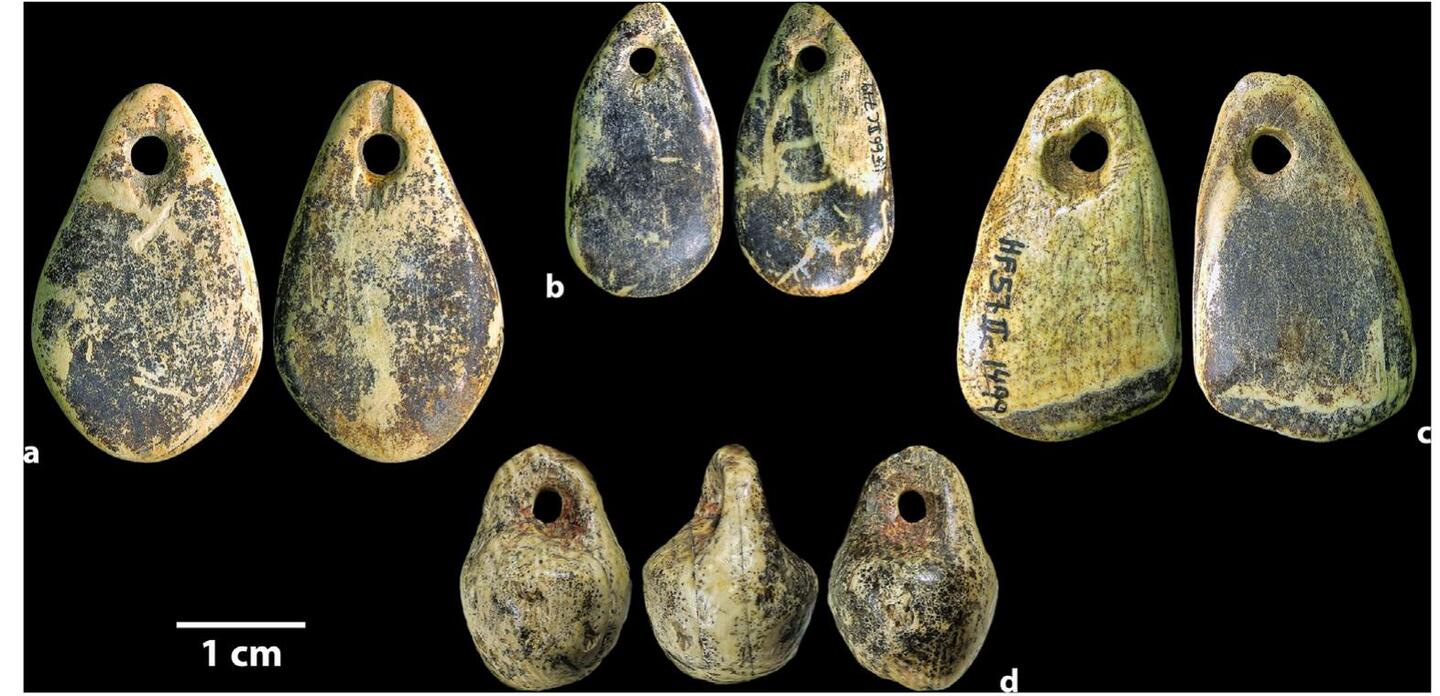
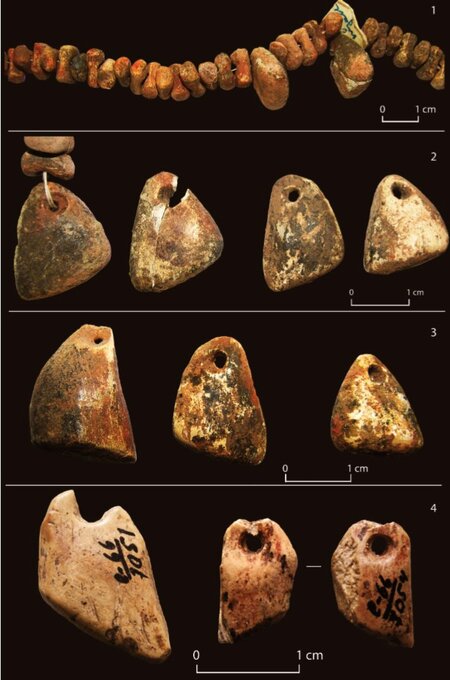
Perforated marine shells from Tafouralt. Morocco, approximately 82,000 years ago.
The shells were found a significant distance from their natural habitat. This suggests that humans transported natural materials between different areas. Holes in the shells indicate that they were intentionally prepared for use as ornaments. Aesthetically, these objects are interesting for their minimalist form. The natural oval shape of the shell is complemented by a small hole that serves not only a functional but also a compositional purpose.
Chapter 1.2 Materials and Their Artistic Potential
The material dictated the form of the adornment and how it could be worked. Ancient masters utilized what nature provided, gradually learning to alter the shape and surface of these objects. Materials included marine and freshwater shells, teeth, bone, mammoth ivory, horns, soft stones, minerals, and pigments. Each material possessed its own unique properties and history. Shells were distinguished by their variety of shapes and colors, bone and ivory allowed for the creation of complex three-dimensional forms, and stone offered a smooth, polished surface.
Animal bones and teeth
Animal bones and teeth occupied an important place among materials for jewelry making. Teeth were often used with virtually no change to their original form. The artisan could shape the base, drill a hole, and polish the surface. Consequently, the object’s natural expressiveness was preserved, but it became possible to fasten it to clothing or thread. The fangs of predators were particularly significant, as their elongated shape and pointed tips gave them a striking silhouette.
Pendants made from animal teeth and other personal ornaments from Paleolithic sites. Denisova Cave, Altai. Approximately 45,000 years ago.
Denisova Cave is of particular interest due to the diversity of personal adornment found there. Among the finds are pendants made from mammalian teeth, bone, ivory, and other materials. Holes drilled into the teeth allowed them to be strung onto cord or incorporated into more complex jewelry. The use of animal teeth demonstrates humanity’s fascination with expressive natural forms and the ability to transform materials of animal origin into elements of decorative composition.
Mammoth tusk as a material for artistic treatment
Mammoth tusk became one of the most significant materials of the Upper Paleolithic.
Its structure allowed for the creation of small beads, pendants, bracelets, and other personal adornments. Unlike shells or untreated teeth, the tusk offered greater possibilities for shaping.
The artisan could divide the raw material into blanks, give them specific proportions, drill holes, and carefully finish the surface.
The light coloring of the tusk emphasized the shape of the objects, while the natural texture lent the creations a characteristic appearance.
Variety of Ivory Bead Shapes
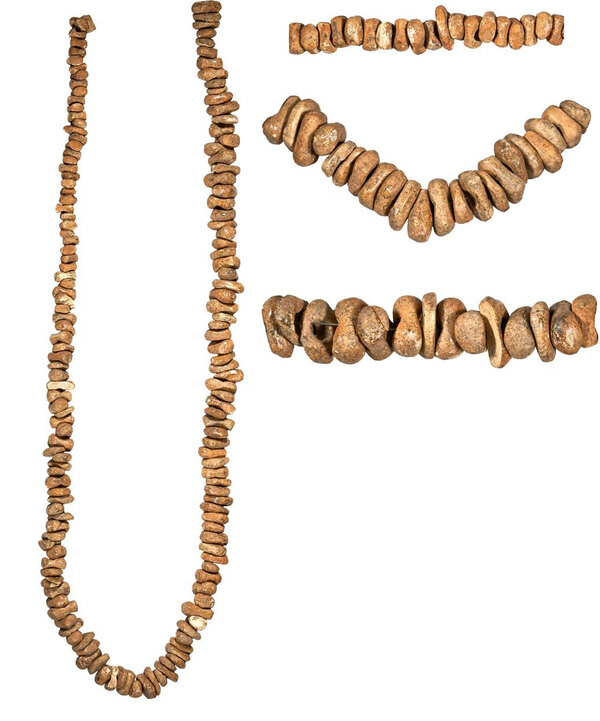
Beads and individual beads made from mammoth ivory. Sungir Upper Paleolithic site. Circa 34,000 years ago.
Beadwork crafted from ivory exhibited a variety of geometric forms. Elements included rounded, cylindrical, disc-shaped, and elongated pieces.
Variations in proportion allowed for the creation of compositions with a specific rhythm. Attaching beads of uniform size resulted in a regular sequence, while alternating large and small elements formed a more complex decorative structure.
Consequently, the jewelry ceased to be a random collection of elements; it became the result of a preliminary compositional decision.