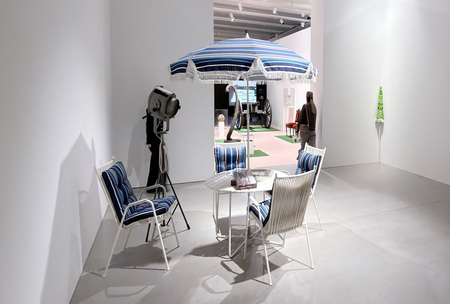
At the exhibition «Still Life. Portrait. Landscape. After Genre, ” Marcel Broodthaers’ installation „Decor. Conquest“ (1975) is presented in the „Still Life“ section, where objects are examined within the context of life’s transience, exchange, consumption, and power. However, Broodthaers' work raises a different question: who determines the meaning of objects—the artist or the one who decides how they are presented to the viewer?
At GES-2, this question becomes particularly relevant because the composition of the installation has been altered. In 1975, Broodthaers created the installation „Decor. Conquest“ for the Institute of Modern Art in London. Two rooms represented the 19th and 20th centuries. The first contained cannons, furniture, palm trees, and decorative objects, while the second featured automatic rifles, garden chairs, an umbrella, and an unfinished jigsaw puzzle depicting the Battle of Waterloo.
The artist himself designated the theme of the work as the relationship between war and comfort. By juxtaposing two eras, he demonstrated that well-being and violence coexist side-by-side and are often connected. Most of the items were borrowed or rented, and film props were also utilized. Broodthaers did not create the objects himself; rather, he brought together existing items, imbuing them with new meanings. Thanks to the lighting, artificial turf, and theatrical staging, the installation resembled a historical museum, a residential interior, and a film set simultaneously. Thus, the artist showed how much the perception of an object depends on where and how it is presented.
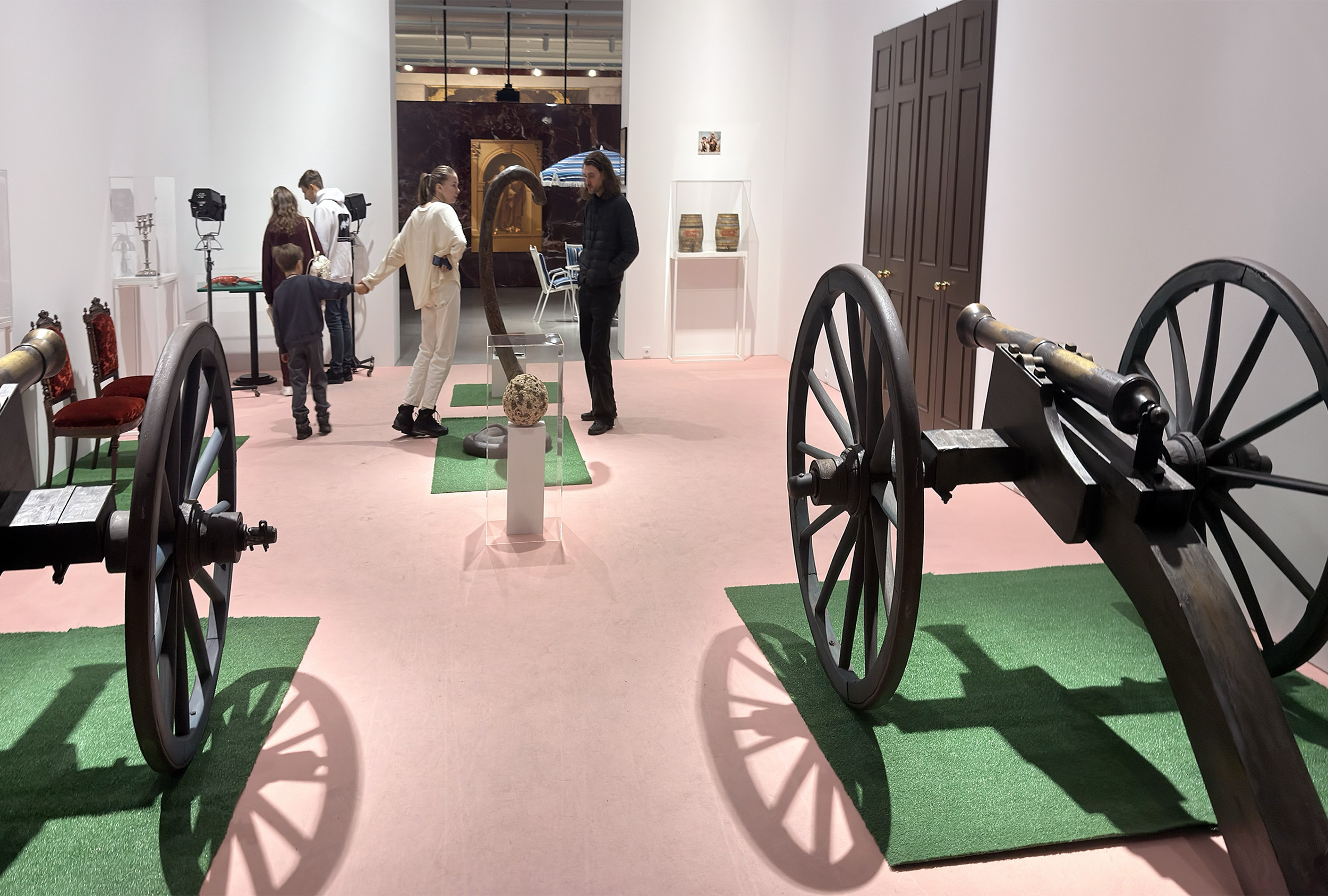
In GЭС-2, the viewer walks between two cannons mounted on green mats. Nearby are red chairs, an umbrella, a table, a still life composition featuring a crab and a lobster playing cards, and other objects. The pink floor and deliberately decorative arrangement lend the space a theatrical quality. However, this version lacks a crucial part of the original installation—the rows of 20th-century automatic rifles. Along with them, the direct juxtaposition of two historical eras disappears. The cannons are now perceived more as historical artifacts, part of the decorative composition. Modern weapons placed alongside garden chairs would create an entirely different impression: they would more pointedly evoke the real violence that exists beyond the museum.Including the work in the «Still Life» section encourages the viewer to look at it in a new light. Here, the relationships between objects—their connection to consumption, well-being, and power—take center stage. The cannons and the chairs become part of a single composition where military force neighbors comfort. This interpretation does not contradict Brotar’s intent, but it shifts the emphasis. The theme of war becomes less prominent, and the viewer’s attention shifts to the objects themselves and their juxtapositions.
In my view, the new version of the installation simultaneously reveals certain meanings within the work while diminishing others. The absence of rifles significantly alters the perception of the piece: what initially appeared as a collision between war and peaceful life is now more easily interpreted as a decorative composition. A paradox emerges: Brotars showed how a museum setting can change the meaning of objects, and now his own work becomes an example of that very shift. This is precisely what makes it so compelling in the context of the «GES-2» exhibition—it prompts us to consider not only the meaning of things but also how much that meaning depends on the decisions of those who exhibit them.