The history of 20th-century physics is a series of intellectual revolutions that fundamentally changed our understanding of nature. Discoveries, following one another, dismantled the neat yet limited worldview established by classical physics. This era began with the enigma of thermal radiation, the solution to which led to the birth of quantum theory; concurrently, research into the structure of the atom and the properties of light laid the foundations for a new physical worldview. Our timeline will guide you through the key milestones of this fascinating journey: from the first tentative hypotheses about the quantum to the creation of the Standard Model in particle physics.
December 14, 1900
Max Planck, Quantum Theory
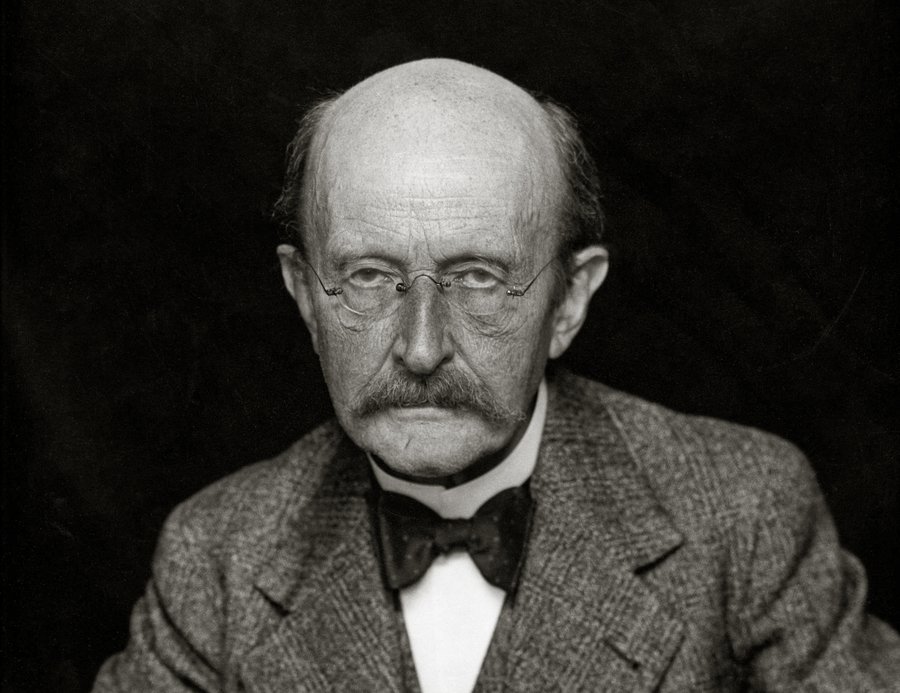
Hugo Erfurt. Max Planck. Photography. 1938
December 14, 1900 — the birthday of quantum physics. At a meeting of the Berlin Physical Society, Max Planck presented a formula describing the radiation spectrum of a black body. Classical laws of physics predicted the «ultraviolet catastrophe» for this case—infinite radiation energy at high frequencies. To derive a formula matching the experiment, Planck had to make a revolutionary assumption: energy is emitted and absorbed not continuously, but in discrete, indivisible packets—quanta. The magnitude of each quantum was defined by a new fundamental constant he introduced, later named Planck’s constant. The scientist himself did not immediately grasp the full significance of his discovery. His hypothesis was a forced mathematical technique, but it was this technique that gave rise to a new physics.
In the following years, Planck continued to develop thermodynamics and radiation theory, but the discovery of the quantum of action became his most significant contribution to science. Planck’s work demonstrated that classical physics was inadequate for describing the microscopic world, setting the task before scientists to build a new theory. However, his contemporaries did not immediately appreciate his ideas. Planck was deeply conservative and himself spent a long time trying to fit his discovery into the framework of classical physics, which he ultimately failed to do. Nevertheless, his formula, published on December 19, 1900, became the cornerstone upon which the edifice of quantum mechanics would be built. In 1919, for this discovery—"the development of physics thanks to the discovery of energy quanta"—Planck was awarded the Nobel Prize.
February 1905
The Quantum of Light. Albert Einstein
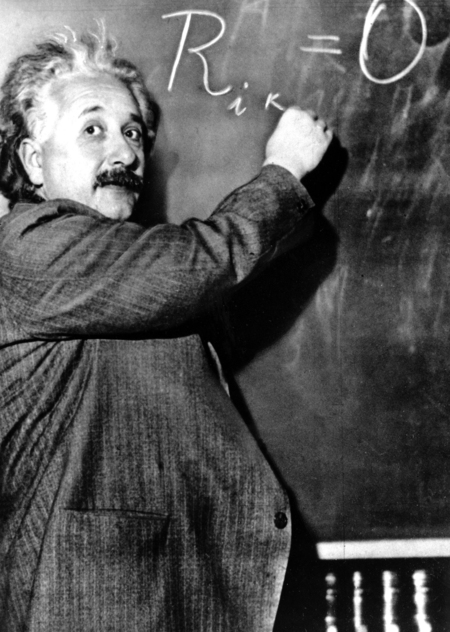
Albert Einstein in his office. University of Berlin. Photograph. 1920
The next pivotal step was taken by Albert Einstein in 1905. In his famous paper on the photoelectric effect, he developed Planck’s ideas and hypothesized that discreteness applied not only to processes of emission and absorption but to light itself. According to Einstein, light propagates in the form of discrete particles—quanta of the electromagnetic field, which were later named photons. This hypothesis brilliantly explained all known laws of the photoelectric effect: the independence from inertia, the dependence of the maximum energy of photoelectrons on the frequency of light rather than its intensity, and the existence of the «red cutoff.» Einstein’s equation for the photoelectric effect became a direct application of the law of conservation of energy to the elementary act of a photon interacting with an electron.
The theory of photons radically diverged from the wave theory of light, which explained phenomena like interference and diffraction. This established the foundations of wave-particle duality, which became one of the fundamental principles of quantum mechanics. Einstein’s hypothesis initially met with skepticism, even from Planck himself, but it was confirmed by Robert Millikan’s experiments. For his explanation of the photoelectric effect, Einstein received the Nobel Prize in Physics in 1921. His work not only completed the development of the quantum theory of light but also demonstrated that quantum laws are fundamental, not merely a convenient mathematical tool for describing equilibrium radiation.
March 7, 1911
The Atomic Nucleus. Ernest Rutherford
Sir Ernest Rutherford. Circa 1920s
Parallel to the development of quantum ideas, a revolution occurred in the understanding of atomic structure. In 1911, Ernest Rutherford, based on experiments conducted by his assistants Geiger and Marsden on the scattering of alpha particles off gold foil, proposed a new model of the atom. Thomson’s classical «plum pudding» model, which pictured the atom as a positively charged sphere with embedded electrons, could not account for the fact that some alpha particles were deflected by very large angles, even resulting in backscattering. Rutherford concluded that the positive charge and almost the entire mass of the atom were concentrated in a tiny nucleus, around which electrons orbit. Thus, the planetary model of the atom was born.
The discovery of the atomic nucleus became the foundation of nuclear physics. Rutherford’s model was elegant and intuitive, yet it contained a fatal contradiction with classical electrodynamics. According to Maxwell’s laws, an electron moving with acceleration in an orbit around the nucleus should continuously emit electromagnetic waves, lose energy, and, in an infinitesimally short time, spiral into the nucleus. Rutherford’s atom was fundamentally unstable, which contradicted the obvious fact of matter’s stability. It was up to his student—Niels Bohr—to resolve this contradiction, who took the next step two years later by supplementing the planetary model with quantum postulates.
July 1913
The Quantum Atom. Niels Bohr
Niels Bohr. Photograph. 1935
In 1913, the young Danish physicist Niels Bohr, while working in the Rutherford laboratory, made a breakthrough by unifying the nuclear model of the atom with the quantum hypothesis. To prevent the atom from the catastrophic collapse of the electron onto the nucleus, Bohr postulated the existence of stationary states. According to his first postulate, an electron can orbit along specific allowed paths without emitting energy. These orbits are characterized by discrete energy values. The second postulate states that light emission or absorption occurs only when the electron makes a quantum leap from one stationary orbit to another. The frequency of the emitted or absorbed quantum is determined by the energy difference between these states.
Bohr’s model successfully explained the line spectrum of the hydrogen atom. He managed to theoretically calculate the Rydberg constant, which had previously only been determined experimentally. The success of this theory was immense, and in 1922, Bohr received the Nobel Prize for his research on atomic structure and spectra. However, his theory was incomplete: it artificially merged classical concepts of orbits with quantum postulates without explaining their origin. Furthermore, the model failed when applied to atoms more complex than hydrogen. A fundamentally new theory was required—one that would be entirely quantum and consistent.
November 25, 1924
Matter Waves. Louis de Broglie
Prince Louis-Victor de Broglie. Nobel Prize in Physiology or Medicine. November 13, 1929
In 1924, a pivotal event occurred in the history of physics—one that is often cited as the starting point of wave mechanics. The French physicist Louis de Broglie, in his doctoral dissertation defended at the Sorbonne on November 25th, advanced a bold hypothesis: that the wave-particle duality, previously observed for light, is a universal property of matter. He proposed that any moving particle, such as an electron, possesses not only corpuscular properties (mass and momentum) but also wave-like characteristics. The wavelength of this «matter wave,» as he termed it, is inversely proportional to the particle’s momentum. This idea, initially perceived as absurd, was inspired by Einstein’s work on the quantum theory of light and de Broglie’s profound belief in the symmetry and harmony of nature.
De Broglie’s dissertation made a profound impression on Albert Einstein, who highly praised the work in his letters. It was Einstein who pointed out the significance of De Broglie’s ideas to Erwin Schrödinger, which subsequently led to the creation of wave mechanics. De Broglie’s hypothesis not only provided a physical basis for Bohr’s quantum rule of orbits in the atom but also predicted the possibility of observing electron diffraction, which was experimentally confirmed in 1927 by Davisson and Germer. De Broglie’s work became a bridge between the corpuscular and wave pictures of the microcosm, establishing the foundation for building a new, comprehensive theory.
6. 1925
The Architecture of Matter. Wolfgang Pauli
Wolfgang Pauli. 1953
In 1925, Wolfgang Pauli, one of the most brilliant theoretical physicists of his generation, made a discovery that describes all the matter around us. To explain the complex structure of atomic spectra and the order of electron shell filling in atoms, he formulated the Pauli exclusion principle—according to him, two electrons cannot exist in the same atom if they have the same four quantum numbers. In other words, each quantum state (a specific orbital with a defined spin) can be occupied by no more than one electron. This simple rule became the key to understanding the structure of Mendeleev’s periodic table of chemical elements.
The Pauli Exclusion Principle, which later became organically integrated into the formalism of quantum mechanics, has far-reaching implications. It explains why all electrons in an atom do not «collapse» into the lowest energy level, but instead fill shells, thus determining the chemical properties of elements. It underpins the stability of matter and accounts for why two atoms cannot penetrate each other. This exclusion principle applies not only to electrons but also to all particles with half-integer spin—fermions, which include protons and neutrons. Furthermore, it dictates the structure of atomic nuclei and even the evolution of stars by preventing their gravitational collapse. For this fundamental discovery, Pauli was awarded the Nobel Prize in Physics in 1945.
July 29, 1925
Quantum Mechanics. Werner Heisenberg
Portrait of Werner Heisenberg. 1927
A decisive step in developing a consistent quantum theory was taken in 1925. Werner Heisenberg, twenty-four years old and recovering from hay fever on the Helgoland island, developed the foundations of matrix mechanics—the first complete formulation of quantum mechanics. By abandoning attempts to describe electron motion via classical orbits, Heisenberg proposed building the theory using only observable quantities, such as frequencies and the intensities of spectral lines. He presented these quantities in the form of tables of numbers—matrices that did not adhere to conventional rules of multiplication. Soon, Max Born and Pascual Jordan joined his work, lending mathematical rigor to the matrix formalism.
Matrix mechanics, unlike the semi-classical model of Bohr, was internally consistent and allowed for the calculation of spectral line intensities—something the old theory could not achieve. However, its mathematical framework was extremely complex and not intuitive. Heisenberg’s work marked a definitive break from classical physics. The idea that an electron does not possess a definite trajectory, but rather its properties are described by abstract matrices, was revolutionary. For the creation of quantum mechanics, Heisenberg was awarded the Nobel Prize in 1932. In the same year, 1925, independent of Heisenberg, Erwin Schrödinger began developing an alternative approach that would soon lead to the creation of wave mechanics.
8. 1926
Wave Function. Erwin Schrödinger