Лабиринт
Визуальное исследование художественного мотива от античности до конца XIV века.
The labyrinth in art has not always been a puzzle. It has been depicted on coins, in manuscripts, mosaics, and cathedrals. In this study, I examine how its form, scale, and placement have evolved.
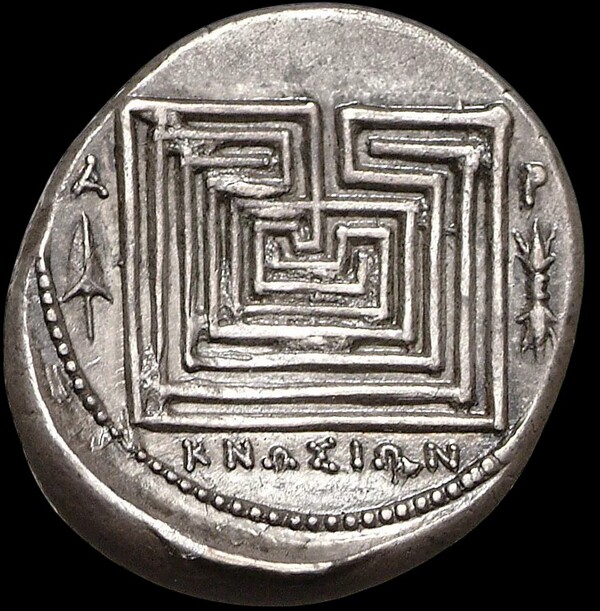
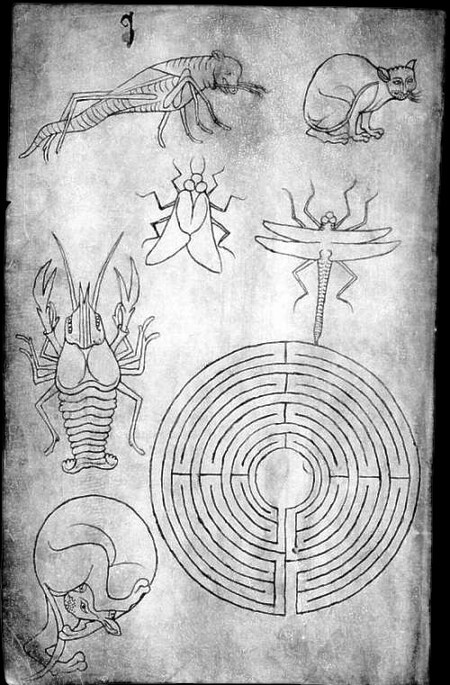
1. The Silver Starter of Knossos depicting a square labyrinth. Crete, circa 300–270 BCE. 2. Villard de Honnecourt. Labyrinths and animal sketches. Drawing album, sheet 7 of 8, circa 1230.
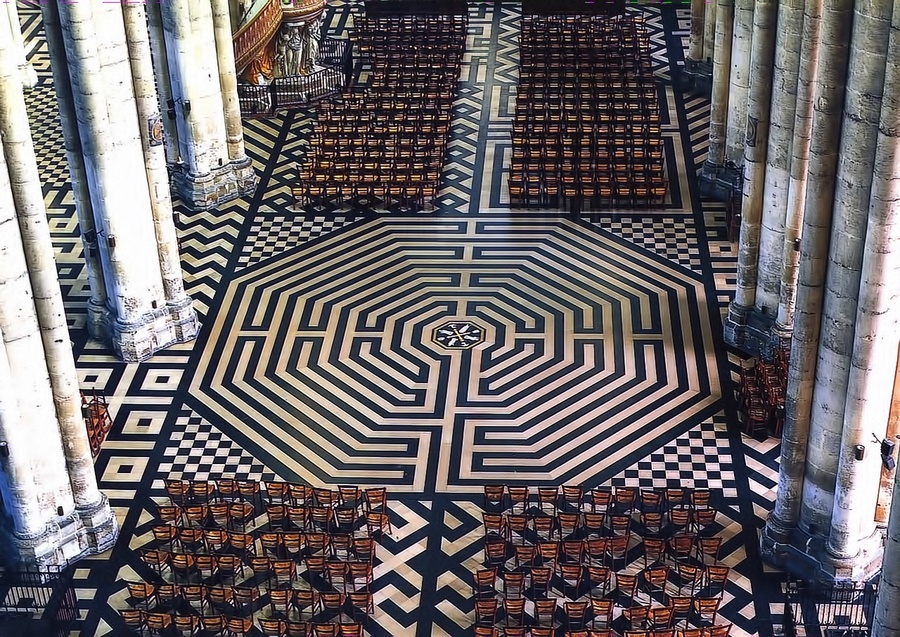
Amiens Cathedral Labyrinth. Created in 1288, restored in 1894. Amiens, France.
Navigation
- Introduction
- Ancient Origins of the Labyrinth
- From Antiquity to the Middle Ages
- Labyrinths in Manuscripts and Mosaics
- Labyrinths in Cathedral Architecture
- The Meaning and Perception of Space
- Conclusion
- Bibliography
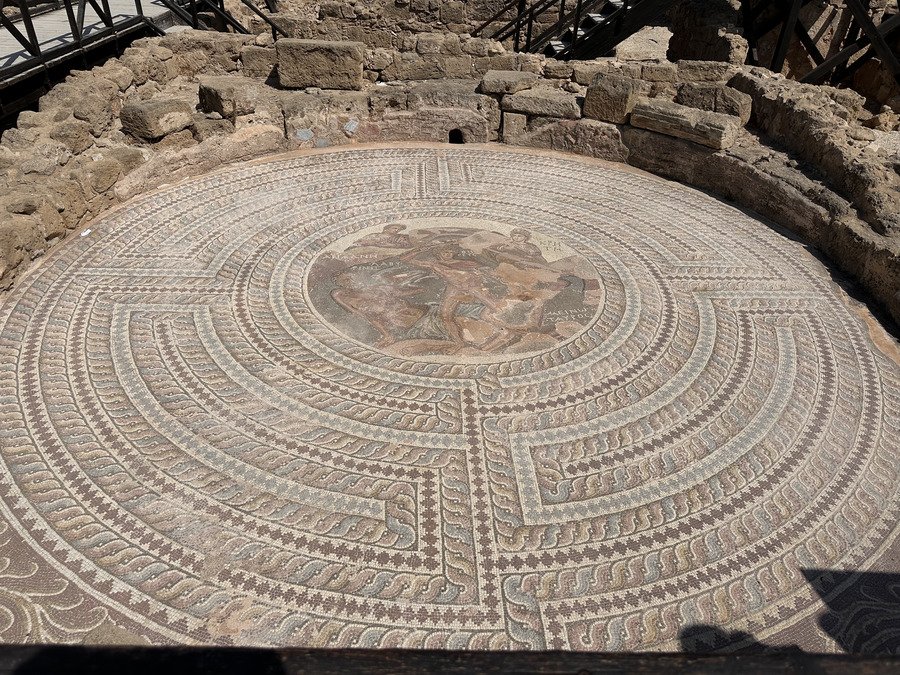
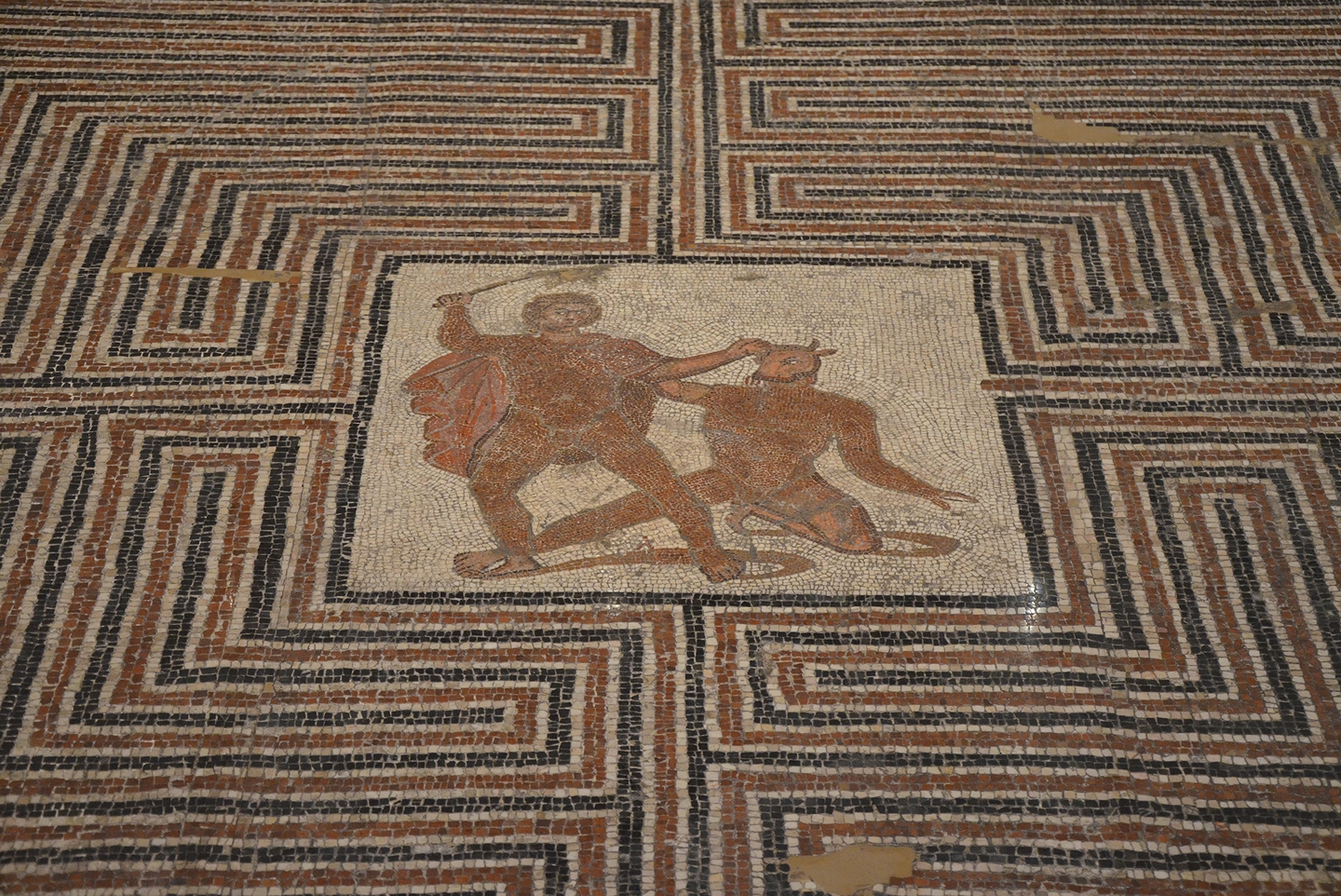
Theseus and the Minotaur. Floor Mosaic of the House of Theseus. Paphos, Cyprus, late 3rd — early 4th century CE.
Introduction
When I started searching for images of medieval labyrinths, I was surprised to find that most of them contained no dead ends. At first glance, the pattern appears intricate, yet there is only one path. One can walk for a long time through the turns, approaching the center and then moving away from it again, but there is no choice in direction.
What is particularly interesting is that such patterns appear on vastly different subjects. On ancient coins, the labyrinth fits within a circle just a few centimeters in diameter. In the Duomo di Lucca, it is carved into a stone pillar, and in Chartres, it occupies a large portion of the central nave floor. I wanted to understand why one motif endures across such differences in scale and material.
In ancient art, the labyrinth could be a standalone drawing or a part of the story of Theseus and the Minotaur. During the Middle Ages, both variations persisted, but other ways of depiction emerged as well. For example, labyrinths began to be placed on the floors of large cathedrals, where they were perceived quite differently than on a coin or a manuscript page.
The work focuses primarily on Western European monuments from the 12th–14th centuries. I compare their drawing style, material, layout, and preservation. Ancient examples are needed to compare medieval labyrinths with earlier depictions of this motif.
Edinburgh Vase Painter. Amphora depicting Theseus and the Minotaur. Attic, circa 500 BCE. Terracotta, black-figure technique.
The Ancient Origins of the Labyrinth
According to ancient Greek myth, King Minos commanded the craftsman Daedalus to build a labyrinth on Crete for the Minotaur—a monster with the head of a bull and the body of a man.The Athenian hero Theseus went there to slay the Minotaur. Ariadne helped him find the way out by giving him a ball of thread.This plot frequently appears in classical art. Some artists depicted the hero’s battle with the monster, while others showed the labyrinth itself.
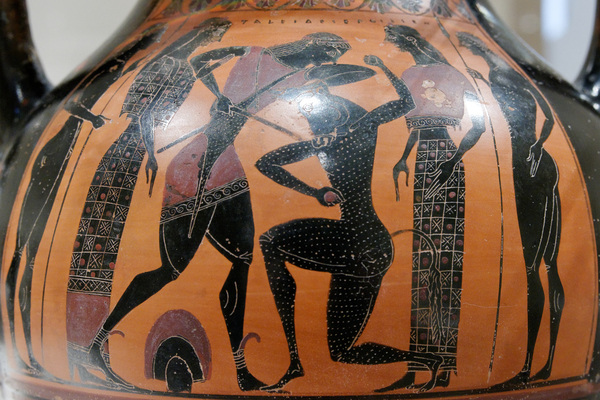
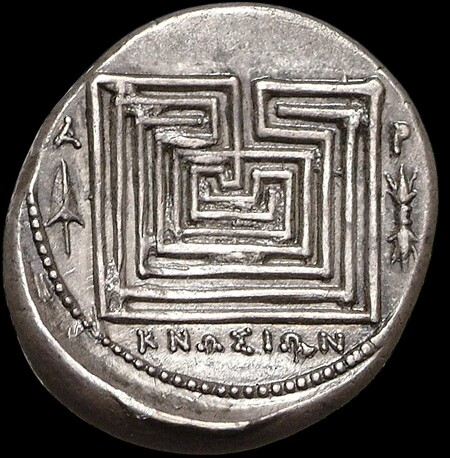
1. Attic amphora with Theseus and the Minotaur. Circa 540–530 BCE. 2. Knossos silver stater. Circa 300–270 BCE.
Theseus and the Minotaur at the center of the labyrinth. Floor mosaic from the Labyrinth House, Pompeii. Circa 70–60 BCE.
From Antiquity to the Middle Ages
The Greek amphora depicts Theseus’s fight with the Minotaur, but the labyrinth itself is absent from the composition. Conversely, the Knossos coin features the square labyrinth as its central motif. A Roman mosaic from Pompeii unites both motifs. At its center is a scene of Theseus and the Minotaur, surrounded by the geometric pattern of the labyrinth.
Theseus defeats the Minotaur. Floor mosaic from a Roman villa in Loigerfeld near Salzburg. 4th century CE.
During the Middle Ages, similar compositions continued to appear, and the labyrinth also began to be used separately from ancient narratives.
Labyrinth in Manuscript and Mosaic
In medieval manuscripts, the labyrinth can be found as a standalone geometric pattern. In the album of Villard de Honnecourt from the 13th century, it appears on the same page as sketches of animals and insects.Another example is the Hereford Mappa Mundi, created around 1300. On this map, the labyrinth is depicted on the island of Crete. It recalls an ancient myth while simultaneously becoming part of the medieval concept of the world.
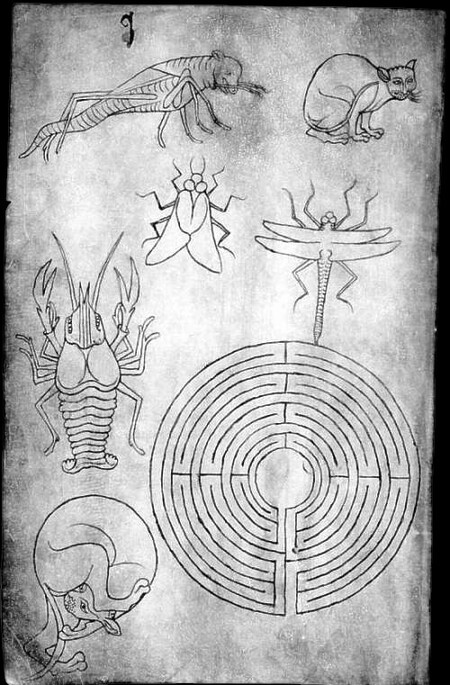
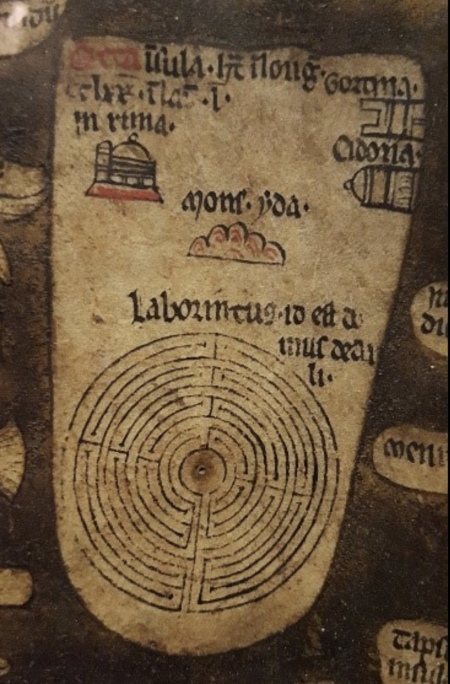
1. Villard de Honnecourt. Labyrinth. Fragment of a drawing album, circa 1230. 2. Labyrinth on the island of Crete. Fragment of the Hereford World Map, circa 1300.
During the Middle Ages, labyrinths appeared not only in books but also in church interiors. In the Basilica of San Michele Maggiore in Pavia, the labyrinth design was incorporated into a large mosaic image on the floor before the altar. Nearby were calendar figures and scenes from ancient myths.
Preserved section of floor mosaic featuring calendar figures and a labyrinth. Basilica of San Michele Maggiore, Pavia, 12th century.
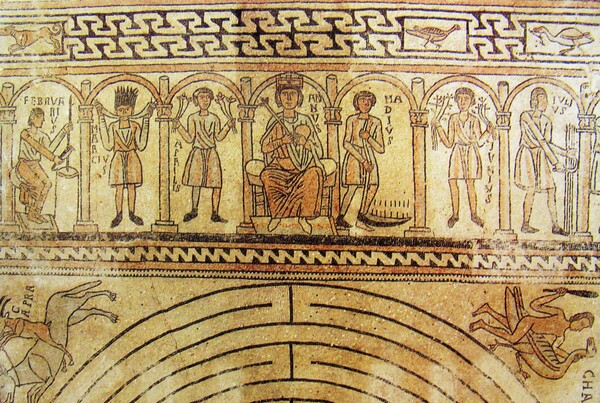
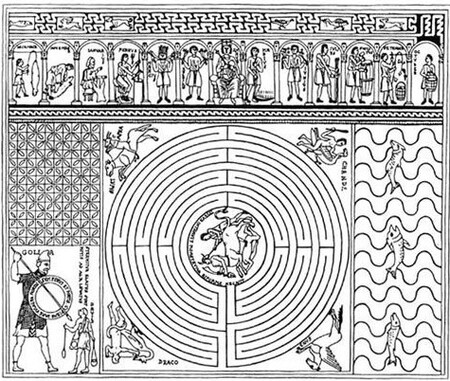
1. Calendar figures and the upper section of the labyrinth in St. Michael’s Basilica. An illustration of the original composition based on surviving fragments. Pavia, 12th century. 2. Graphic reconstruction of the lost composition.
At the center of the initial labyrinth was depicted Theseus defeating the Minotaur. Above this, an allegory of the year and the figures of the months, illustrated with seasonal activities, were placed. Thus, on one church floor, an ancient legend and a calendar cycle coexisted. The full view of the composition is known through old drawings.
Only a portion of the original composition remains from the Pavillon mosaic. The center of the labyrinth, featuring Theseus and the Minotaur, is lost. The surviving fragments allow for an examination of the floor’s material and drawing, while historical depictions and reconstructions help to visualize the missing sections.
Labyrinths in Cathedral Architecture