Мир, который мы не понимаем
почему средневековая европейская живопись выглядит так странно?
INDEX
1. Concept 2. Characteristics of Medieval European Artistic Language 2.1 Strange-Looking People 2.2 Bestiaries: Fantastic Animals 2.3 Marginalia: Life on the Margins 3. Conclusion 4. Sources
CONCEPT
Medieval depictions of people, animals, and fantastical creatures sometimes appear strange, comical, and slightly eerie. Unfamiliar faces, disproportionate bodies, and unexpected scenes can be found in illuminated manuscripts, bestiaries, and manuscript marginalia. These images formed the starting point for this research. I am interested in understanding why artists created such figures and what they signified to the people of their time.
The images served to convey the text’s content; however, the artists did not always aim to accurately replicate the appearance of people and objects. Often, conveying the meaning of the character or event was more important. Therefore, the size and features of characters could depend on the scene’s meaning rather than on real proportions. These illustrations did not suddenly appear in the 12th century. They continued a pre-existing tradition of manuscript illumination: in the 11th–12th centuries, monastic workshops in Europe were developing, where books were painstakingly created and decorated by hand.
However, the situation began to change gradually in the 12th–13th centuries. As cities and universities developed, the demand for books grew, leading city workshops to begin producing them, staffed by professional scribes. Manuscripts passed from one owner to another, ending up in libraries and private collections. It is precisely because of the preserved books, which are now held in European museum and library collections, that we can see what art looked like during that era.
The unusual depictions of people and animals found in the margins of medieval manuscripts were called marginalia. These pages featured rabbits with weapons, snails engaged in combat with knights, animals dressed in human attire, and creatures composed of parts from different bodies. These illustrations appeared alongside religious texts but were not always directly related to them. They could be amusing, surprising, or frightening—disrupting the familiar order of things and satirizing human behavior. However, the meaning of every single scene could not be precisely determined. Some images might have been the artist’s playful invention, while others served as allusions to known stories and contemporary beliefs.
In the 12th century, bestiaries—books about real and mythical animals—became widespread. They relied on earlier texts, merging descriptions of beasts with Christian teachings. Animals served as examples of virtuous or wicked actions, and their behavior explained religious ideas. Consequently, unicorns, dragons, and basilisks appeared alongside ordinary creatures. More important was conveying how these beings were described in books and legends, rather than their resemblance to actual animals.
The objective of this study is to understand why European images from 1100–1300 appear strange to a contemporary viewer and what conceptions of their time they reflect. Why did medieval artists depict the world in this specific manner? What did these peculiar drawings reveal about the people who created them and the people who were portrayed in them? The hypothesis posits that the unconventional nature of these works was not an error or a result of the medieval European artists' technical ineptitude. Instead, it was influenced by the demands of art, religious beliefs, narratives concerning animals and monsters, as well as an interest in humor and play. What seems absurd, comical, and slightly unsettling today may have held a coherent meaning for someone living in the Middle Ages.
CHARACTERISTICS OF MEDIEVAL ARTISTIC LANGUAGE
1. People Who Look Unusual
Medieval depictions of people can differ significantly from the portraits and illustrations we are used to. Figures often appear elongated, faces exhibit unusual features, and gestures can sometimes seem overly abrupt. Artists did not always aim to precisely replicate human appearance. For them, it was more important to convey the action, transmit the meaning of an event, and draw the viewer’s attention to the main character. Medieval faces, in particular, can seem unfamiliar. In some manuscripts, artists depicted people with large eyes, elongated noses, and slender features. Occasionally, a face is shown in profile, yet the eye is angled almost directly toward the viewer. These characteristics recur across different characters, becoming part of the overall artistic style.
«The Annunciation.» Psalter of St. Albans, circa 1130. Master Alexius.
Maria is depicted at the moment of the angel’s unexpected appearance. She breaks away from reading, turns her head, and raises an open palm. This gesture helps convey surprise. The artist communicates emotion not only through the face but also through the posture of the hands and body.
Artist unknown. Figures within an illuminated initial. Psalter of St. Albans, c. 1130.
Artist unknown. «The Lord’s Finding,» circa 1175.
Artist unknown. «The Monk Tastes Wine from a Barrel.» Late 13th century.
In the 13th century, European art began to show a growing interest in human movement and posture. Figures became more dynamic, clothing better conveyed the body’s form, and the interactions between characters appeared more natural. However, this did not signify a complete abandonment of previous conventions. Artists still utilized stylized backgrounds, symbolic colors, and unusual figure arrangements. Consequently, 13th-century art blended the drive toward greater naturalism with established medieval methods of world depiction.
«The Flagellation of Christ.» Psalter of St Albans, circa 1130. Master Alexis.
In this scene, movement is conveyed through the abrupt turns of the bodies and the positioning of the arms. Even the background supports the direction of the action. The artist deliberately emphasizes the moment of impact, causing the figures to appear tense and almost theatrical.
Artist unknown. «Clarice, Swinging on the Letter Q.» Psalter of Clarice, Augsburg, late 12th — early 13th century.
Artist unknown. «Jacob’s Struggle with the Angel.» Psalter, England, c. 1200–1220.
Artist unknown. «Two knights fight on foot, while their horses battle.» c. 1230
2. Bestiaries: Fictional Animals.
The unusual appearance of an animal did not always mean the artist was simply inventing its look. Often, they followed descriptions from earlier books, conveying the creature’s characteristics as described in the texts. Consequently, the same animal could appear in different manuscripts with similar features. Furthermore, the illustrations did not strive for precise naturalistic representation. What was more important to the artist was to show the animal’s essential characteristic, make it recognizable, and connect its appearance to the story. As a result, both real and fictional creatures could look equally convincing.
Artist unknown. «Hunt for a Bonnancone.» Circa 1300–1320.
The Bonnacone was described as a wild beast resembling a bull, but with unusually curved horns. Legend holds that it defended itself against pursuers by releasing a caustic substance from its body. In manuscripts, this creature was depicted as a very real animal, even though its properties were fantastical. This example illustrates how thoroughly medieval authors could describe creatures that did not exist.
Artist unknown. «Bonnacone.» Northumberland bestiary, England, c. 1250–1260.
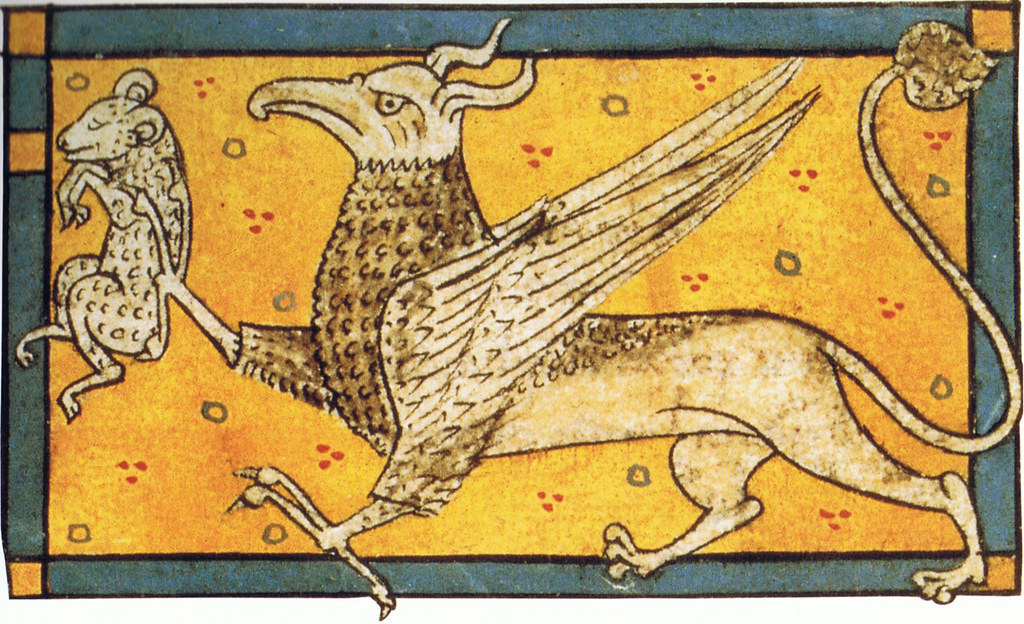
One method for creating fantastic creatures was combining traits from several different animals. This gave rise to beasts with the body of a lion and the head of an eagle, serpentine beings with multiple heads, and animals with unusual limbs. Such combinations were not merely decorative page elements. They served to illustrate that the creature differed from ordinary animals and possessed special properties. These imagery elements were part of the medieval conception of natural diversity. The world was considered to be filled not only with animals familiar to humans but also with beings from distant lands, legends, and religious texts.