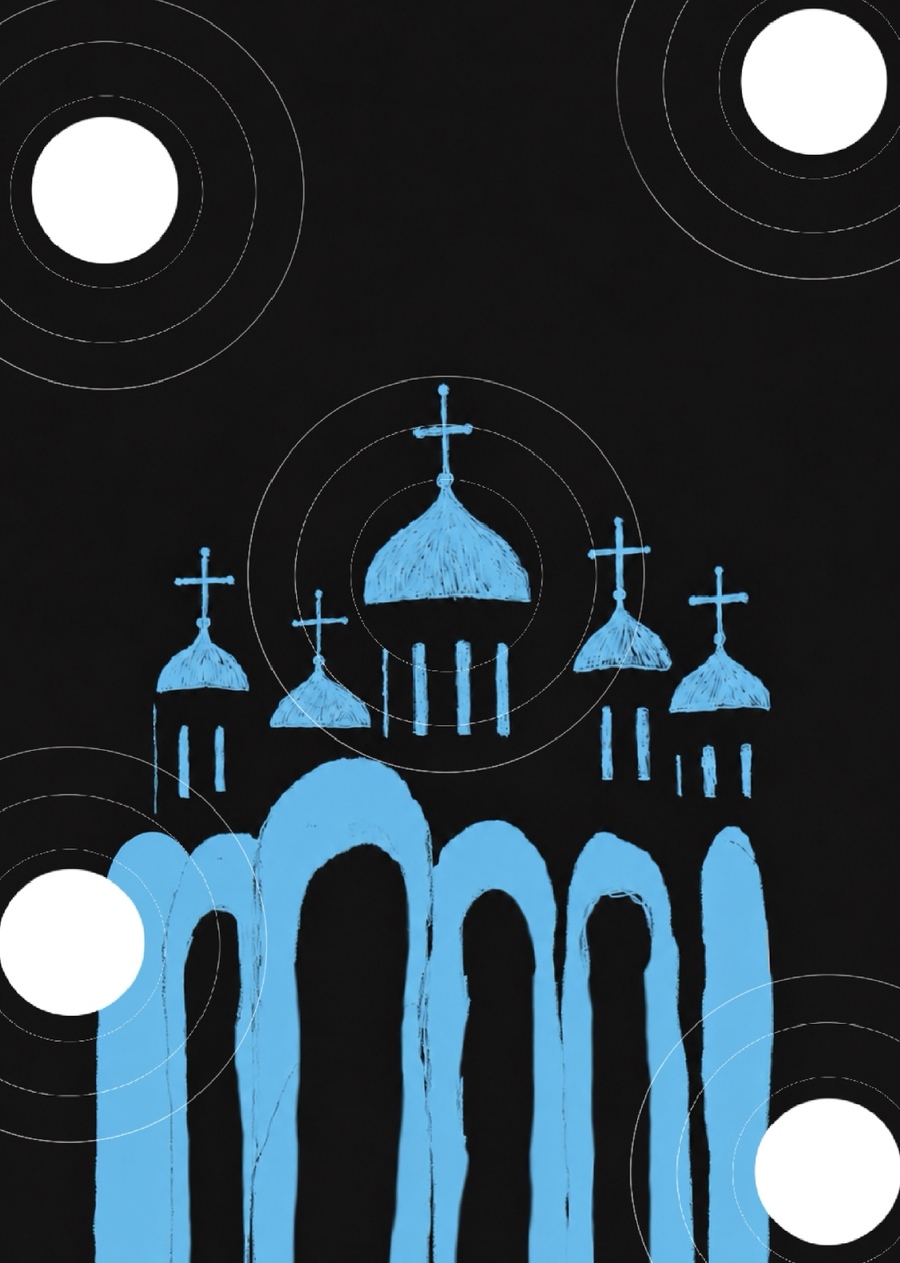
Concept
— St. Petersburg as a city of coexisting architectural languages of faith St. Petersburg began forming as an open city, one where people from different cultures, traditions, and faiths could coexist. As early as 1702, before the city was even established, Peter published a manifesto inviting foreigners to Russia. Seeking to attract military personnel, artisans, and merchants, he guaranteed them the right to maintain their faith and hold religious services. At that time, this held particular significance: for a person to root themselves in a new place, it is vital that there is space for their familiar way of life, memory, and spiritual grounding.

This is precisely why ecumenism has become one of the characteristic features of Petersburg. Historically, the city’s urban environment houses a coexistence of Orthodox, Catholic, Lutheran, Armenian, and other religious traditions. Their temples not only reflect the spiritual life of the city but also shape its unique sonic identity. Thus, Petersburg reveals itself as a space of dialogue and harmony. I wanted to translate this idea into musical form and attempt to merge the sounds of four religious traditions into a single piece.

For this project, I visited the cathedrals of St. Petersburg and collected my own audio material—field recordings. I recorded liturgical chanting, organ music, bell ringing, and the acoustic environment of the spaces. My primary sources included Orthodox cathedrals, the Catholic Basilica of St. Catherine, the Lutheran Petrikirche, and the Armenian Apostolic Church.
Sound Creation
The next phase involved working with sound material. I selected the most expressive fragments and assembled them into a unified musical structure using digital editing.
The diagram shows the peak envelopes of the oscillograms: the minimum and maximum sound amplitude for every 0.2 seconds. All traces are presented in a unified temporal and amplitude scale.
Performance Posters
The core principle of the composition was the gradual interaction of sounds. I wanted each tradition to remain recognizable yet not exist in isolation from the others. As a result, I prepared independent audio tracks of equal length, designed for simultaneous playback during the performance.
The performance transports the polyphony of St. Petersburg into the space of the studio. Four columns, positioned at the corners, reproduce recordings from Orthodox, Catholic, Lutheran, and Armenian Apostolic traditions. Listeners are situated among the sound sources: the voices sound independently, echoing and intertwining while maintaining their distinctiveness.During the performance, I control the sound of individual tracks—gently fading them in and out—and play instruments such as the bell, kalimba, ocean drum, and jingle stick. Moving the columns alters the sonic perspective, generating a sense of movement within the city. My actions, pauses, and the room’s acoustics each time reveal the idea of diverse voices coexisting within a shared space in a new way.
The live instruments create timbral call-and-response with recordings from four religious traditions. Their selection is based on my sonic associations rather than the instruments' association with liturgical practice. The bells represent the Orthodox tradition. Their chime recalls cathedral bells, translating the vast urban soundscape into a quiet sound close to the listener. The kalimba represents the Lutheran tradition. Individual, clear notes enter into a dialogue with the liturgical singing. Short melodic phrases and pauses support focused listening. The jingle stick represents the Catholic tradition. Its light metallic shimmer resonates with the overtones and reverberation of the organ within the church space. The oceanic drum represents the Armenian Apostolic tradition. The wash of sound is associated with the breath of sustained chant—its build-up, flow, and gradual fading.
Artistic Outcome
For me, the core idea of this work is that unity does not necessarily imply sameness. Sounds do not have to completely dissolve into one another; preserving their differences allows for the creation of a multi-layered musical space. This, to me, is the sonic image of St. Petersburg—a city where different voices maintain their individuality while existing within a unified space. In the future, this principle could be utilized for a sound installation or an audio walk through St. Petersburg, where architectural exploration occurs through its acoustic identity.