Concept
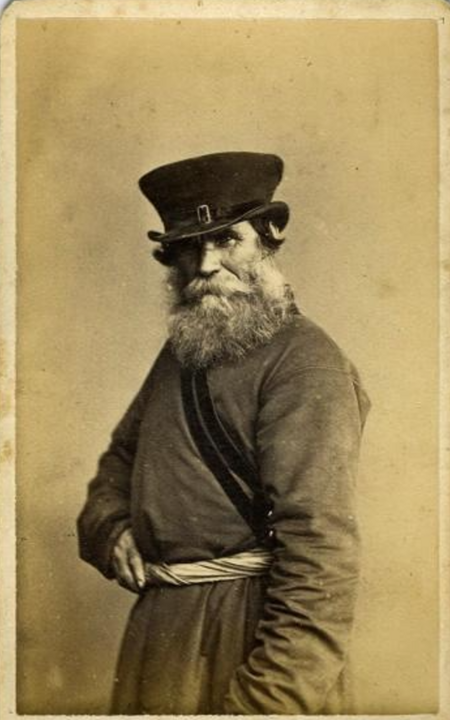
In 19th-century city portraits, a figure wearing a long kaftan, belt, and hat can remain recognizable even against a plain background. However, placing a photograph of a merchant in similar outerwear nearby raises the question: how much of that recognizability belongs to the costume itself? The choice of topic stems from the fact that the daily history of fashion can be traced through the clothing of people who worked outdoors. Hackney drivers and street vendors encountered unknown clients every day. Their appearance was shaped by movement and waiting—seated in a carriage, behind a stall, or carrying goods. These situations allow us to examine clothing simultaneously as a part of urban daily life and as a visible trace of labor.Research Subject — the depictions of hackney drivers and street vendors in Moscow and St. Petersburg during the 19th century. Focus — the silhouette, length, and volume of the garments, headwear, belts, aprons, sleeves, footwear, and how these elements change based on posture and tools of the trade. Goal — to determine what characteristics allow a viewer to guess a person’s occupation, and where reliable identification requires knowledge of the work tools, setting, or inscription. Street vending here refers to selling on the go and trading from an open point, including portable tables and trays.The timeframes are dictated by the artifacts themselves. St. Petersburg of the first half of the century is represented by the paintings of Shchedrovsky, which the Tretyakov Gallery dates to after 1839, and by lithographic sheets from an 1855 publication. St. Petersburg of the 1860s is represented by the photographs of William Carrick, while Moscow is represented by street photos from the 1880s and 1897–1899. Two portraits of Karl Bulla, cataloged between 1895 and 1905, serve as a separate comparison at the turn of the century. The difference in the makeup of the Moscow and St. Petersburg materials necessitates comparing the methods of representation. To conclude differences in the clothing of the inhabitants of the two cities, comparable series from the same period would be required.
The visual sequence is composed of attributed photographs, lithographs, and paintings. For analyzing form, figures whose clothing edges and body posture are discernible have been selected. For analyzing the profession within its urban environment, views of streets and squares have been utilized. The image is first examined as a whole, and then attention is directed to the silhouette, sleeve, waist, and visible part of the footwear. Object names are cross-referenced with catalogs, and descriptions from contemporaries and modern research help clarify vocabulary, hiring conditions, and forms of commerce. Studio posing, artistic composition, and urban photography are considered as different ways to present the same work.
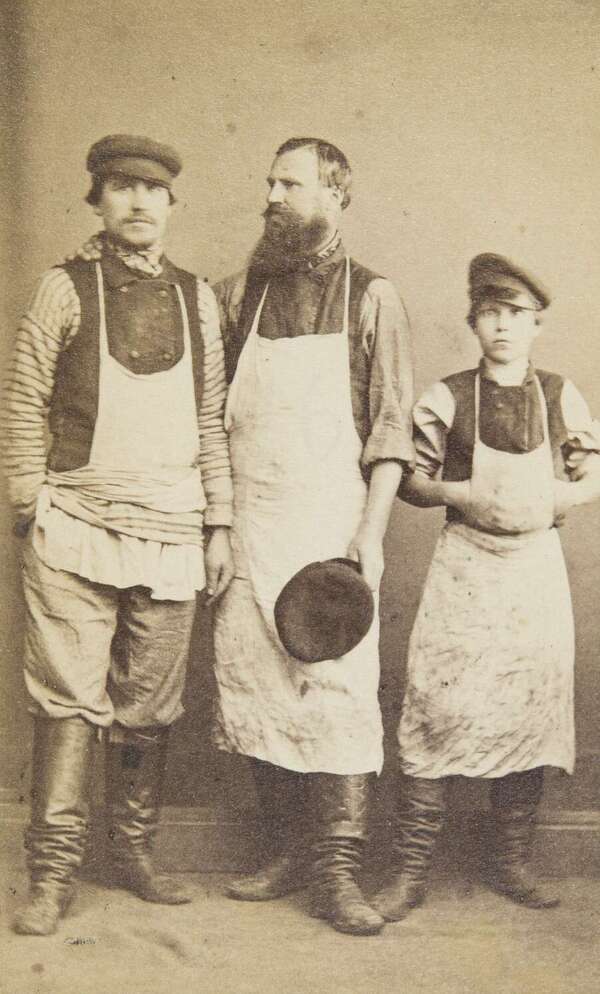
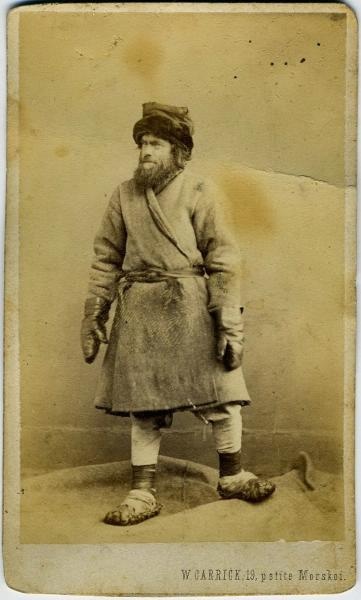
(Ill. 01. William Carrick, «Vanka the Cab Driver,» 1860s, St. Petersburg, MAMM / MDF.)
Navigation Menu
The Street as a Workplace. The staging area and crew hiring. Market square and mobile vendor point. On the Cabs. The cab driver’s attire. The caftan on the standing figure. Clothing on the seating bench. Gloves, cap, and boots. Cab drivers at the Moscow staging area. With a tray, with a basket, at the stall. The clothing of street vendors. The pastry seller’s table. Sleeve and container for vessels. Foldable table and woven sieves. Selling near the parapet and at the corner of the alley. What Reveals a Profession. Aprons worn by people of various trades. Photography and lithography. Headwear and equipment. Comparison at the turn of the century. Conclusion. What can be learned from the clothing and what the work scene clarifies.
Key Question
Is it possible to identify a coachman or a street vendor by their clothing if you remove the carriage, cart, or goods from the frame?
Hypothesis
The profession became recognizable through a combination of silhouette, clothing details, working posture, and tools of trade. The costume reveals how a person protected their body from cold or contamination and how they positioned their hands while working. To determine which of these traits are linked to a specific profession, one must compare them across individuals from different occupations. Long coats, aprons, or headwear might be noticeable, but the degree of professional specificity varies with each image.
The Street as a Workspace
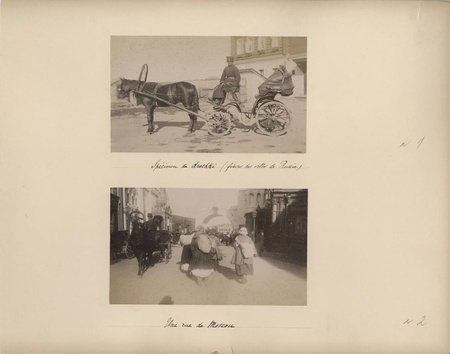
The carriage wheels almost disappear among the horses and people, but figures situated above the pedestrians are immediately noticeable. To spot the coachman, the gaze moves from the horse, along the harness line, to the seat. The upper part of the figure remains above the edge of the carriage. However, the legs and the lower part of the clothing are much harder to discern from this viewpoint. The elevation above the cobblestone helps identify a working person even when their face is too small for a portrait-like examination. The driver’s position in the carriage offers a more reliable clue here than the color of the clothing or the shape of the headwear.(Fig. 02. Unknown artist, «Hackney Carriages on a Moscow Street, ” 1880s, Moscow, MAMM / MDF.)
Ill. 02. Unknown artist, «Hackney Carriages on a Moscow Street, ” 1880s, Moscow, MAMM / MDF.
Nearby are people whose work involves the carriage drivers, and others whose path simply crosses by. The hackney driver needed to be visible to the person looking for a ride. In the essay «Hackney Drivers—The Mischievous and the Simple» by Ivan Kokorev, he describes Moscow’s «bourses”—the stopping points near squares and intersections where a carriage could be hired. The essay was published in 1849, and the photograph dates from the 1880s. The text explains how the stopping point operated in mid-19th-century Moscow, while the image shows the proximity of carriages and pedestrians in a later version of the city. It is difficult to determine the precise address and operating schedule of the location depicted in the photograph.
Trade Show Area and Mobile Point
Ill. 03. «Sherer, Nabholz and Co., ” „Trade on Red Square, ” 1886–1889, Moscow, MAMM / MDF.
In the photograph of Red Square, the focus shifts from individual figures to the way the open area of the city is occupied. Carts, horses, and people are visible, with the Kremlin buildings rising above them. The figures are small. While one can establish the people’s positions relative to the carts and trade areas, the edges of sleeves and fastenings are almost invisible. At this scale, the placement of goods and the movement of passersby convey more information about the labor than the portrait features of individual vendors.
Street vending might have begun where the vendor set out the goods and continued at another location. The portable table functions as a stall while on the ground. A box or basket allows the viewer to see the goods directly in the vendor’s hands. Victor Alekseev’s study on pre-revolutionary street food examines itinerant and stationary forms together. Kokorev illustrates this connection in «Small-Scale Industry in Moscow.» He describes how a family carries a samovar, water, coal, and dishware to a public gathering. In motion, people distribute the belongings among themselves, and at a fixed spot, they assemble a point of sale from these items. The essay mentions Sokolniki and Maryina Rosch. Although the trading shown in the picture of Red Square is from a much greater distance, the question of the relationship between portability and the establishment of a workspace remains the same.
On the Ass. Coachman’s Attire
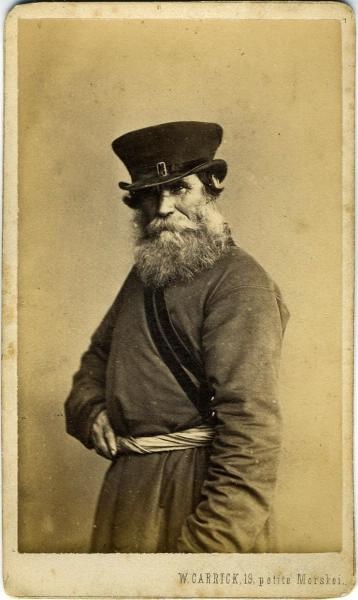
Caftan on a standing figure A belt on the caricature divides the caftan into two parts. Above the waist, the garment is gathered around the torso; below, it flows out into long panels. The hat continues the figure’s vertical line. When the coachman stands, the length of the garment can be correlated with the legs. The overall contour and the spot where the belt gathers the fabric are best discernible. The line of the front panel is noticeable, but the fastenings are difficult to distinguish. The belt is visible separately from the edge of the panel, so its placement can be described independently of how the caftan was fastened.(Fig. 04. William Caricature, «The Coachman, ” 1860s, St. Petersburg, MMAM / MDF.)
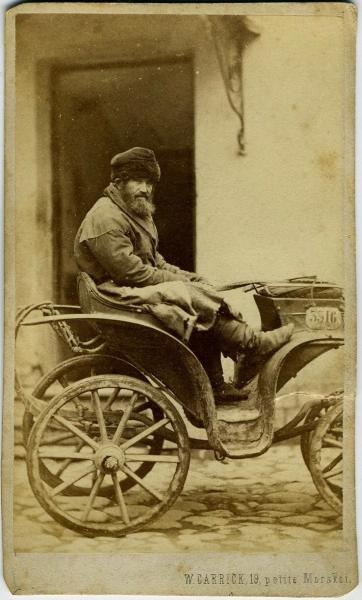
Clothing on a Seat in a Carriage In the carriage’s line, the clothing changes direction at bent elbows and knees. At the seat height, a long garment loses its straight vertical line. Part of its volume sinks into folds, and part is covered by the crew. The head and shoulders remain above the seat. The headwear in the illustration is designated as a fur cap. The belt fastening point and footwear are harder to discern than on a standing figure. However, the position of the sitter’s forearms can be seen in front of the torso.When working with reins, the elbow bends, and the forearm extends forward, with the hand resting in front of the torso. The image allows us to see how the sleeve gathers around the bent arm. A standing person covers their legs vertically with long hems. While seated, they can cover part of their legs in the front by draping the hems over their knees.(Fig. 05. William Carrick, «Coachman in a Carriage, ” 1860s, Saint Petersburg, MAMM / MDF.)
Paired with the previous portrait, there is a difference in what the viewer sees. The belt and hem on the standing figure provide information about the costume. The height of the torso above the seat and the position of the arms provide clues about the action. If we mentally hide the figure and leave the upper body, the bent elbows allow for various interpretations. In the full scene, the position of the arms relative to the back of the uniform helps read the same pose as a working posture.
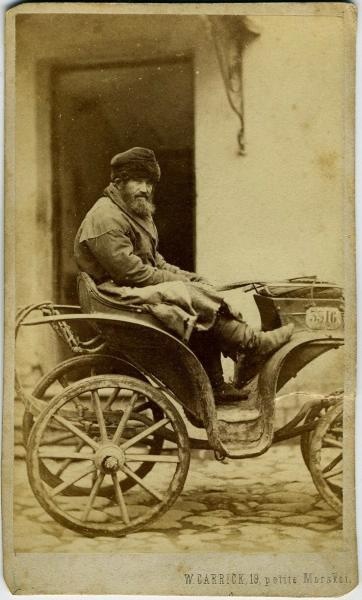
1860s, St. Petersburg, MAMM / MDF
Gloves, hat, and footwear
The cuff covers the hands, the hat creates a high volume around the head, and beneath the long armyak, wrapped shins and lapti are visible. A belt gathers the clothing in the midsection of the figure. The suit can be traced from here to the footwear. The cuffs completely change the appearance of the hand and allow us to visualize one of the difficulties of winter work: the hand must be protected from the cold while still allowing the ability to hold reins. It is difficult to determine the degree of finger freedom in the stationary hand. The names of the armyak, cuffs, and lapti are based on the MAMM / MDF card. History of Russia in PhotographsKokorev connects the nickname «Vanka» with a modest and accessible urban hackney carriage. Diana Loginova examines it within a broader hierarchy of the carriage trade and separately discusses the freight, or lomovoy, carriage. This gives historical context to the name of the Carrick photograph. The lapti and wrappings show the structure of the lower part of a specific person’s ensemble. To judge the position of the coachman in the trade, information about the экипаж (carriage), horse, orders, and trip costs is also necessary.
Rickshaws at the Moscow stand
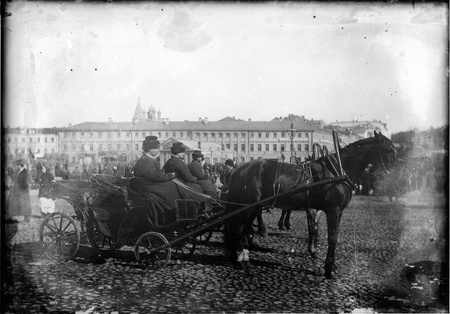
In Pavlov’s photograph, wheels, harness arcs, and raised seats are repeated. The distinction between the person in the carriage and the person by the wheel is revealed to the viewer. The seat hides the legs from sight while retaining the head and shoulders. The standing figure provides more verticality but might be positioned between carriages or behind the horse. The placement of the figures indicates where the cab driver should be looked for. It is much harder to determine from a lone figure in the distant background whether they are transporting passengers.(Illustration 06. Pyotr Pavlov, «Moscow Cabmen, ” 1897–1899, Moscow, MAMM / MDF)
Ill. 06. Pyotr Pavlov, «Moscow Hackers, ” 1897–1899, Moscow, MAMM / MDF
The image can be compared with Carrick’s span. In both cases, the person is connected to a seat and harness, and Pavlov has several such connections. If part of the figure is obscured, the subject helps identify the repetition of the entire scene. The Moscow standing scene of the late century shows what the profession looks like from a distance where the urban public encounters several carriages at once. The St. Petersburg portraits from the 1860s allow for a closer look at a single individual. The difference between the photographs includes the time, the shooting distance, and the composition. These variables limit conclusions about changes in tailoring.
With a tray, with a basket, at the stall. Street vendors' clothing
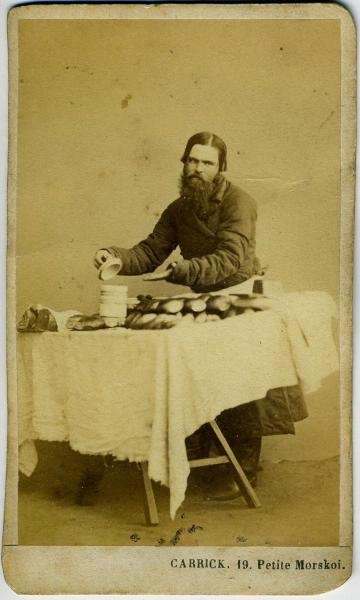
Pie Seller’s Counter The edge of the counter separates the open section of the body from the area occupied by the goods. A face, shoulders, and sleeves are visible above the tablecloth. The table holds pastries and pottery jars. In the card, the outerwear is called an «Armenian.» The mere presence of the «Armenian» connects the photograph to the portrait of «Vanka» on the cover. The difference becomes apparent in the body’s posture relative to the objects. The seller is shown at a level where a customer can view and select the merchandise. (Ill. 07. William Carrick, «Pie Seller, ” 1860s, Saint Petersburg, MAMM / MDF)
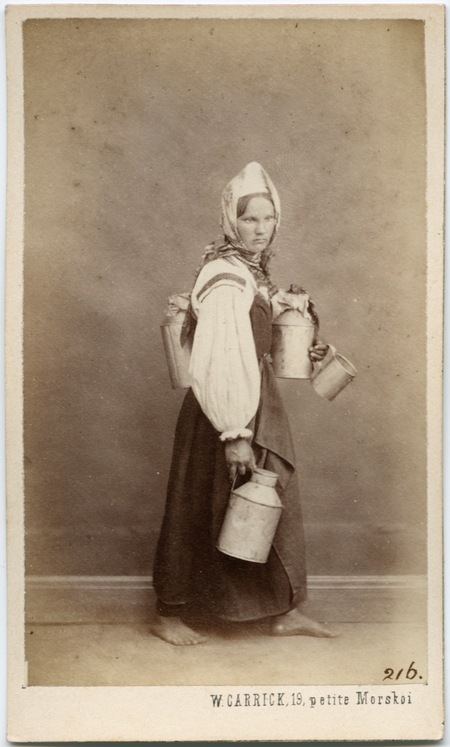
Sleeve and Vessel Carriage Hands are lowered to the handles, shoulders and forearms are open for examination, and the light-toned sleeves create volume over the arms. The kerchief rests against the head, leaving the face uncovered. Bare feet are visible beneath the long hem of the garment. The Pitt-Rivers Museum identifies the scene by another signed print with the same model and describes the photograph as a St. Petersburg studio portrait from the 1860s. The bare feet characterize this pose. The portrait does not indicate what kind of footwear the woman typically wore in the city. cabinet (Fig. 08. William Carrick’s Atelier, «Cream Seller, ” 1860s, Saint Petersburg, Pitt-Rivers Museum, University of Oxford.)