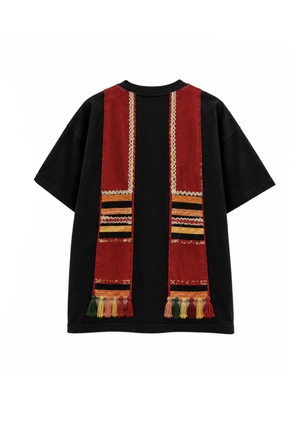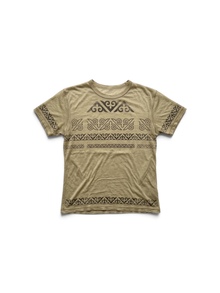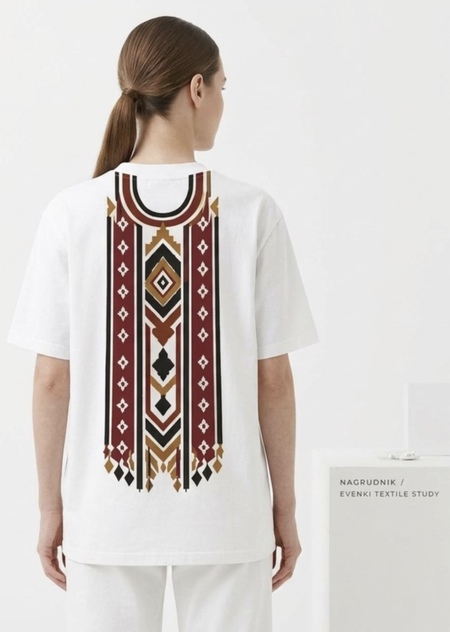
Reimagining the traditional Evenki apron cuirass through the lens of contemporary apparel design.
About the Project:
This project is dedicated to researching the possibilities of transferring the decorative language of the traditional Evenki apron-bodice into contemporary fashion design.
The starting object is a historical artifact that combines an elongated shape, geometric ornamentation, contrasting color lines, and fur trim. These characteristics are analyzed as the foundation for creating an independent graphic composition.
As a result of this research, a print is developed for a T-shirt that maintains a visual connection to the original object while acquiring a new form and function.
Concept and Relevance
Traditional costume is not just a method of garment organization; it is a unique system of forms, materials, decorative techniques, and visual solutions. When elements from a historical artifact are transferred to contemporary design, there is an opportunity to explore which qualities of the original maintain their expressive power despite changes in scale, material, and function. In this project, a cuirass serves as the starting point for creating modern graphics. Its decorative structure is translated onto a t-shirt—a piece of everyday apparel—allowing the visual language of traditional costume to find a new application. The project views cultural heritage not as an immutable image of the past, but as a source for meaningful design work.
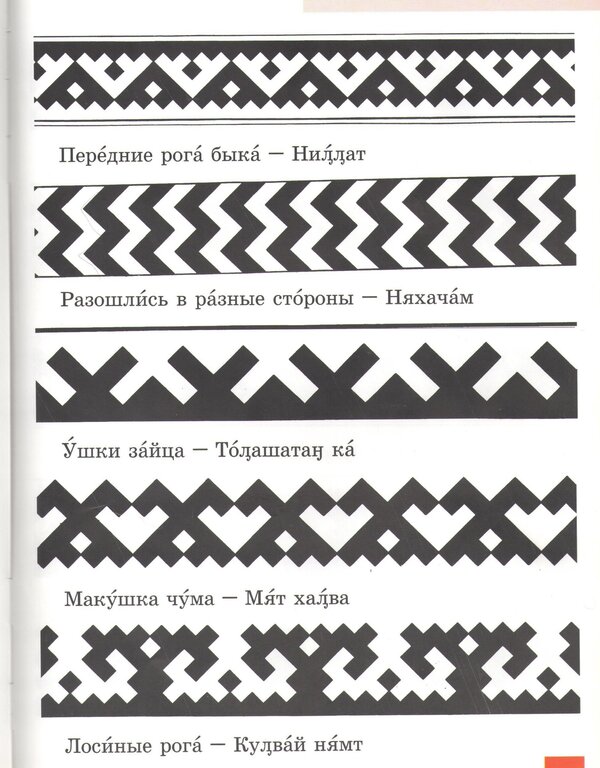
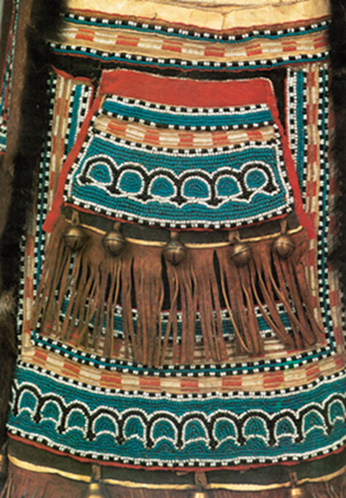
Source Object
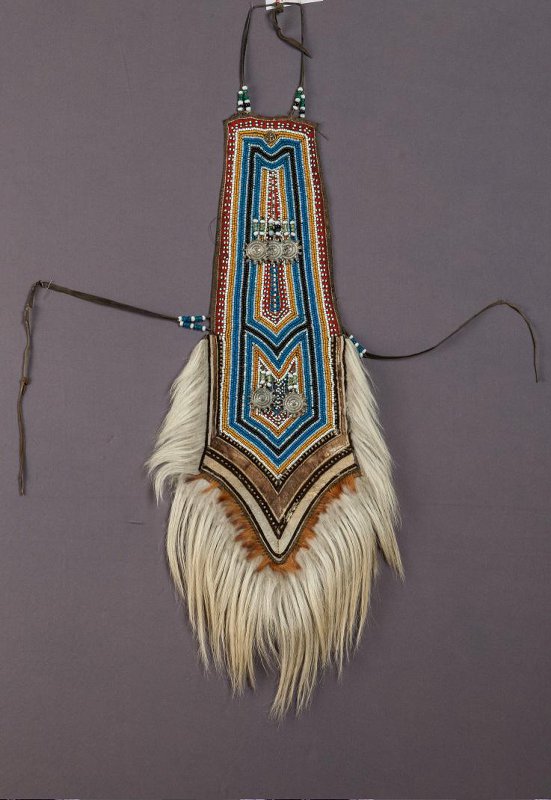
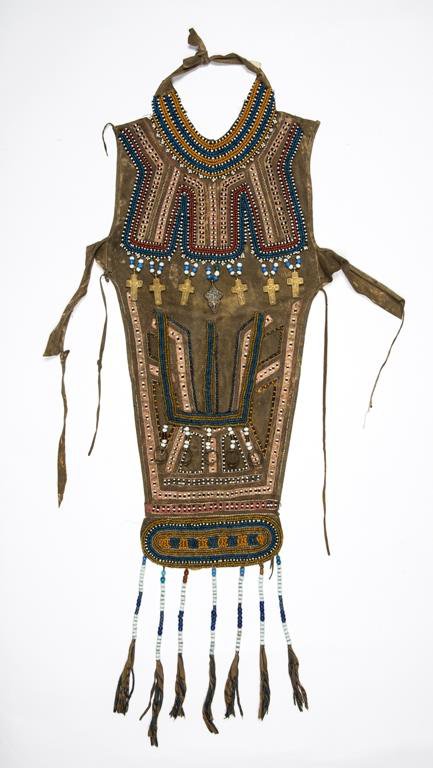
Russian Ethnographic Museum, late 19th — early 20th century.
As the foundation for the project, a museum example of a traditional Evenki apron-breastplate was selected. It is distinguished by its elongated vertical shape with a pointed lower finish, a complex multicolored ornamental composition, and a long, light fur trim.
The upper section of the piece is structured around a combination of a central geometric composition and several surrounding lines. The ornamentation is organized symmetrically, and the repeating decorative elements form a consistent rhythm.
The contrast between the strict geometry of the embroidered section and the free texture of the fur holds particular significance for further development. It is this juxtaposition that becomes one of the primary visual principles for the future print.
Form and Ornament Analysis
The museum piece selected as the foundation for this project is a traditional Evenki chest apron. It is characterized by its elongated vertical shape with a pointed bottom, a complex, polychromatic ornamental composition, and long, light fur trim.
The upper section of the piece is structured around a combination of a central geometric composition and several surrounding lines. The ornament is arranged symmetrically, and the repeating decorative elements form a sequential rhythm.
The contrast between the strict geometry of the embroidered portion and the free texture of the fur holds particular significance for further development. This combination becomes one of the main visual principles of the future print.
Graphics
The main objective of graphic design is not to reproduce a photograph of a fur coat on fabric, but to transform its visual structure into a standalone print. To achieve this, the original item is divided into several levels: the outer silhouette, the central ornament, color contours, dotted decor, and fur trim. These elements are then translated into graphic forms. The characteristic proportions, symmetry, sequence of contours, and the ratio of large to small details are maintained. Consequently, a graphic composition is created that references the original item but is not its photographic representation.
Color Palette
The print’s color palette is built upon a combination of dark and warm tones contrasted with bright lines.
— Navy blue forms expressive contours and strengthens the graphic structure.
— Red-brown supports the saturation of the central composition.
— Ochre creates warm accents and ties together individual elements.
— Brown helps define boundaries and distinct decorative areas.
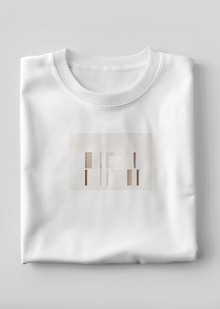
— Milk color is used for the t-shirt and can remain an unprinted section of the design.
Final Design
The final design is a t-shirt featuring an original print developed from research on a traditional Evenki chest apron.
The graphic composition integrates a streamlined silhouette, a symmetrical structure, geometric contours, repeating decorative elements, and a stylized interpretation of the fur trim.
Transferring the ornamental structure onto a contemporary garment allows for the preservation of a visual link to the original object while simultaneously altering its scale, function, and context of perception.
The t-shirt becomes an independent design piece, where the traditional object serves as the source for modern graphics.
Print Application Technology
For print production, the DTF technology is used—transferring an image from a print film onto fabric using a heat press.
This technology is suitable for graphic images with sharp boundaries, rich colors, and complex outlines. It allows for the reproduction of multi-color compositions and is ideal for producing single items.
To ensure the chosen design maintains the crispness of geometric elements and the readability of decorative details, it is essential to check the minimum thickness of individual elements, remove stray dots, and verify the absence of unwanted semi-transparent areas when preparing the production file.
Implementation Potential
The project can be realized as a single item or a small run. Thanks to the use of print technology, the print does not require reproducing complex hand embroidery, and its graphic form can be adapted for reuse on other garments. In the future, the project could form the basis of a collection of items unified by an exploration of traditional costume and its decorative systems. Each new piece must be based on a specific historical source and account for its specific form, ornamentation, and materials. At the current stage, the main outcome is the development of a T-shirt design and the preparation of the graphic solution for production.
Product Specification