Navigator
1. Concept
2. Introduction
3. Nature as a Reflection of the Cosmos
4. From Observation to Symbol
5. Bestiary — A Book of Symbols
6. Animals and Their Meanings
7. Beyond the Illuminated Miniature
8. The Artistic Language of the Bestiary
9. One Image — Multiple Meanings
10. Conclusion
11. Bibliography
12. Image Sources
Concept
Rationale for Topic Selection: The natural world held a significant place in the worldview of the medieval person. Animals were perceived not merely as part of their environment but also as images capable of conveying religious, moral, and philosophical ideas. Through observation of nature and its artistic representation, people sought to understand the structure of the world, the relationship between good and evil, and virtue and sin. Medieval bestiaries held a special place in this system—illustrated works that combined descriptions of animals with their allegorical and moral interpretations. In these texts, both real and fantastic creatures became unique symbols, concealing specific meanings beneath their exterior appearance. The depiction of an animal gained significance not only through its visual characteristics but also through the accompanying text and cultural context. The selection of the topic, «Nature as a System of Signs: The Symbolism of Animals in 13th-Century Medieval Art, ” stems from an interest in how natural imagery transformed into artistic symbols and how medieval cultural concepts were conveyed through them. This research allows for an examination of medieval art not just as a collection of cultural monuments, but as a distinct system of visual communication.
Chronological and geographical scope: The research primarily focuses on the 13th century and the art of Western Europe. This period was selected due to the active proliferation and development of illuminated bestiaries. Earlier antique and early Christian traditions are examined as historical prerequisites for the formation of medieval animal symbolism, but they do not constitute the core of the visual material.
Visual Material Selection Principle: Visual materials are selected based on the principles of historical accuracy, alignment with chronological frameworks, and the potential for substantive analysis of the works. The research centers on medieval illustrated manuscripts, particularly 13th-century bestiaries, as well as monuments of sculpture, architectural decoration, and ornamentation, which allow for tracing the use of animal imagery across various artistic contexts. Special attention is paid to depictions of animals that hold a prominent place in medieval symbolic tradition: the lion, the unicorn, the pelican, the dragon, and other creatures. When selecting these, the possibility of correlating the artistic representation of the image with its written interpretations is considered. Furthermore, the study does not assume that each animal corresponded to only one immutable meaning—interpretation is examined in light of the specific work, text, and historical environment. Images from museum and library digital collections are used for analysis, allowing for the determination of the provenance, dating, and storage location of the monuments. Preference is given to materials with accessible information regarding the original works and sufficient image quality for detailed study.
Research Structuring Principle: The study is built upon a historical-thematic principle. This structure allows for a logical progression from a general understanding of the medieval perception of nature to an analysis of specific symbolic images and the characteristics of their artistic embodiment. The beginning examines conceptions of nature as part of the religious worldview and the historical origins of the symbolic interpretation of animals. Next, the emergence and development of bestiaries, their structure, and the interaction between the written text and the image are explored. The central part is dedicated to analyzing individual animals and their meanings in medieval culture. Then, the images of animals outside of the book miniature—in sculpture, architectural decor, and ornament—are examined. The concluding sections focus on the peculiarities of the artistic language of bestiaries and comparing various depictions of the same animal. This sequence enables us to move beyond merely listing symbolic meanings to demonstrating the relationship between the historical context, the content of the work, and its visual form.
Principles for Selecting and Analyzing Textual Sources: The textual foundation of this research consists of scholarly publications on medieval art history, studies of illuminated bestiaries, academic editions of historical texts, museum catalogs, and materials from digital library collections. Particular importance is given to the early Christian text, The Physiologus, which influenced the formation of the tradition of symbolic interpretation of animals. It is examined as a historical source necessary for understanding the origins and subsequent development of medieval bestiaries. When selecting textual sources, we consider scholarly reliability, authorship, relevance to the period under study, and the presence of supporting evidence for the information provided. Preference is given to academic research and publications from specialized museums, libraries, and scientific institutions. The analysis of written materials is conducted in comparison with visual sources. Special attention is paid to how the descriptions of animals relate to their depictions, what meanings are associated with specific images, and how these meanings are conveyed through the means of medieval art. The historical context of the works' creation is taken into account during interpretation to avoid projecting modern conceptions onto medieval monuments.
Key Research Question: How did medieval art transform images of real and fantastic animals into a system of visual symbols through which religious, moral, and worldviews were conveyed?
Research Hypothesis: In medieval art, the depiction of animals served not only as a way to represent natural or fantastical beings but also as a means of conveying complex cultural, religious, and moral meanings. The significance of these images was shaped through the interaction of artistic representation, written description, and historical context. Because of this, animals became part of a special visual language through which the medieval person interpreted the surrounding world and its spiritual order. The research aims to test this hypothesis by analyzing specific 13th-century works, comparing animal depictions with historical texts, and identifying the characteristics of their artistic embodiment. Therefore, this study is directed toward uncovering the relationship between nature, symbolic thought, and the artistic language of the Middle Ages, as well as identifying the role of animal imagery in shaping the visual culture of that era.
Introduction
Medieval art portrayed nature not merely as the world surrounding humans, but as a space imbued with symbolic meaning. Animals—both real and fantastical—became crucial motifs through which religious doctrines, moral precepts, and worldviews were communicated. This tradition was particularly vivid in illuminated bestiaries—manuscripts that combined animal descriptions, illustrations, and their symbolic interpretations. This study focuses primarily on works from 13th-century Western Europe, allowing us to trace how the depiction of an animal transformed into a sign and how its meaning unfolded through artistic form, written text, and cultural context.
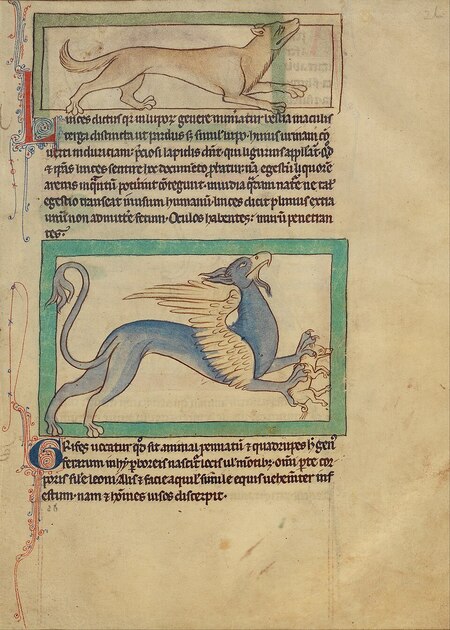
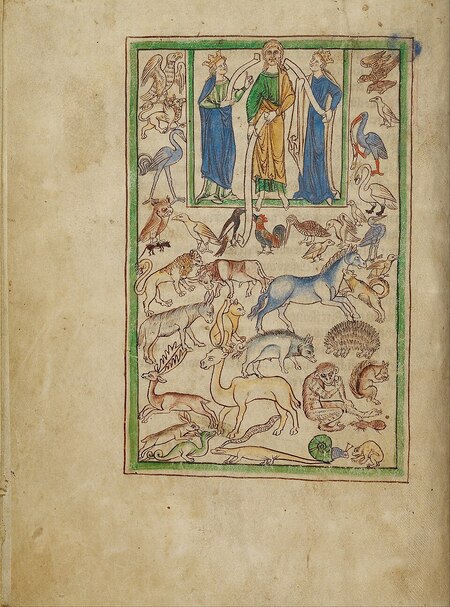
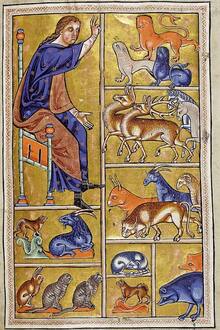
1. Unknown English artist. «Adam names the animals.» Northumberland Bestiary, circa 1250–1260, leaf 5v. 2. Unknown English artist. «A Lynx; A Griffin.» Northumberland Bestiary, circa 1250–1260, leaf 26. England. Parchment, ink and pen drawing with colored toning.
Nature as a Reflection of the Cosmos
In the medieval worldview, nature was perceived as an integral part of divine design. According to the biblical narrative, the creation of the world occurred sequentially: God created light, celestial bodies, plants, aquatic and terrestrial animals, and finally, humankind. All elements of creation occupied a specific place within the order established by God.
This idea was reflected in medieval art. In illuminated manuscripts, scenes of creation depicted animals not in isolation, but as part of a single, structured space interconnected with the heavens, earth, water, and humanity.
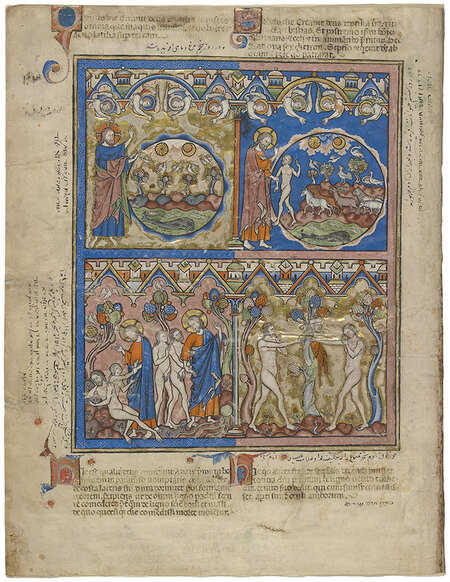
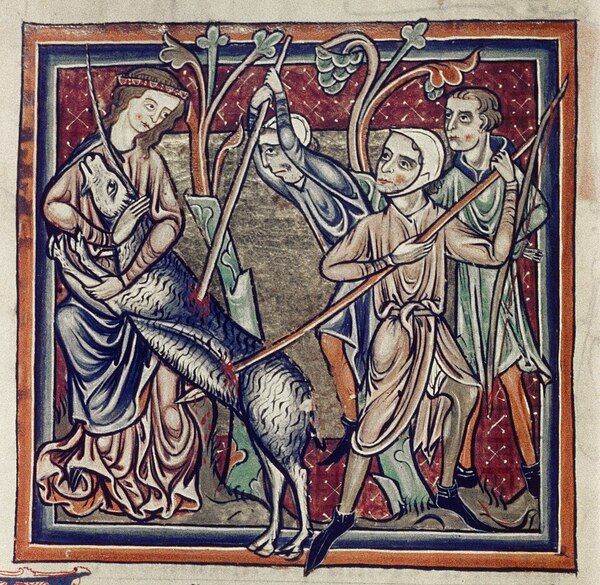
1. Morgan Bible Unknown French artist. «The Fifth and Sixth Days of Creation; The Creation of Eve; The Fall of Man.» Morgan Picture Bible, c. 1244–1254, folio 1v. Paris, France. 2. Bodley Bestiary 764 Unknown English artist. «The Killing of the Unicorn.» Bodley Bestiary 764, 1230s, folio 10v. England.
Two miniatures illustrate different ways of conceptualizing the animal kingdom in medieval culture. In Morgan’s Bible, animals are incorporated into the creation narrative: they are presented as part of a divine order, where each creature occupies its designated place. In the Bodley Bestiaries, image 764 of the unicorn acquires not only fantastic but also religious significance. The scene of its capture was linked to the Christian allegory of Christ’s incarnation. Thus, nature and the world of fantastic creatures were perceived as a space through which conceptions of divine purpose were revealed.
From Observation to Symbol
In medieval culture, the characteristics of animals became the basis for their symbolic interpretation. In bestiaries, descriptions of creatures' appearance, habits, and unusual properties were combined with religious beliefs and moral teachings. Furthermore, information about animals was often borrowed from earlier writings and legends rather than based on direct observation. Thus, a natural attribute was transformed into an image capable of conveying a specific idea. The animal kingdom was perceived as a unique book, where a spiritual meaning lay hidden behind visible phenomena.
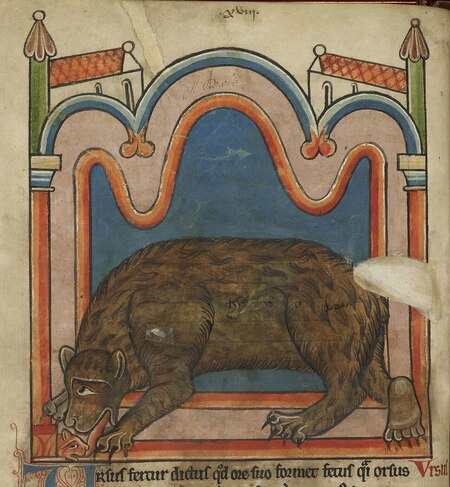
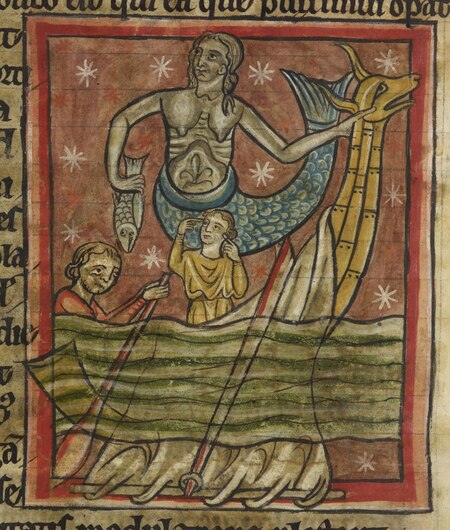
1. Mother Bear and Cub Unknown English artist. «The mother bear shapes the cub.» Harley Bestiary MS 4751, circa 1230–1240, folio 15v. England. 2. Siren and Sailors Unknown English artist. «The siren enchants the sailors.» Harley Bestiary MS 4751, circa 1230–1240, folio 47v. England.
In medieval bestiaries, the bear was attributed a peculiar characteristic: it was believed that bear cubs were born shapeless, and the mother would give them form by licking them with her tongue. This narrative traces back to earlier written perceptions of animal nature. The miniature illustrates how such a belief became integrated into the visual storytelling of the animal world. Here, the focus is not on the actual behavior of bears, but on how medieval culture perceived and depicted nature. The image of the siren is based on the concept of a creature capable of luring sailors with its song. In medieval tradition, this motif received a moral interpretation: the siren became an archetype of temptation that humanity must resist. The composition unites the fantastical creature with human figures, transforming a tale of maritime peril into a warning about human spiritual vulnerability.
The miniatures under consideration reveal that the medieval depiction of animals was shaped not only by notions of their appearance and behavior. Written lore, fantastic narratives, and moral interpretations played a crucial role. Consequently, the bestiary evolved beyond a mere compilation of animal facts; it became a means of explaining the world through the imagery of living creatures. It was precisely the interplay of text, image, and symbolic meaning that transformed the animal world into a distinct system of signs.
Bestiary — A Book of Symbols
The origins of medieval bestiaries are linked to ancient and early Christian traditions of describing animals. The Greek text «Physiologus,» which presumably arose in the 2nd–4th centuries, held particular importance. Its author is unknown. In the work, accounts of animals were accompanied by Christian interpretations: the characteristics of the creatures served as examples illustrating religious truths and moral concepts. Over subsequent centuries, the text was translated into other languages and supplemented with new narratives. From this foundation, the tradition of medieval bestiaries developed.
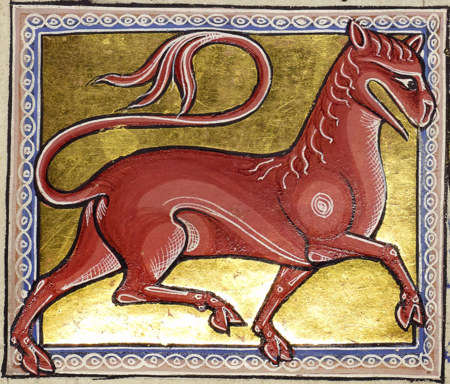
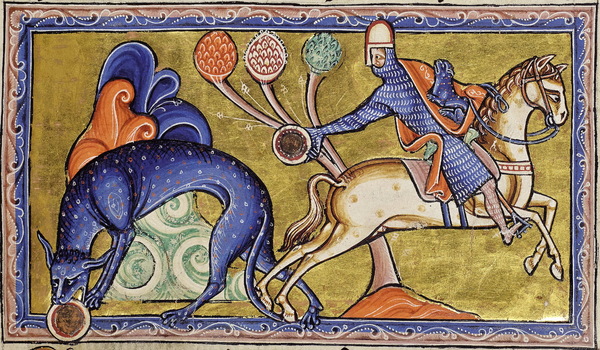
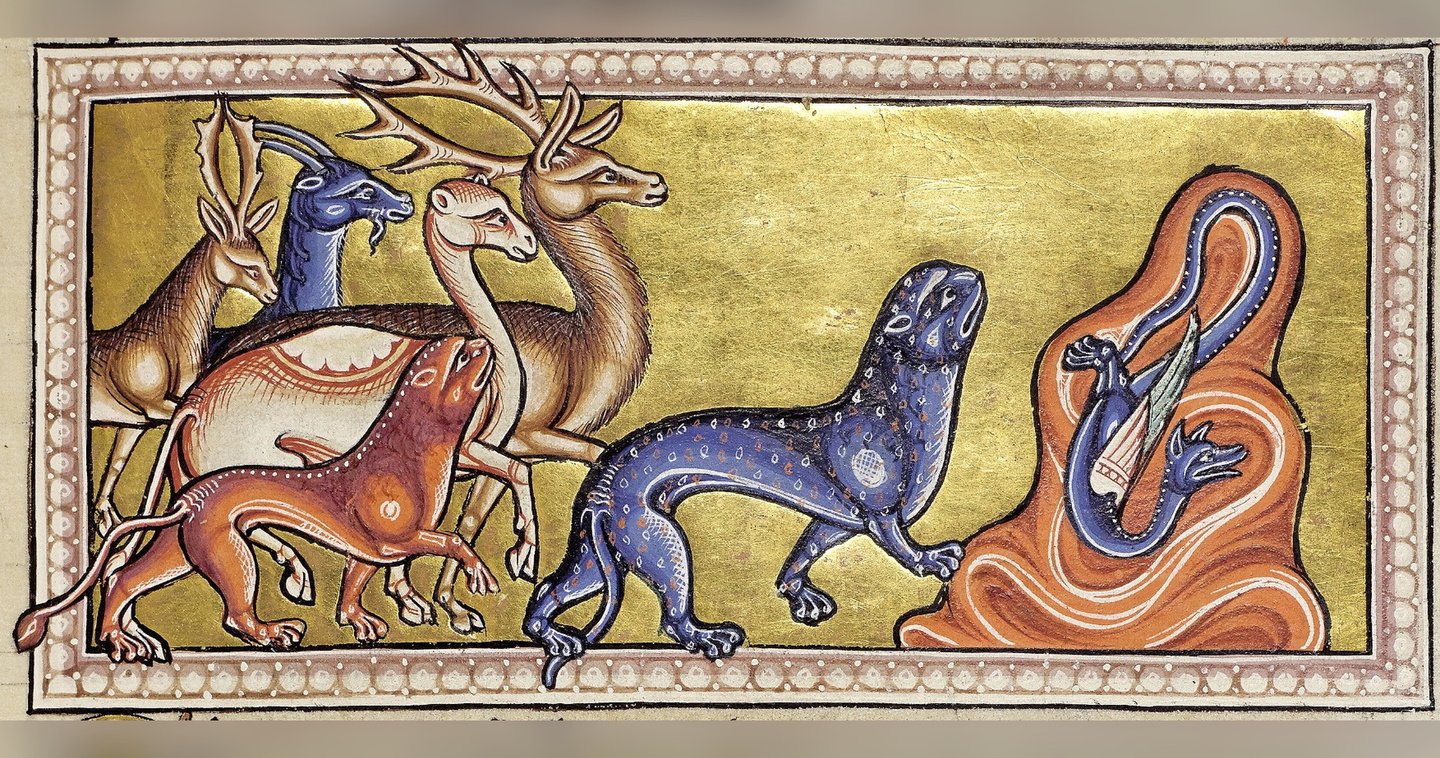
1. Tiger, leaf 8r Unknown English artist. «Tiger.» Aberdeen Bestiary, c. 1200, leaf 8r. England. 2. Leucrota, leaf 15v Unknown English artist. «Leucrota.» Aberdeen Bestiary, c. 1200, leaf 15v. England.
The tiger and the leckrotos demonstrate the variety of images that medieval bestiaries unified. Alongside animals whose existence was confirmed by observation and classical accounts, fantastic creatures were depicted in manuscripts. For the medieval reader, the boundary between the real and the imaginary world was not always obvious. Both types of imagery became part of a unified vision of the world, in which every creature could carry a specific meaning.
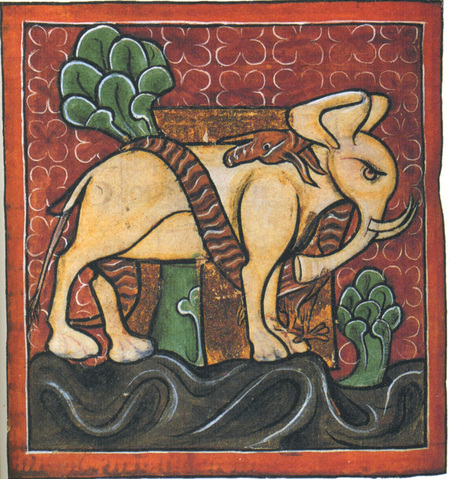
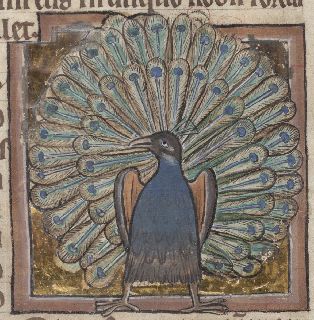
1. Elephant and Dragon Unknown English artist. «The Dragon Smothering the Elephant.» Bodley Bestiary 764, circa 1225–1250, folio 92v. England. 2. Peacock Unknown English artist. «Peacock with Disheveled Tail.» Bodley Bestiary 764, circa 1225–1250, folio 84v. England.
Bestiaries combined descriptions of real and fantastic creatures, alongside illustrations and moral interpretations. Lions, eagles, foxes, unicorns, dragons, and other figures became part of a narrative about a world created by God. Through the characteristics and behavior of animals, authors explored concepts of virtue, sin, faith, and salvation. Therefore, a bestiary cannot be viewed as a standard zoological text. Its primary purpose was not to accurately describe nature, but to reveal the underlying spiritual meaning of the surrounding world.
Unknown English artist. «The Lion-Cat Devours Its Prey.» Bodley Bestiary 764, circa 1225–1250. England.