Visual Research Concept
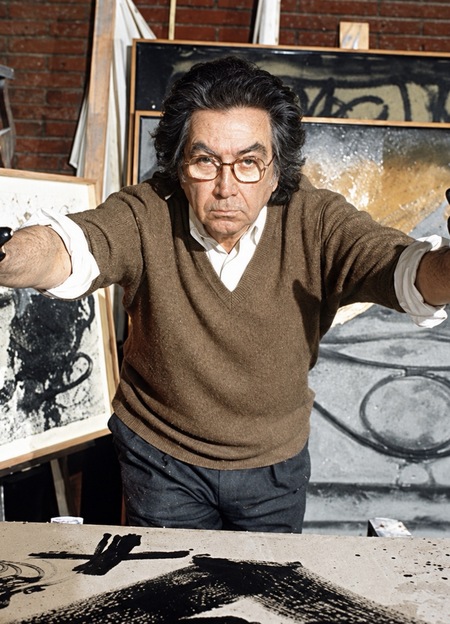
Antoni Tàpies is a Catalan artist whose work involves rethinking painting as a material object. Moving away from the traditional concept of a painting as a flat surface meant to represent the surrounding world, Tàpies engages with texture, relief, marks, scratches, and everyday objects. His works exist at the intersection of painting, collage, assemblage, and sculpture, challenging conventional notions of artistic material and its application. Tàpies was chosen for this research because his practice allows us to examine painting not merely as a visual image, but as a physical form that interacts with its surrounding space. This visual research complements the curatorial project for the solo exhibition, «Against the Rules: The Materiality of Antoni Tàpies’ Painting, ” which proposes examining the artist’s work within the context of the historical architecture of the Marble Palace in the Russian Museum.
This research aims to analyze how the understanding of painting evolves in the work of Tapiés and how the materiality of the artwork influences its viewer perception. In his early works, the artist engages with surrealist imagery; however, he gradually moves away from traditional representation toward texture and the immediate presence of the material. Subsequently, his practice expands by incorporating everyday objects, utilizing volumetric elements, and creating pieces that interact with architectural space. A particular focus is given to the cross—a recurring motif that exists simultaneously as a graphic gesture, a compositional element, and a symbol. In his later works, materiality converges with themes of the body, memory, and time. This trajectory allows us to ask how the shifting artistic form affects the modes of perceiving the work and at what point painting ceases to be solely an image, transforming into an autonomous object.
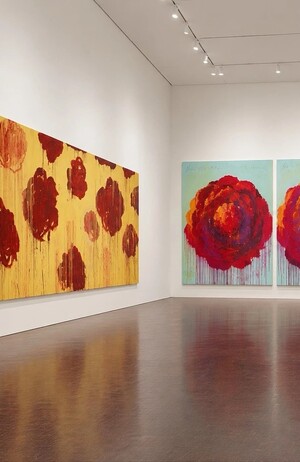
The architectural context of the Ludwig Museum, the Russian Museum, holds particular significance for this study. The historical interiors, decorative finishes, and monumental scale of the palace space establish certain expectations regarding what a work of art should look like and how it should be exhibited. Tapiesa’s material painting, in contrast, engages with roughness, damage, marks, and unpretentious materials—elements that clash with the notion of a finished and aesthetically ordered surface. Consequently, the research examines architecture not as a neutral backdrop for the works, but as an active element of the exhibition that influences their interpretation. This allows us to formulate the core research question: how does Tapiesa’s material painting conflict with the historical architecture, and how does this conflict alter the perception of the artwork and the exhibition space itself.
The study aims to trace the evolution of Tapies' practice—from his surrealist period in the late 1940s and transition to material painting in the 1950s, through to works where the artist utilizes everyday objects, explores the interaction between object and space, refers to the cross as a recurring symbol, and develops the theme of materiality in his later career. The visual material will be organized according to seven thematic sections of the exhibition: surrealism; the transition from representation to matter; material painting; everyday objects as material; object and space; the cross as a sign; and matter and time. This structure allows the chronological principle to be integrated with the thematic elements, enabling an examination not only of the sequence of changes in the artist’s work but also of the development of key motifs that reappear across different periods of his practice.
Visual material will be selected based on the work’s relevance to the research problem. For each piece, we plan to use both overview and detail shots that allow for an examination of texture, surface structure, materials used, and how objects are incorporated into the composition. For works related to volume and space, photographs demonstrating their scale, placement, and interaction with the surroundings will be particularly important. Some works will be analyzed in detail, while others will be presented to provide visual and historical context.
The research database will consist of Tapies’ own statements, catalogs of his exhibitions, monographs and critical publications about his work, as well as theoretical works dedicated to the materiality of art, exhibition space, and the institutional conditions of artwork perception. The artist’s statements will allow for an examination of his relationship to material, surface, and the traditional boundaries of painting. Critical studies will be used to analyze how his practice is interpreted within the context of post-war art and the expansion of the concept of the artwork. Additional theoretical context will be provided by research on the relationship between the artwork, architecture, and the viewer. Comparing the author’s statements with critical interpretations will reveal how materiality becomes not only a formal device but also a way of rethinking the status of painting.
The research structure will align with the logic of the exhibition. The first part will focus on the transition from image to material surface and the formation of Tapiesa’s individual artistic language. The second part will examine the use of everyday objects and the shift from painting to object, as well as the changing relationship between the artwork and its surrounding space. The third part will be dedicated to the cross as a recurring symbol and the artist’s late work, in which matter becomes a carrier of traces, memory, and time. In the concluding stage, the analysis results will be correlated with the architecture of the Ludwig Russian Museum to determine how the interaction between the works and the historical interior reveals the project’s central conflict—the contradiction between the materiality of contemporary art and the concept of architecture as a complete, ordered, and aesthetically unified form.