Idea and Concept
In 1899–1904, German biologist and naturalist Ernst Haeckel, along with lithographer Adolph Gillich, published the atlas Kunstformen der Natur («The Art Forms in Nature»). Microscopic radiolarians, jellyfish, corals, and diatoms are arranged on his plates with near-drafting symmetry—like miniature, natural mechanisms. In my project, I decided to reverse this perspective: to train the generative neural network Stable Diffusion XL using the DreamBooth LoRA method on the specific style of late 19th–early 20th-century scientific chromolithography and create a series of botanico-technical plates titled «Techno-Flora.» In this series, modern engineering objects—a watch movement, a quadcopter, a silicon microprocessor, and acoustic instruments—are presented as if they were dissected, classified, and sketched by a 1900s researcher.
Training Dataset and Copyright Compliance
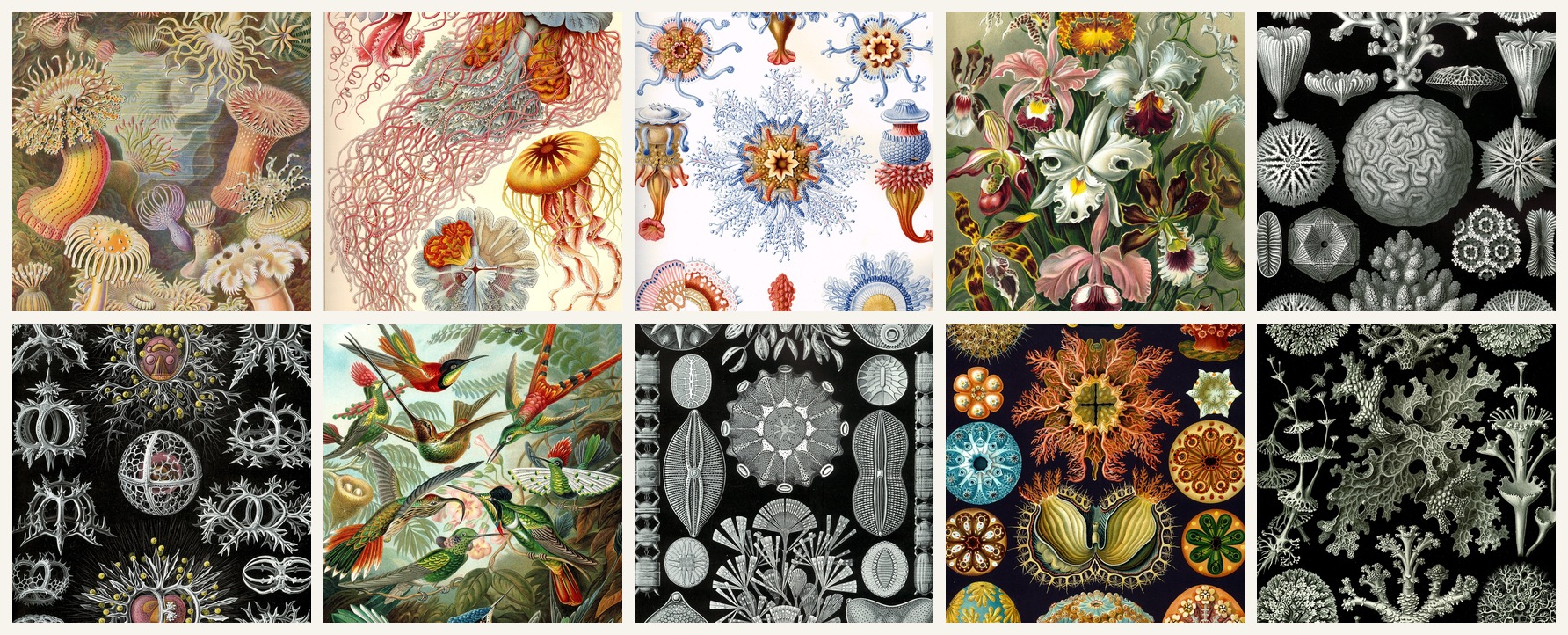
For training, I selected and prepared 25 high-quality square images (1024×1024 pixels, 1:1 aspect ratio). Each card features a distinct biological taxon without repetitions or duplicates: Actiniae, Discomedusae, Siphonophorae, Orchidae, Hexacoralla, Radiolaria (Stephoidea, Spumellaria, Cyrtoidea), Diatoms (Diatomea), Ascidians (Ascidiae), Pitcher Plants (Nepenthaceae), and others. During preparation, I carefully cropped the external typographic margins, including page numbers, to prevent the model from learning the borders and small peripheral inscriptions.Dataset licensing: All 25 source illustrations were published in the work Kunstformen der Natur (1899–1904). The engraver, Ernst Haeckel, died in 1919; therefore, all materials are in the Public Domain (CC0 1.0 Universal) and are fully licensed for model training and the publication of derivative works. A complete list of all 25 files with direct links on Wikimedia Commons is saved in the dataset_sources_cc0.csv table.
Learning Process Description
I based this on the foundational notebook, SDXL_DreamBooth_LoRA_Colab.ipynb, and adapted it to train my own style:
Automatic description labeling via BLIP (metadata.jsonl): Using the Salesforce/blip-image-captioning-base model, a concise description of the biological object was generated for each of the 25 illustrations, and the prefix «scientific chromolithograph plate in HAECKEL_LITHO style» was programmatically inserted at the beginning of the line. This is an important technical detail: if the model is trained with one identical phrase without object descriptions, the style token will «stick» to the jellyfish and shells. Including the objects in the text allowed the HAECKEL_LITHO token to capture the graphical manner—the lithographic raster, contour, axial composition, and mineral palette.
Training progression: A learning rate of $1\text{e-}4$ was used with a constant scheduler, a signal-to-noise ratio stabilizer ($\text{snr_gamma} = 5.0$), and a total of 500 steps, with an intermediate checkpoint saved at step 250.
Generator Details and Adapter Weight Selection
To achieve a compelling hybrid of a modern instrument and an antique scientific plate, a single retraining pass is not enough—it is crucial to capture the correct LoRA merge weight during inference. I tested the same prompt (mechanical chronograph + radiolarian skeleton) in three modes:
To the left—checkpoint-250 with a weak lora_scale of 0.45: the base photorealistic nature of SDXL dominates. The result is almost a standard macro photograph of brass pocket watches on beige paper, with the lithographic drawing barely discernible. In the center—the final 500-step model with lora_scale = 0.85 (the selected working mode): the gear wheels, bridges, screws, and escapement mechanism retain sharp engineering readability, yet they are rendered with fine lines and stippled shading, organically sprouting from the radial calcareous needles and domes of jellyfish. To the right—an exaggerated lora_scale of 1.25: the adapter begins pulling the generation toward the training examples—the metallic parts dissolve, and the image transforms into an almost pure marine radiolarian from the original atlas.
Additionally, to maintain the clarity of the printmaking style across the entire series generation, I used num_inference_steps = 32, guidance_scale = 7.5, and the negative prompt modern 3d render, glossy plastic, neon, blurry, text, watermark, asymmetric, excluding plastic 3D gloss and modern highlights.
Final «Techno-Flora» series and expanded visual analysis
What stylistic elements were captured:
Two historical substrate types: In the original edition of Kunstformen der Natur, most tables are printed on warm, thick ivory-colored paper, while separate sheets featuring transparent and phosphorescent marine organisms are set against a deep matte black background. The trained model has accurately adopted both approaches, allowing the paper type to be switched via prompt (on cream paper / on matte black background) without losing the unified handwriting of the series. Stippled lithographic ink and mineral color palette: The volume is constructed not with smooth computer gradients, but with grainy stippling and fine contour outlines in the color range characteristic of chromolithography—terracotta-coral, ochre, sage-teal, pearly gray, and brass. Museum symmetry 1:1: Each techno-biological object is frontally centered within a square field, much like preserved specimens are arranged on educational zoological plates.
Analysis of individual works and their variations in the series:
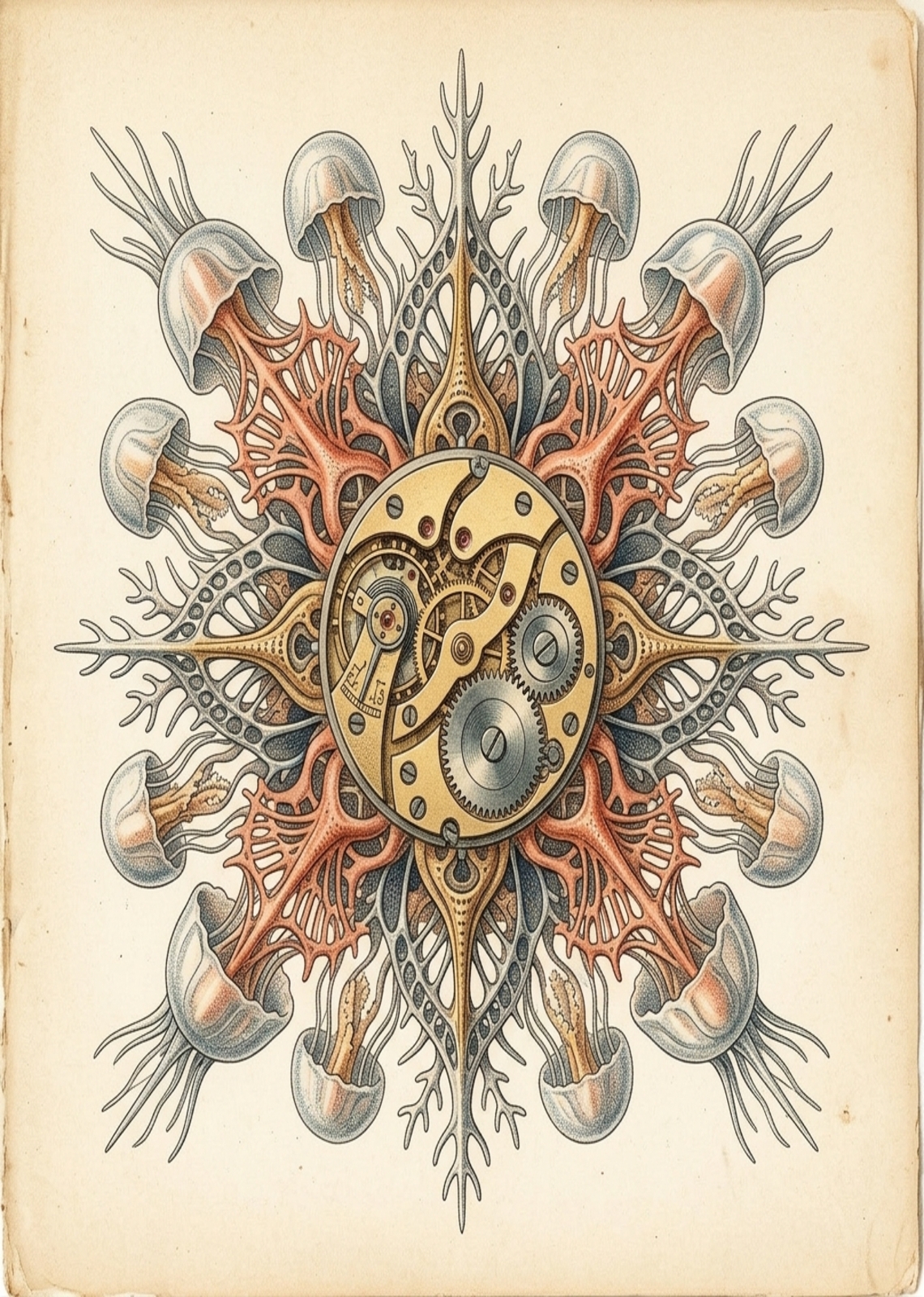
Sheet 1. Chronograph Radiolaria (Caliber I): The central core of the composition is an open brass clockwork mechanism with legible gear wheels, bridges, screws, and a regulator. Radiolaries of terracotta and steel shades radiate from the circular frame across eight axes in filigree silica lattices, while the outer contour is closed by twelve translucent jellyfish domes functioning as natural clock markings on warm lithographic paper.
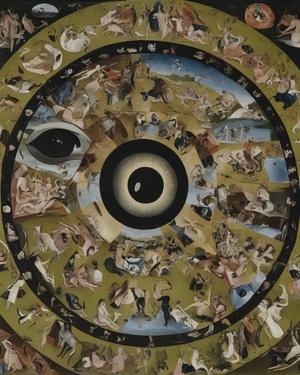
Sheet 2. Quadcopter-Jellyfish (Aeroplankton II) The drone body, featuring a central glass camera lens and four beam-rays, has been reimagined through the morphology of the jellyfish Discomedusae and siphonophores. The four lift rotors have transformed into the ribbed umbrellas of jellyfish, while beneath the main body, instead of a payload mount, extends a symmetrical entanglement of flat streamers, wires, and connectors—like tentacles—rendered in a restrained coral-sage and ochre palette.Sheet 3. Silicon Coral (Microprocessor III) The work is executed on the characteristic matte-black lithographic background favored by Heckel. At the center resides a square microprocessor crystal, from whose contact pads golden circuit board traces extend at 45° and 90° angles. As the structure moves away from the center, the strict geometry of the microchip proliferates into a crown of turquoise and terracotta polyps resembling hexacorals (Hexacoralla) and diatomaceous rosettes.Sheet 4. Parabolic Apertures and Diaphragms (Table IV) An interesting compositional variation within the series: because the training dataset included multi-figure Heckel tables with several top-down views, the model autonomously organized this sheet from four circular frontal projections of parabolic mirrors and optical diaphragms. Concentric rings of emitters and reflector spokes transition into the radial septa of actinians and sea urchins, and small circular medallions—like cross-sections in an authentic scientific atlas—have emerged at the corners of each sector.
Leaf 5. Horn Acoustics and Orchids (Botanical Leaf V) Unlike the circular mandalas of the first leaves, this one is dominated by the strict bilateral symmetry of botanical illustration. Expanding phonograph horns and ribbed copper resonators sprout from a single stem with segmented corrugated tubes at the base, while the corners of the square format hold four symmetrical chitin-brass overlays.Leaf 6. Acoustic Nautilus (Resonator VI) The second leaf in the series, printed on a carbon-black lithographic stone, rhymes with «Silicon Reef.» The upper segmented arch of the head on the central stand transitions into two symmetrical spiral chambers of the nautilus shell, which substitute for the acoustic cups of headphones, while the cut is complemented by white circular diffuser membranes on the sides.How do the results align with the initial idea: The series fully validated the project’s original hypothesis: when using a moderate blending coefficient (0.85) and separating style and object via SDXL BLIP prompts, it does not merely overlay a «vintage filter» onto the subject but finds morphological rhymes between technology and living nature. Notable compositional variations emerged within the series: the centralized star-shaped rosette («Chronograph-Radiolaria»), the vertical silhouette with trailing flagella («Quadrocopter-Discmedusa»), the closed circular mandala on black stone («Silicon Reef»), and the paired spiral-botanical forms in the remaining leaves.
Description of Generative Model Application
In this academic project, generative and multimodal artificial intelligence models were utilized as the primary subject of practical research and as an artistic tool:
Stable Diffusion XL Base 1.0 (stabilityai/stable-diffusion-xl-base-1.0) — Repository: https://huggingface.co/stabilityai/stable-diffusion-xl-base-1.0 (in conjunction with the stabilized autoencoder SDXL VAE fp16-fix: https://huggingface.co/madebyollin/sdxl-vae-fp16-fix and the open-source Hugging Face Diffusers framework: https://github.com/huggingface/diffusers). Its application and purpose: fine-tuning a style adapter using the DreamBooth LoRA method on a custom dataset of 25 public domain (Public Domain / CC0) illustrations, and generating the final «Techno-flora» illustration series based on custom prompts.
BLIP Image Captioning Base (Salesforce/blip-image-captioning-base) — Repository: https://huggingface.co/Salesforce/blip-image-captioning-base. Its application and purpose: automatically generating basic text descriptions for the training images in the metadata.jsonl file prior to launching the LoRA training (in accordance with the course tutorial notebook code).
The artistic concept, selection, and framing of the 25 plates from Kunstformen der Natur, verification of their legal status (Public Domain / CC0), configuration of the learning parameters in the notebook, prompt creation, comparison of checkpoints (250 and 500 steps), and selection of the lora_scale weight and thematic analysis of the series were completed solely by me. A third-party language model was used only for auxiliary support during the final stage of preparing the long-read article to check spelling, punctuation, and the neat formatting of the exhibition text.
Final Series
Link to Google Drive