How different cultures depicted judgment, punishment, demons, and death. Iran, Byzantium, Western Europe, and Buddhist East
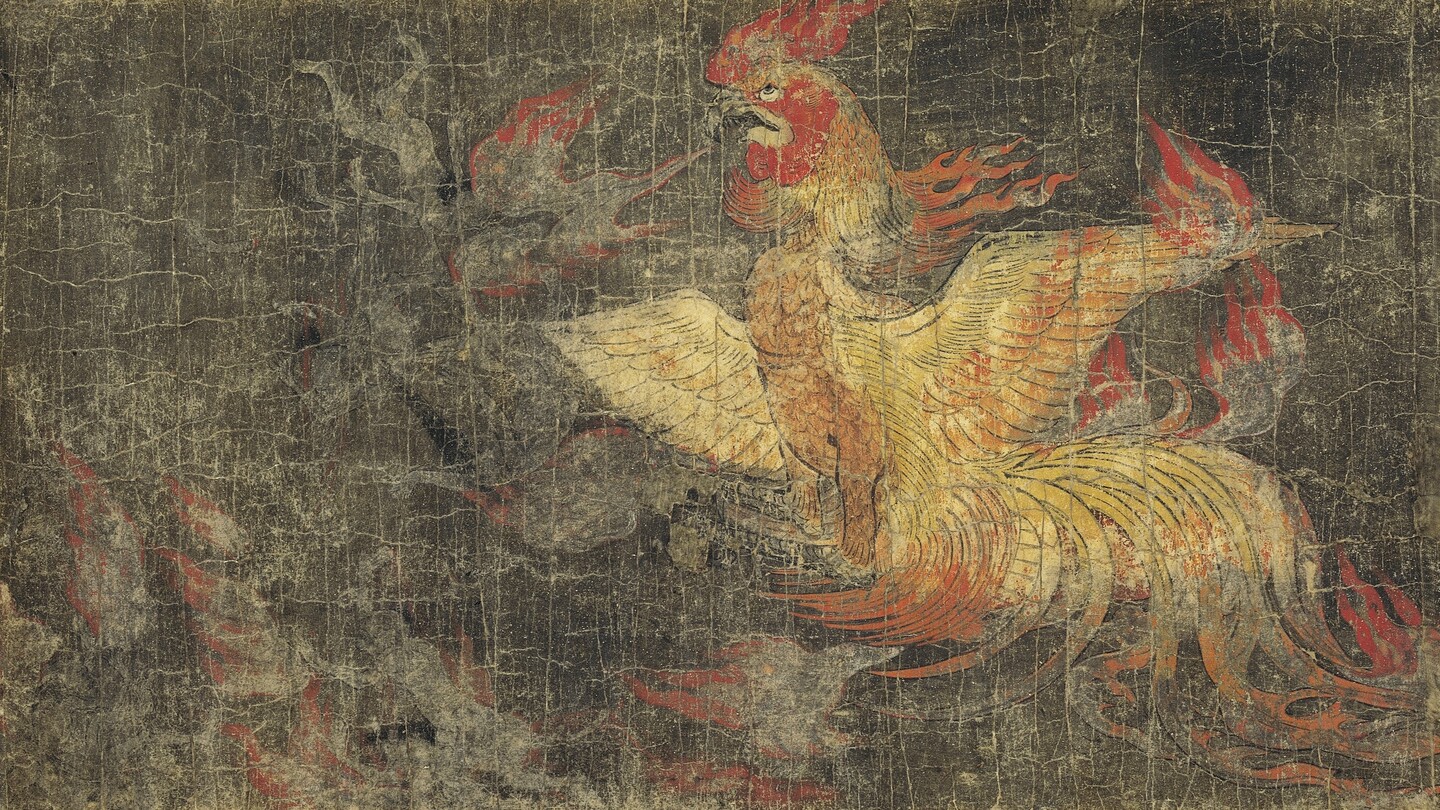
Ill. 1 Scroll of Hell, fragment: Hell of the Fire Rooster (Jigoku-zōshi), late 12th century Unknown Japanese artist. Horizontal scroll, ink and pigment on paper, height 26.5 cm. Nara National Museum. National Treasure of Japan
Concept
Medieval hell—one of the most thoroughly described places, yet unmapped on any chart.
Concepts of the afterlife emerged in texts long before they were depicted: the Egyptian «Book of the Dead, ” Zoroastrian hymns and Pahlavi treatises, the Book of Daniel and the Apocalypse, and Buddhist sutras describing the eight hells. The artist was not given an image, but a highly detailed description. How to paint a bridge that is nine cubits wide for the righteous but thinner than a blade for the sinner? How to depict the „outer darkness“ without coloring the wall black? How to represent time if a soul passes through ten trials in three years? Each culture had to find its own answers to these questions.
This study compares depictions of hell, judgment, and death created before the end of the 14th century across four major traditions: in Iran and Sogdiana (from Sasanian reliefs to Mongol miniatures from Tabriz), in Byzantium and its environs, in Western Europe, and in the Buddhist worlds of China and Japan. These are very different works of art: a portrait of a priest carved into a rock face in Fars, a gold mosaic on the western wall of a Venetian cathedral, a Japanese paper scroll four and a half meters long. However, when placed side by side, one can discover a curious thing: artists who knew almost nothing about each other consistently arrive at the same solutions.
There are few such solutions, and they can be called visual formulas—recurring techniques by which judgment and punishment are shown. The scales are one of the key symbols of justice. They weighed—compared—evidence, arguments, and deeds. The bridge is a liminal space where a person confronts a moral choice, a path from which one can fall. The maw represents hell as a living creature that devours sinners. The fiery river symbolizes punishment originating from the divine itself. The judge with the book signifies hell as an office where all deeds are recorded. And the cell represents hell divided into compartments, each punishing a specific sin.
The lower right corner of the western wall mosaic of the „Last Judgment“ in Torcello: hell divided into rectangles, like a page from a textbook. In one rectangle, bodies are burning; in another, skulls lie upon which snakes crawl; in a third, only heads are present. Hell is portrayed not as chaos, but as classification: every sin has its own place and its own punishment.
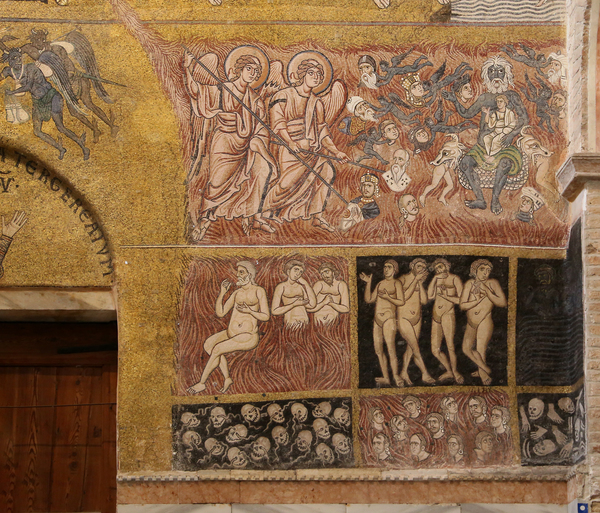
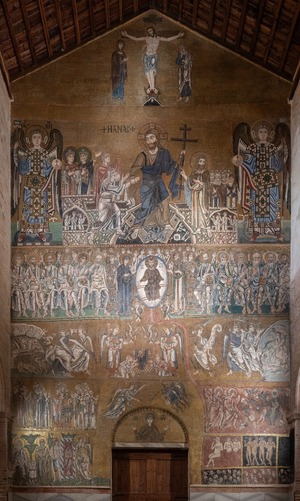
Fig. 2 The Last Judgment, detail: hell (Giudizio Universale), late 11th–12th century Unknown mosaicists of the Byzantine school. Lower right corner of the west wall. Santa Maria Assunta Cathedral, Torcello. Photo: Sailko, CC BY 3.0 Fig. 3 The Last Judgment (Giudizio Universale), late 11th–12th century Unknown mosaicists of the Byzantine school. Mosaic of the west wall of Santa Maria Assunta Cathedral, Torcello island, Venetian Lagoon
On the same scales in Egypt, Sogdiana, Byzantium, and Japan, different things are compared, and most importantly, they are linked to time in different ways. For a Christian artist, hell is an end after which there is nothing more. For a Buddhist artist, it is a pause in the cycle of rebirth. For a Zoroastrian artist, it is a trial followed by the purification of the world. Therefore, the study is structured not only as a review of subject matter but also as an attempt to understand how imagery conveys order and time.
How did medieval artists from Iran, Byzantium, Western Europe, and Buddhist East transform the invisible afterlife into images, and what visual formulas for judgment, punishment, and demons did they share?
Medieval hell is depicted not as chaos, but as an order composed of several common formulas: the scales, the bridge, the maw, the river of fire, the judge with a book, the cell. These formulas shift across cultures, and their meaning evolves alongside the concept of hell’s duration—eternal, as in Christianity; temporary, as in Buddhism; or until the end of the world, as in ancient Iran.
The chronological framework spans from the 3rd century, when the high priest Kirder carved a narrative about his vision of the afterlife into the rocks of Fars, to the end of the 14th century. The lower boundary for Iran has been consciously pushed deeper—without Sasanian and Sogdian artifacts, it is unclear where the imagery of the bridge and the scales originates in later art. A 13th-century Egyptian papyrus is included as a sole exception—it is the oldest surviving «judgment formula, ” and without it, the comparison would be incomplete.
The Bridge (Iran and Sogdia, 3rd–8th Centuries)
The oldest image of the afterlife judgment is the scales. A bridge is characteristic of Iranian tradition. Between them lies the entire backdrop of the medieval hell.
One should begin with Egypt. In the «Book of the Dead,» the judgment scene depicted by the scribe Hunefru (Fig. 4) is shown as a procedure. Anubis, a jackal-headed figure, leads the deceased to the scales; on one pan lies his heart, and on the other—the feather of the goddess of truth, Maat. The god-scribe Thoth, with an ibis head, records the outcome, while beside him sits Ammit—a crocodile-headed monster ready to devour the heart if it outweighs the feather. Adha is not present here as a place, but rather as a threat of annihilation. Yet, nearly everything required for future trials is already present: the scales, the scribe, the devourer-guardian, and the path along which sinners are led.
Fig. 4. Fragment. The Weighing of the Heart before Osiris. Book of the Dead of the Scribe Hunefere, circa 1275 BCE. Unknown Egyptian master. Papyrus, 19th Dynasty, Thebes. British Museum, London.
The Funerary Papyrus of Hunnefer dates to around 1275 BCE—more than a thousand and a half years before the other known artifacts. It stands here as a starting point: this is what the weight formula looks like in its earliest form.
In Iran, the judicial process is structured differently. According to Zoroastrian texts, for three nights following death, the soul remains with the body. At the dawn of the fourth day, it approaches the Chinvat Bridge—the «bridge of separation.» There, it is greeted by the divine judges Mithra, Sraosha, and Vohu Manah, who hold the scales, as well as its own belief, daena. For the righteous, daena appears as a beautiful young woman, and the bridge beneath her widens; for the sinner, it appears as an ugly old woman, the bridge narrows to a blade’s edge, and the soul enters the «house of lies.» Crucially, even this hell is not eternal: at the end of time, the entire world will pass through a torrent of molten metal, and the punishment will cease. The first evidence of this story in Iran is not a painting, but text carved into a rock. Khirdar, the high priest to several Sasanian kings in the last third of the 3rd century, left four inscriptions in Fars. In two of them, at Sar-Mashhad and Naqsh-e Rostam, he describes a vision: his double meets a noble woman; together they see a bottomless abyss filled with snakes and scorpions, and a bridge above it that widens beneath their feet. Next to the shortest inscription, at Naqsh-e Rajabe, a portrait of Khirdar is carved (Fig. 6): the priest raises his index finger in reverence and gazes at the text as a witness. The relief does not depict the actual vision, but the relief does what all later depictions of hell would do—it attests that someone saw it.
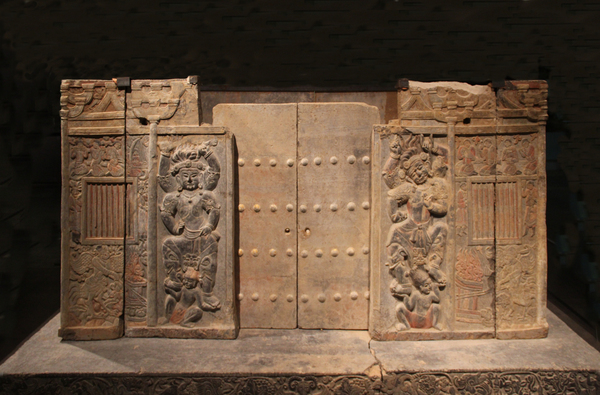
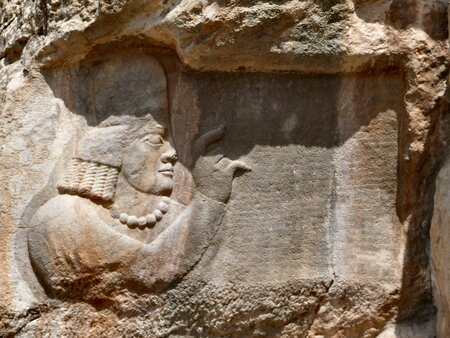
Fig. 5. Stone Sarcophagus of the Sogdian Virkak (Shi Jun) and His Wife (Shi Jun Stone Sarcophagus), 579–580 Unknown artisan (Chang’an Sogdian community). Limestone, relief with remnants of painting and gilding. Found in Xi’an, China, in 2003. Fig. 6. Portrait of the Chief Priest Kirdar with His Inscription, Late 3rd Century Unknown Sasanian artisan. Rock relief. Naksh-e Rajab near Persepolis, Fars Province
The decision to depict the bridge was not made in Iran, but on its eastern periphery—among the Sogdians, merchants from Samarkand, Bukhara, and Khiva who settled along the Silk Road. In 579, Virkak, the head of the Sogdian community in Chang’an (modern Xi’an), died; he was known in Chinese as Shi Jun. His sons buried him and his wife in a stone sarcophagus shaped like a Chinese house (Fig. 5) and covered the walls with reliefs where the Chinese form tells an Iranian story. On the eastern wall (Figs. 7, 8), the couple, along with people and animals, crosses a bridge spanning the water. Monsters hide in the waves, waiting for those who fall, and one figure is already flying down. At the top, there is a meeting of souls with deities (Fig. 9) and an ascent upon winged horses. The bridge is shown not as a metaphor, but as a typical Chinese bridge with railings: the carver took a familiar form and filled it with foreign content. Thus, the formula crosses cultural boundaries.
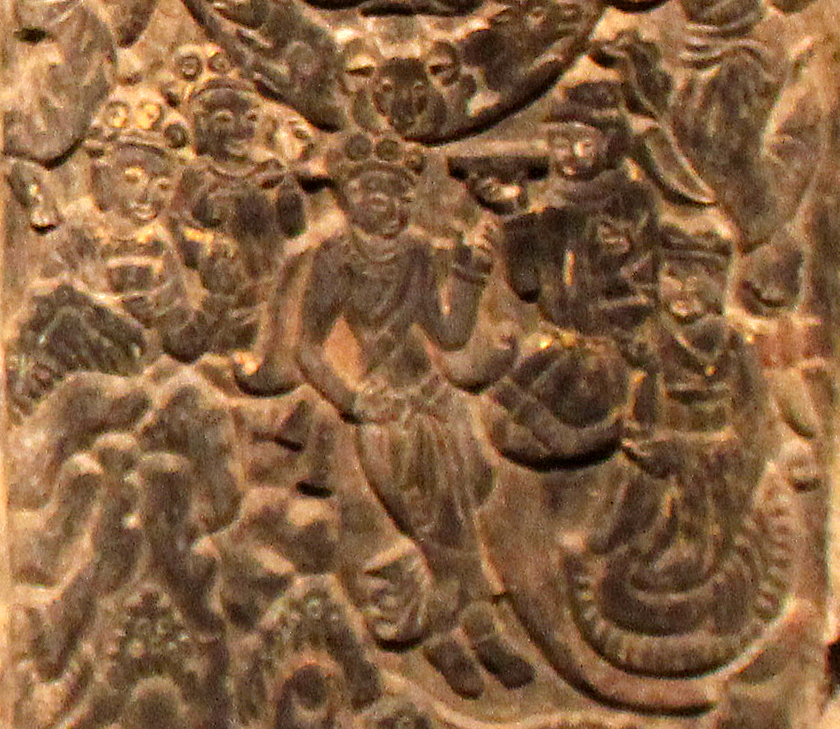
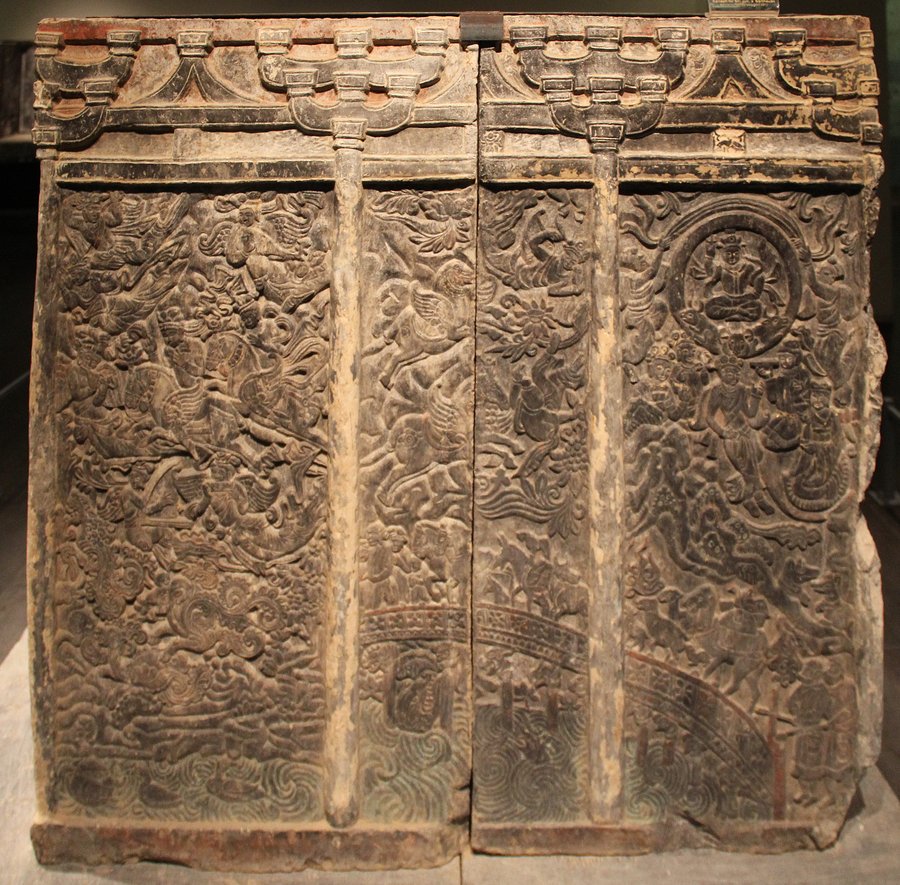
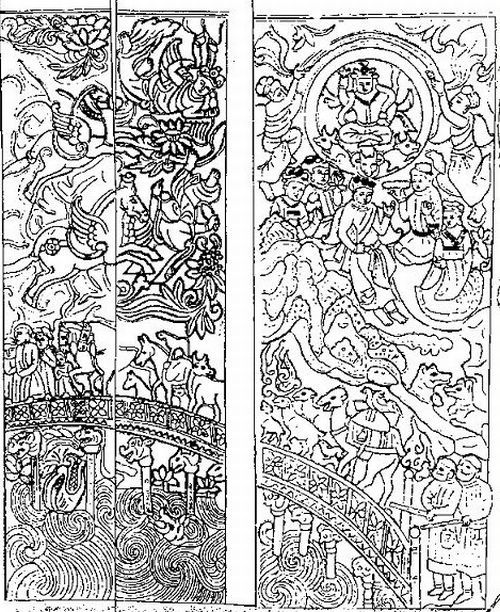
Fig. 7. Virkaka Sarcophagus, East Wall: Crossing the Chinwat Bridge, 579–580 Unknown artisan (Ch’angan Sogdian community). Fig. 8. East Wall of the Virkaka Sarcophagus, Relief 579–580 Sketch based on excavation publication. Fig. 9. Virkaka Sarcophagus, Detail of Plaque 9: Gods of the Underworld Judgment, 579–580 Unknown artisan (Ch’angan Sogdian community).
The relief is worn in places, so a drawing from the excavation publication is provided nearby. The reading of the scene as a passage through the Chinwat was suggested by François Grenet, Penelope Ribu, and Yan Junqian shortly after the 2003 discovery.
The same legal formula permeates the artifacts found in the burial chambers. The Sogdians, following Zoroastrian custom, did not bury bodies in the ground; they left them in open areas and placed the cleaned bones in clay chests—ossuaries. In the ossuary from Shahrisabz—ancient Kesh, from which Virkak supposedly originated according to an inscription—a deity holding scales stands in the center, likely Rashnu (Fig. 10). The scales that stood in the Egyptian court hall are now placed directly on the coffin.
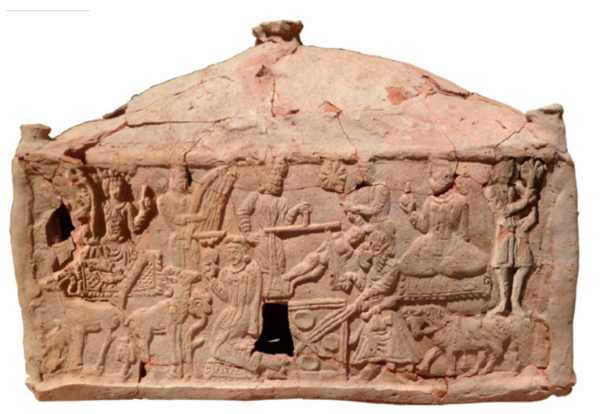
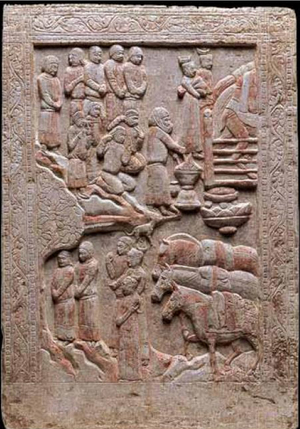
Fig. 10. Ossuary (bone box) depicting a god of judgment with scales, 7th–8th century Unknown Sogdian artisan. Fired clay, relief. Found in Shahrisabz (ancient Khash), Uzbekistan. Fig. 11. Sogdian burial slab, central panel: ritual by the sacred fire, c. 570 Unknown Sogdian artisan in Northern China. Limestone, relief with painting. Miho Museum, Shiga Prefecture, Japan.
The burial ritual itself is visible on another Sogdian slab, currently held in the Miho Museum in Japan (Fig. 11). On the central plate, a priest wearing a headcloth that covers his mouth—to prevent his breath from defiling the fire—stands at the fire altar, with mourners behind him, and a saddled horse and laden animals below. In Sogd itself, in the temple of Penjikent, a VI-century fresco has been preserved, depicting a scene of mourning (Fig. 12): near the funerary pavilion, whose windows show weeping women, people in despair are pulling at their hair. This scene is associated with mourning rituals that were later reflected in the epic of Siavush. This is not yet hell, but grief—and it is this grief that becomes the primary way Iranian art speaks about death.
Fig. 12. Mourning Scene, 6th Century Unknown Sogdian painter. Mural painting on the southern wall of the main hall of Temple II in Panjikent (Tajikistan). State Hermitage Museum, St. Petersburg. Photo: sailko
In Iran, the court is a passage. They do not cast souls downward; they guide them, and only those who jump from the bridge fall. The horizontal trajectory of the path—that is what distinguishes the Iranian image from all subsequent ones.
River of Fire (Byzantium, 11th–14th Centuries)
The Byzantine Judgment reads from top to bottom and across the tiers. Hell occupies its own corner—the lower right, to the Judge’s left—and never extends beyond its boundaries.
The most striking example is the mosaic on the west wall of the Basilica di Santa Maria Assunta on the island of Torcello in the Venetian Lagoon (Fig. 3). It was assembled by craftsmen trained in the Byzantine tradition in the late 11th–12th centuries; the mosaic has been restored many times since. The Last Judgment was placed on the west wall, above the entrance, so that a worshiper would only see it as they turned to leave—the judgment was thus the last thing they saw in the church. The wall is divided into six tiers. At the top are the Crucifixion and the Descent into Hell; below that are Christ the Judge in a mandorla, the Virgin Mary, John the Baptist, and the apostles; further down is the throne prepared for the judgment and the resurrection of the dead. In the two lowest tiers, paradise is on the left and hell is on the right.
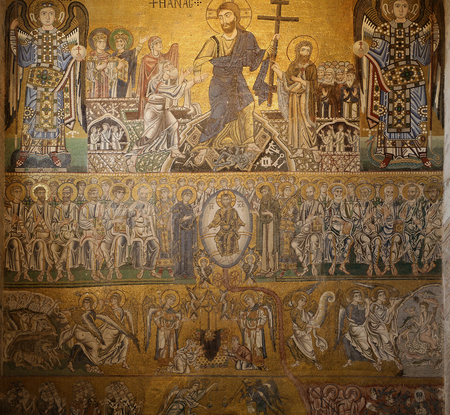
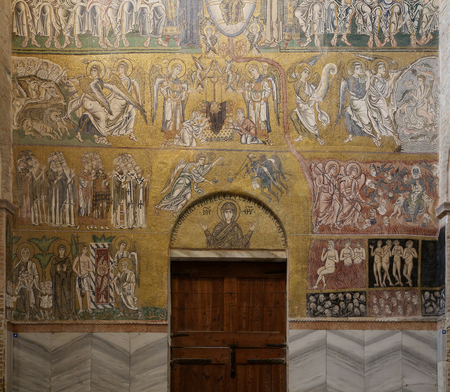
Fig. 13. The Last Judgment, upper tiers: Descent into Hell, Christ the Judge, the river of fire, late 11th–12th century. Unknown mosaicists of the Byzantine school. Santa Maria Assunta Cathedral, Torcello. Fig. 14. The Last Judgment, lower tiers: Weighing of souls, heaven and hell, late 11th–12th century. Unknown mosaicists of the Byzantine school. Santa Maria Assunta Cathedral, Torcello.