RESEARCH CONCEPT
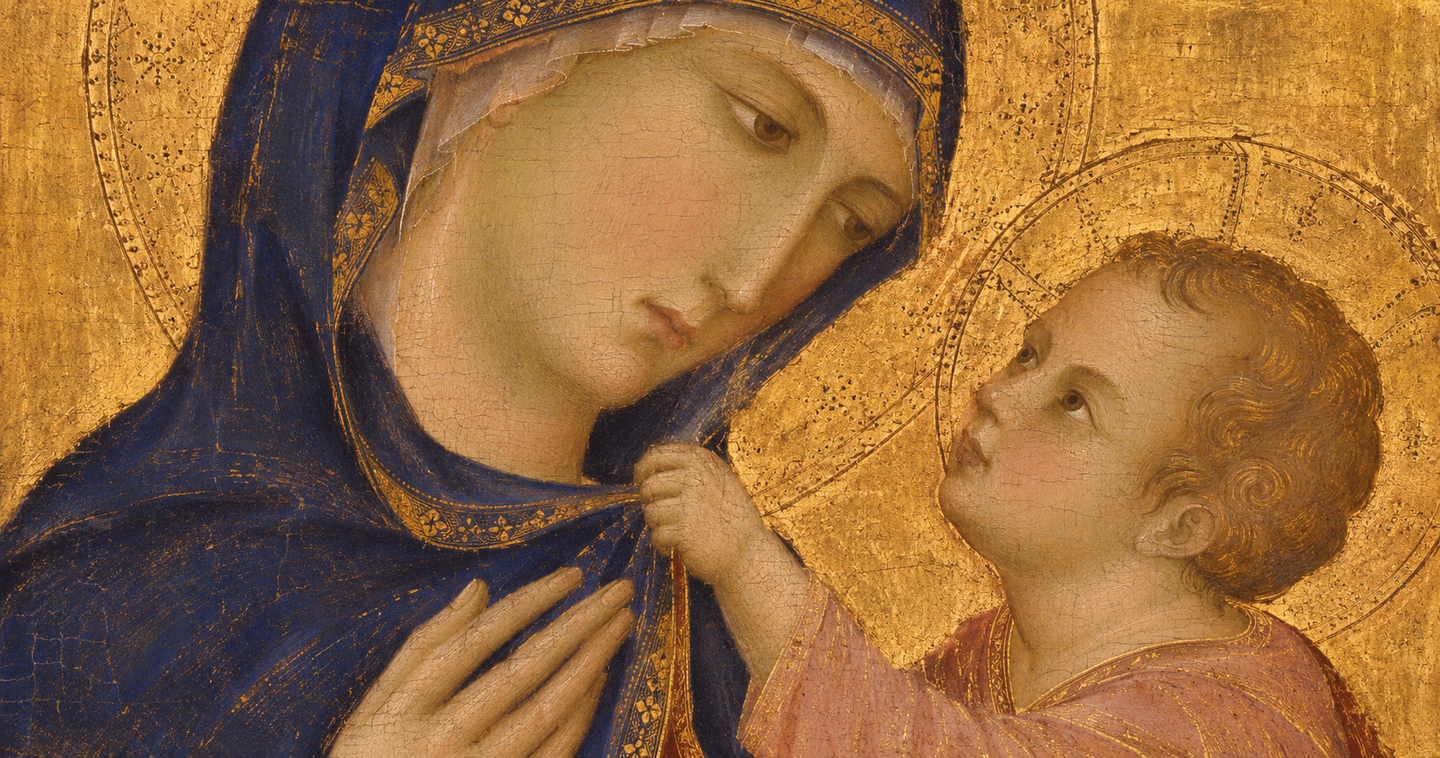
The focus of this visual inquiry is not motherhood in general, nor the history of familial sentiment. I am interested in the specific function of painting: how the relationship between mother and child becomes visible within a sacred image. In depictions of the Theotokos with the Child, the viewer sees two figures connected physically but unequal in meaning—Mary presents the Son to the world, while the Child acts as the future Savior. Therefore, a gesture that appears commonplace and tender in an altarpiece can simultaneously function as a religious sign. It is this ambiguity that allows an investigation into maternal intimacy through the form of the image, without assigning emotions to the characters or the artists that cannot be proven. The boundaries of this study are deliberately narrowed: Tuscan painting from approximately 1280–1330, primarily works by Sienese and Florentine masters. Cimabue, Duccio, Giotto, Ugolino di Neri, Siena di Bonaventure, Simone Martini, and Lippo Memmi were selected for comparison. During this period, solemn throne depictions, small panels for private contemplation, and parts of polyptychs coexisted. They cannot be reduced to a single trajectory «from convention to realism»: at one time, artists addressed the challenge of intimacy in different ways, and a large-scale work is not necessarily built upon the same gestures as a small painting. I am selecting works not based on the author’s fame, but on the possibility of testing a specific visual observation. The corpus includes images where the hands, the Child’s posture, the direction of gazes, the edges of the mantle, and the manner of physical support are clearly discernible. The large «Maestà» by Cimabue, Duccio, and Giotto allow us to see the public, audience-facing form of the image. Duccio’s small «Madonna and Child» demonstrates contact with fabric; Giotto’s work from the National Gallery of Art shows contact with Mary’s finger; the paintings by Lippo Memmi and Ugolino di Neri allow for a comparison of variations on the theme of the mantle. Siena’s «Crucifixion» is included only as an adjacent panel of a diptych, not as a standalone representation of maternal love.
The research question is formulated as follows:
What visual means did Tuscan masters from the late 13th to the first third of the 14th century use to depict maternal closeness, and how did these means relate to sacred iconography? Working hypothesis: closeness is primarily read through the relationship between two bodies—the direction and reciprocity of gestures, touch, head tilt, support, and the distance between figures; facial expression is important, but not the sole or primary indicator. This hypothesis can be tested: if a connection between hands and bodies is still discernible even in a more hierarchical, restrained face, then the image of closeness is not reducible to the expression of emotion. Method: Comparative formal and iconographic analysis. First, I describe only what is visible: which figure initiates the movement, what the hand reaches toward, whether there is a reciprocal gesture, and how the weight and gazes are distributed. Then, I compare images of a single motif, and only after that do I draw interpretations of religious meaning. The sections are structured according to the researcher’s visual progression: first, the entire composition and pose; next, the point of contact, the Infant’s independent movement, the direction of the gaze, and the distance; finally, the possible symbolic meaning of the gesture. This order prevents mixing plastic observations with interpretation and allows for a gradual deepening of the conclusion. Textual sources were selected according to their function. Catalogs from the Uffizi, the Metropolitan Museum of Art, and the National Gallery of Art are used to verify attribution, dates, original purpose, and provenance. The scholarly catalog research by Miklós Boskovits helps separate a described gesture from a possible symbolic reading, especially where a mantle is linked to the future Passion of Christ. The final conclusion should not assert that a gesture always signifies the same thing: in some works, it is directed toward the viewer; in others, it closes the figures in on themselves; in a third set, a solemn distance is maintained. The study aims not to prove an inevitable «progress of emotionality, ” but to identify several coexisting ways to express closeness through painting.
Research Question.
What visual means did Tuscan masters from the late 13th to the early 14th century use to create the image of maternal intimacy, and how did these means relate to sacral iconography?
Hypothesis.
The image of intimacy arises primarily through the relative positioning and actions of the figures: support, touch, turning the head, and the direction of a gesture. Facial expressions do not need to be pronounced. The same gesture can simultaneously evoke human care and possess a sacred meaning. Comparing altar paintings with small panels will allow us to test both parts of the hypothesis. How we compare the paintings. First, we note the observable features: who initiates the gesture, what it is directed toward, what the second figure is doing, and where the gazes are directed. Next, we examine how the scale and purpose of the image alter the distance between the figures and the viewer. Finally, we correlate the findings with museum catalogs and scholarly interpretations. The presumption of religious significance is always separated from what is immediately visible. Five categories form a progression from external to internal: 01 — posture and composition; 02 — touch of fabric and hands; 03 — the Infant’s movement; 04 — gaze and distance; 05 — the dual meaning of the gesture. In each category, the works are presented first, followed by their comparison and a preliminary conclusion. The final section tests the hypothesis across the entire corpus.
01. POSE AND COMPOSITION
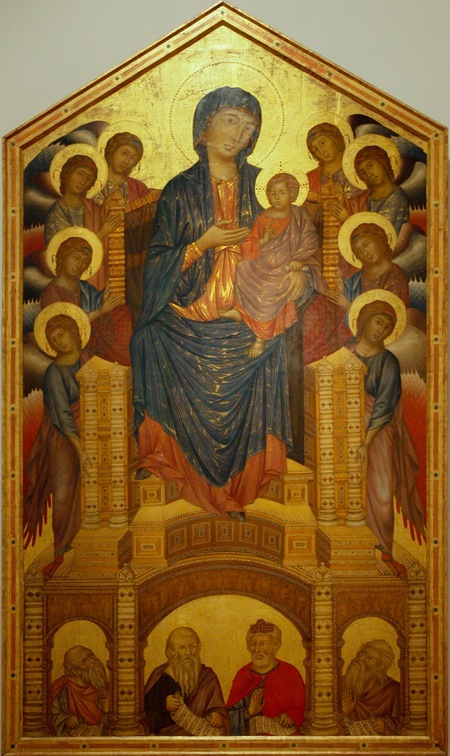
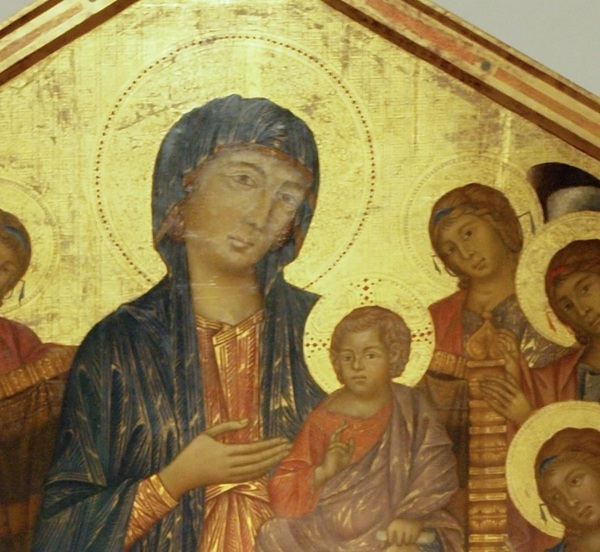
Chimabue. «Madonna of Santa Trinita, ” c. 1290–1300. Uffizi. Mary supports the Infant; he blesses the viewer.
Maria Chimamanda is seated on a high throne, holding the Infant; her hand also directs attention toward him. The child’s hand is raised to bless the viewer, not in response to touching the mother. The diagonals of the angelic figures lead the gaze inward, toward the central pair. Thus, the bond between mother and child is shown here through support and body positioning, but the composition primarily presents the sacred figure of the supplicant. [01]
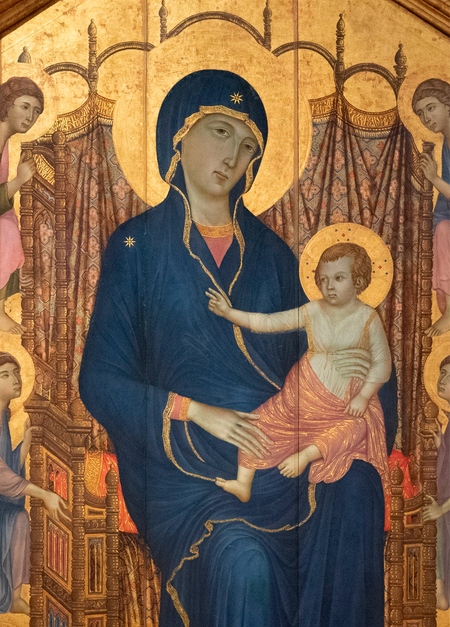
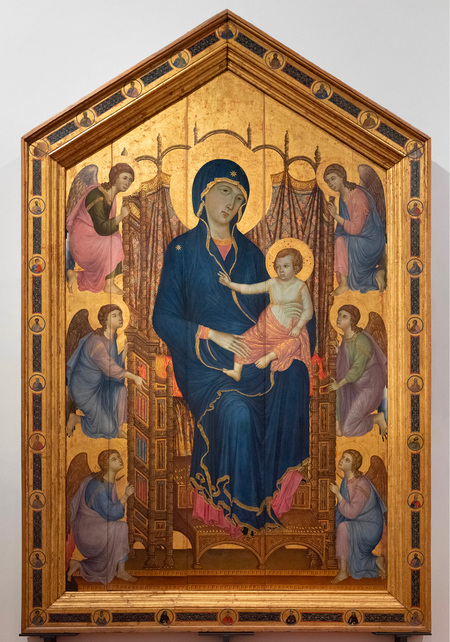
Duccio. «Madonna of the Rucellai,» 1285. Uffizi. Ceremonial altarpiece composition.
In Duccio’s «Madonna col Rocciola, ” the central pair is framed within the elongated silhouette of a throne and surrounded by angels. Mary supports the child while his hand blesses outward. Comparing this to Chimamanda: the mother’s gesture contains the group, but the Infant’s line of action crosses the frame boundary and addresses the viewer. This is not proof of an „absence of tenderness, ” but rather an alternative way to distribute attention within the altarpiece composition. [02]
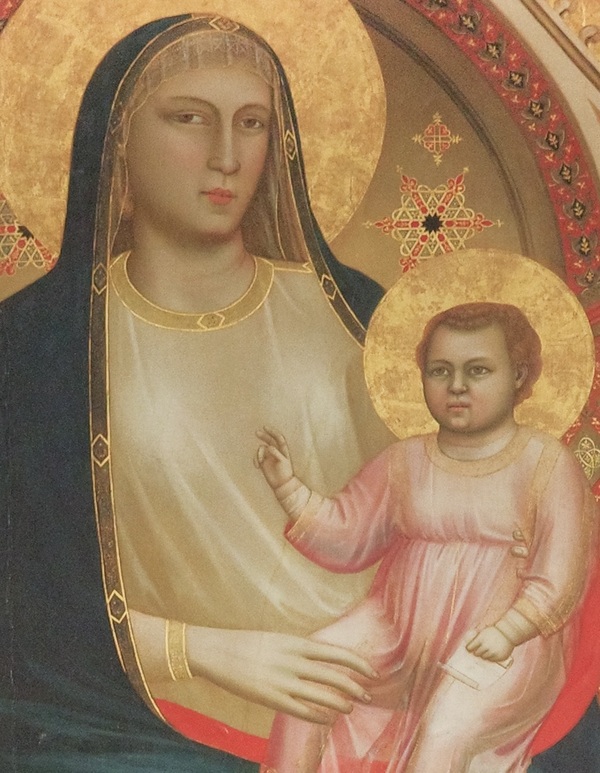
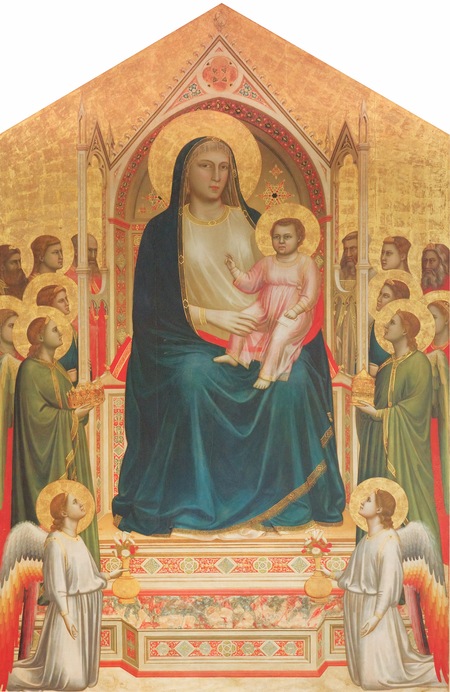
Giotto. «Madonna of Ognissanti, ” c. 1300–1305. Uffizi. Volumetric construction of figures.
In Giotto’s «Madonna of Ognissanti,» the folds of Mary’s drapery define the volume of her knees, and the positioning of her hands makes the weight of the seated Child palpable. Yet, the child still extends a gesture of blessing toward the viewer. A comparison with the «Madonna of Ruccellai» reveals that greater physical persuasiveness does not automatically equate to greater intimacy. It is necessary to distinguish between two variables—the volume of the figures and the direction of their actions. [03]
Duccio. «Maestà» (front side), 1308–1311. Opera del Duomo Museum, Siena. Altarpiece with angels and saints.
On the front of Duccio’s «Maestà, ” Maria and the Infant are centrally positioned among numerous saints and angels. The support for the child is woven into the solemn rhythm of gazes, halos, and frontal figures. This visual order is designed for public contemplation. The takeaway from the first section is that the body’s support is visible even in this grand altarpiece, but its meaning is determined by the intended recipient of the composition—the viewer before the altar or a character within the painting. [13]
02. TEXTURE AND HANDS
Дуччо. Младенец касается прозрачной ткани у лица Марии: движение руки связывает фигуры.
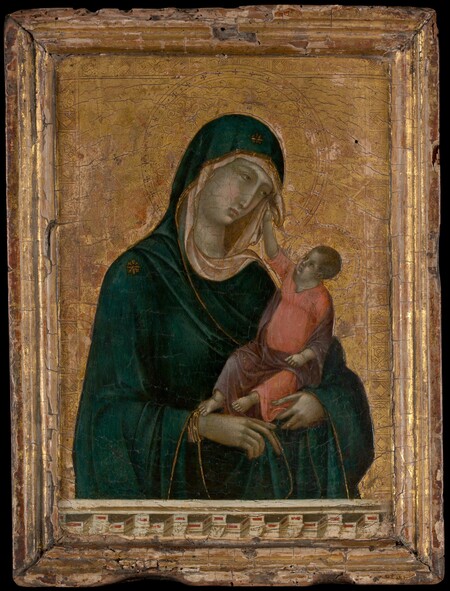
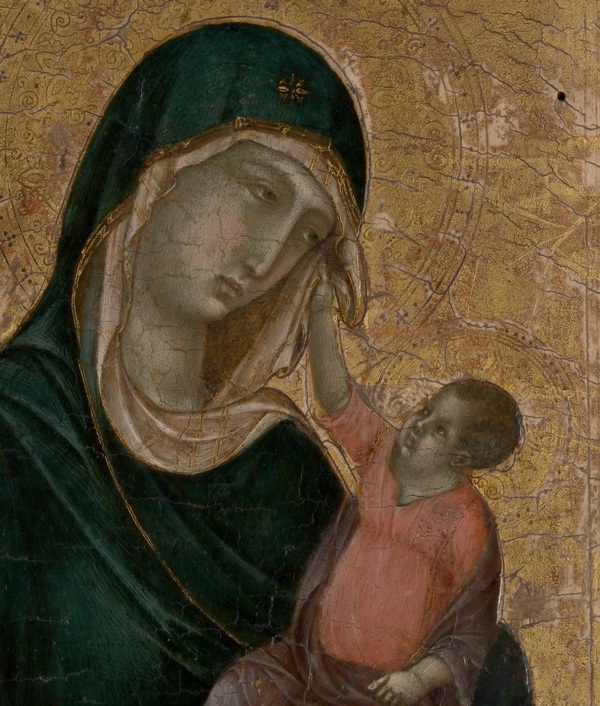
Duccio. «Madonna and Child, ” c. 1290–1300. The Metropolitan Museum of Art. The Christ Child pulls back the veil.
In Duccio’s small «Madonna and Child, ” the child doesn’t just touch the fabric—he pushes aside the mother’s transparent veil. The line of his forearm rises toward Mary’s face, connecting the two heads through a gesture. The lower parapet, conversely, separates the figures from the viewer’s space. We are presented with two opposing operations: contact within the image and boundary outward. The museum suggests a symbolic connection between the veil and the future Passion of Christ. [04; 16]
Duccio. «Madonna and Child, ” circa 1290–1300. Metropolitan Museum of Art. Detail: The Child’s hand pushes aside Mary’s veil.
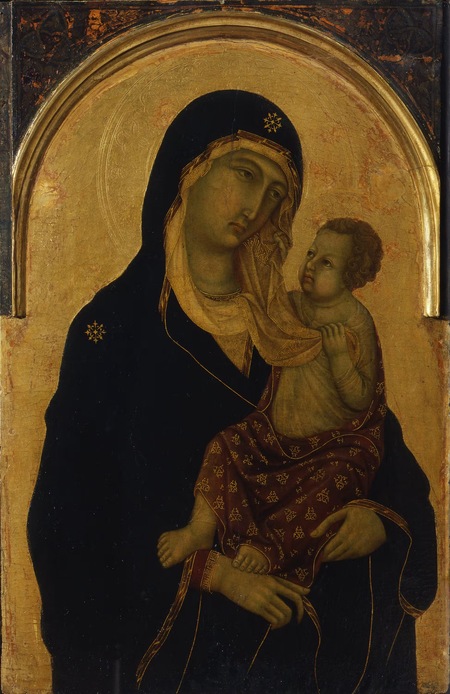
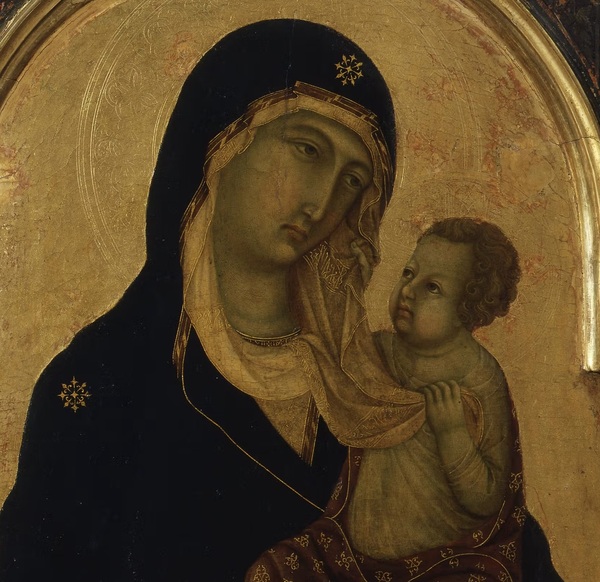
Ugolino di Nerio. «The Virgin and Child, ” circa 1310. Uffizi. The fabric is held by both hands.
Ugolino di Neri’s Infant grasps the blanket with both hands. Compared to Duccio, the point of contact transforms into a more extended action: two hands clutch the fabric, integrating it into the figures' connection. This can be described without psychological speculation. The Uffizi Gallery also offers an iconographic interpretation of the veil as a prefiguration of a burial shroud. The observation itself and its symbolic explanation warrant separate notation here. [05]
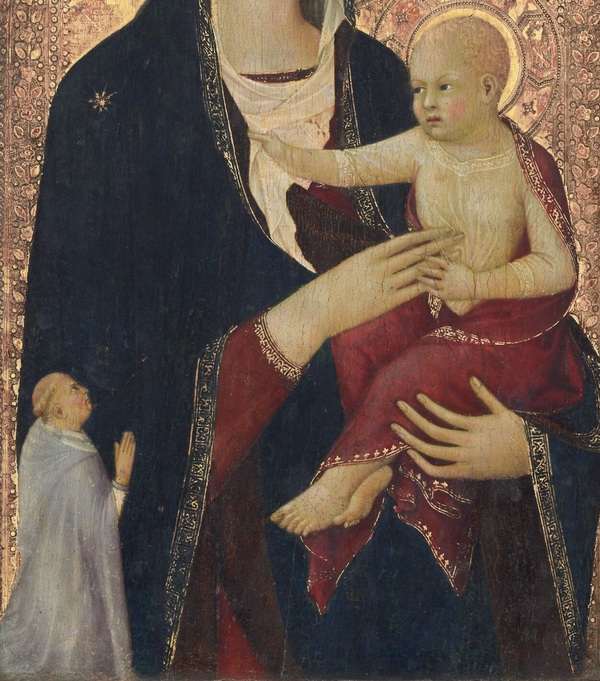
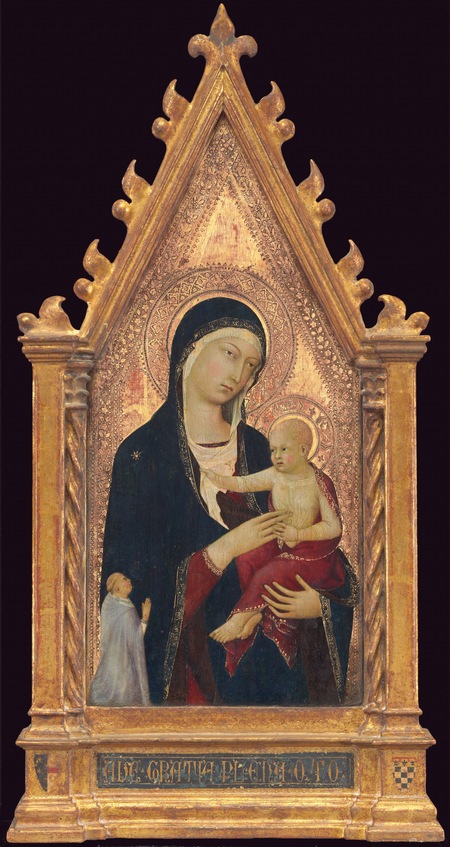
Lippo Memmi. «Madonna and Child with Donor, ” 1325–1330. National Gallery of Art, Washington. Two contacts of hand and fabric.
In Lippo Memmi’s work, two lines of action intersect near the child’s chest: with one hand, he draws Maria’s veil, and with the other, he touches her hand; Maria herself directs his hand toward her chest. This creates a chain of contacts that is easily lost when viewing the entire panel at once. The small donor at the bottom is distinctly different in scale, introducing a private devotional context within the painting. Boskovits distinguishes between the visible gestures and possible allusions to the Passion. [07; 15]
Lippo Memmi. «Madonna with Child and Donor, ” 1325–1330. National Gallery of Art, Washington. Fragment: veil, Mary’s hand, and the Child’s brush.
The initial comparison reveals not a single «formula of tenderness, ” but three mechanisms of contact. Duccio connects the face and hand with a veil, Ugolino introduces a double grip of the fabric, and Lippo Memmi unites the fabric with the touch of fingers. In each image, one can specify the starting point of the action, the object of contact, and Maria’s responsive posture. Consequently, the visual argument for intimacy is based on the mechanics of movement, not on the impression derived from the facial expressions. [04; 05; 07; 15]
03. INFANT MOVEMENT
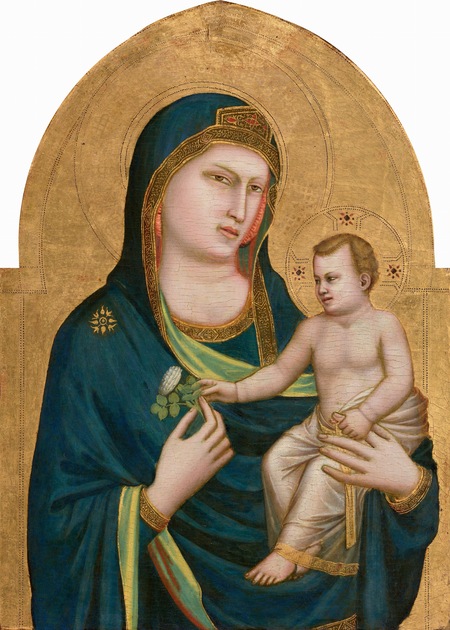
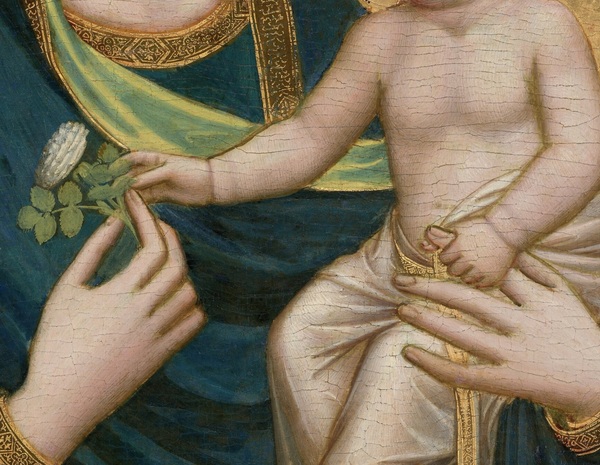
Giotto. «Madonna and Child, ” c. 1310–1315. National Gallery of Art, Washington. The child’s hand reaches toward the rose.