Navigation

— Concept — Early images of the Mother of God and Child: 3rd–4th centuries — Formation of Byzantine iconographic types: 5th–11th centuries — Dissemination of Byzantine images in Western European painting: 12th–13th centuries — Transformation of the Mother of God image in Italian painting, 13th–14th centuries –– Conclusion — Bibliography — Image Sources
Concept
The image of the Theotokos, or more commonly the Theotokos holding the infant in her arms, is one of the most prevalent themes in Christian painting. Despite this ubiquity, there are numerous distinct artistic interpretations, causing its visual embodiment to evolve over time and become increasingly varied. Studying the development of these methods of rendering the same subject allows us to trace how the perception of the Theotokos’s image has changed over the years.
This paper examines how the visual portrayal of Mary evolved in Christian painting from the 3rd to the 14th centuries and the artistic means through which this transformation occurred. Early depictions of this image appear as early as the 3rd century. These early works are characterized by a concise and restrained execution. The image of the Theotokos is quite stylized, sometimes schematic. It symbolizes human faith and hope. In the subsequent centuries, stable iconographic types formed, in which Mary’s and the infant’s positioning carries specific symbolic meaning. The most common of these include:
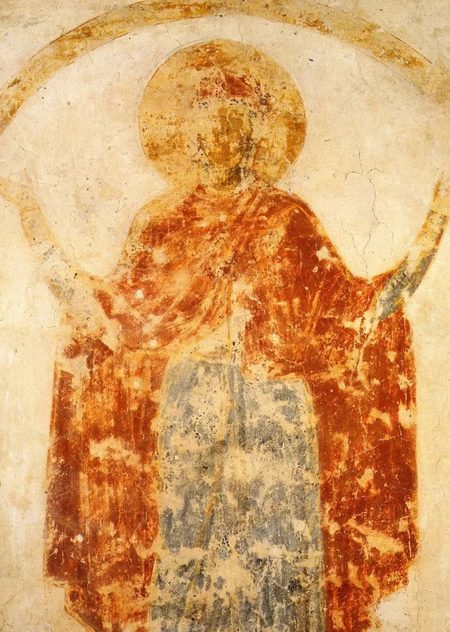
- Oranta (The Theotokos is depicted with raised and outstretched arms in a gesture of prayer, and the infant is shown in the chest area)—intercession and constant prayer.
- Hodegetria (The Theotokos holds the infant and points to him with one hand)—Christ as the path to salvation.
- Eleousa (Mother and child depicted in close union)—the highest degree of maternal love.
- Panaghena (The Theotokos sits on a throne, and the infant sits on her lap)—the majesty of the Theotokos as an earthly and heavenly Queen.
These traditions were reinforced and further developed in medieval Western European painting due to a series of historical factors. Later, in Italian painting, a combination of Byzantine standards and additional elements (volume, achieved through strong chiaroscuro; detailing; and environmental refinement) was used to depict the Mother of God with the infant in her arms.
The study examines frescoes, temple paintings, mosaics, icons, and altarpieces. By tracing changes in the posture and gestures of figures, the interaction between mother and child, proportions, the depiction of space, color, and background, one can follow the evolutionary path of the Mother of God holding the infant. Over time, the image becomes more solemn and majestic. It can be hypothesized that the development of this image did not occur as a direct transition from convention to realism, but rather as an expansion of existing modes of representation. The iconographic tradition maintained the recognizability of the subject, while the composition, the plasticity of the figures, the spatial arrangement, and the emotional gestures became more varied.
Early Depictions of the Virgin and Child: 3rd–4th Centuries
In early Christian art, the image of the Theotokos (Mother of God) is primarily found within the context of biblical narratives, accompanied by Christian symbolism.
Fresco of «The Virgin Mary with the Infant and the Prophet Balaam» in the Catacombs of Priscilla, Rome. 2nd–3rd century.
One of the most famous and ancient depictions of the Mother of God is the fresco in the Catacombs of Priscilla in Rome. Mary with the infant is portrayed in a relatively simple composition, without detailed descriptions of the surrounding environment or specific attributes. During this period, the emphasis was placed on the bond between mother and child rather than on the individual characteristics of the characters.
The emphasis on Mary’s maternal love for the Infant Jesus reflects the reverence of the early Christian community for the Theotokos and the understanding of God’s love for humanity, which was expressed in Him sending His only Son to earth to share our humanity with us» [1]
Rome, the catacombs of Saints Marcellinus and Peter, the Virgin Mary with the infant, and two wise men. First half of the 3rd century
Relief with the theme «Adoration of the Magi.» Priscilla’s Catacombs in Rome, late 3rd — early 4th century
All of Maria’s early works primarily relate to the embodiment of Christ. It is within the catacombs that the fundamental element of this visual narrative is established, a narrative that will later take on countless forms.
Formation of Byzantine Iconographic Types: 5th–11th Centuries
Ceramics. Byzantine — The Virgin Mary with Child 10th Century, Constantinople (modern Istanbul, Turkey)
One compositional option is the Eleousa. This piece emphasizes the physical and spiritual intimacy between the Mother of God and the infant. Their faces are close to each other; the child may lightly touch the mother or reach out to her. This visual choice conveys the immediate image of maternal love while maintaining the religious context.
Mosaic Virgin Mary with Child on Throne Epiphany Basilica, Poreč. 6th century.
Through the development of religious art, several ways of depicting Mary and Christ became established. A diversity of characters, their interactions, gestures, and figure placements emerged. In Byzantine art, the composition featuring the Theotokos (Mother of God) became most popular, wherein she seems to point toward the infant in her arms, thereby making him the central figure of the visual narrative. Furthermore, the Theotokos is often depicted seated on a throne, in the role of Queen of Heaven. This expresses her special status within the Christian hierarchy.
Fresco. The Celestial Queen) with an Infant and a kneeling angel. Fresco. 1st half of the 6th century. Santa Maria Antica, Rome.
Icon, Madonna and Child enthroned with Saint Theodore of Amasea and Saint George, and angels. Late 6th century, Monastery of Saint Catherine, Sinai, Egypt.
In such a composition, the Theotokos, Mary acts more as a mediator between the viewer and Christ. The infant, too, is typically depicted with certain signs of seriousness and awareness—for example, holding a scroll or making a blessing gesture—to emphasize his divine nature.
The Mother of God Forviotissa, Church of Panagia Forviotissa, 7th century.
One of the oldest examples of the Oranta. The Mother of God is depicted frontally, in a prayerful gesture, and the infant Christ is shown on her chest against a sphere. However, this is not the case in all depictions of the Oranta; in many, the Theotokos is shown without a child.
In the era of Byzantine art, images of the Virgin Mary with the Christ Child show a predominance of frontal composition and a greater expressiveness in the silhouettes.
The Diffusion of Byzantine Imagery in Western European Painting: 12th–13th Centuries