The stigmatization of Saint Francis is a subject in which painting confronts the challenge of depicting an invisible religious event. According to the hagiography, in 1224, on Mount La Verna, Francis witnessed a seraph in the likeness of the crucified Christ, after which wounds corresponding to the wounds of the Crucifixion appeared on his body. For the artist, this narrative created a complex visual problem: it was necessary to depict not only the saint and the heavenly vision but also the connection between them and to clarify how the event manifests on the human body. Therefore, the subject of study is not Francis’s biography or the theological significance of the stigmata in and of itself, but rather the artistic methods used to visualize the moment of stigmatization in Italian painting from the 13th to the 16th centuries. The relevance of this approach stems from the fact that the same subject allows for diverse formal solutions. An artist can establish a link between the celestial and the earthly through directed rays, through the relative positioning of figures, through the repetition of the gesture of the Crucifixion, through the depiction of the wounds, or through incorporating the episode into a broader cycle. These elements are not interchangeable: a ray establishes trajectory and causal connection, a gesture shapes the plasticity of the body, a compositional parallel links two events, and chiaroscuro distributes the viewer’s attention. The research examines how these elements function individually and in combination, and how their function changes across the works of different artists. The material is limited to Italian paintings from the 13th to the 16th centuries that specifically depict the moment of receiving the stigmata.
The selection is based on the ability to compare different types of composition and various methods of conveying the connection between celestial vision and the body. Dates, techniques, and museum attributions are verified using the catalogs of the respective collections. The works are not viewed as sequential stages of a single evolution; differences may be explained not only by the time of creation but also by format, original location, purpose, and conditions of perception. The research question is formulated as follows: what compositional and plastic means did Italian artists of the 13th–16th centuries use to visualize the connection between the heavenly vision and the bodily transformation of Francis? The working hypothesis is that this connection is created by a system of means—spatial arrangement of figures, direction of rays and gazes, the plasticity of posture and gesture, the repetition of stigmata, and the organization of chiaroscuro. It is assumed that the composition and hierarchy of these means change from one work to another, so the iconography of stigmatization cannot be reduced to a single, unchanging technique. The research methodology includes formal analysis of composition, plasticity, and chiaroscuro; comparative analysis of several works; iconographic correlation; and consultation of written sources and contemporary scholarly literature. The formal analysis documents the format, arrangement of figures, compositional axes, direction of lines and gazes, relationship between planes, posture, gestures, legibility of the stigmata, and distribution of light. Subsequently, the function of each element in the perception of the event is determined.
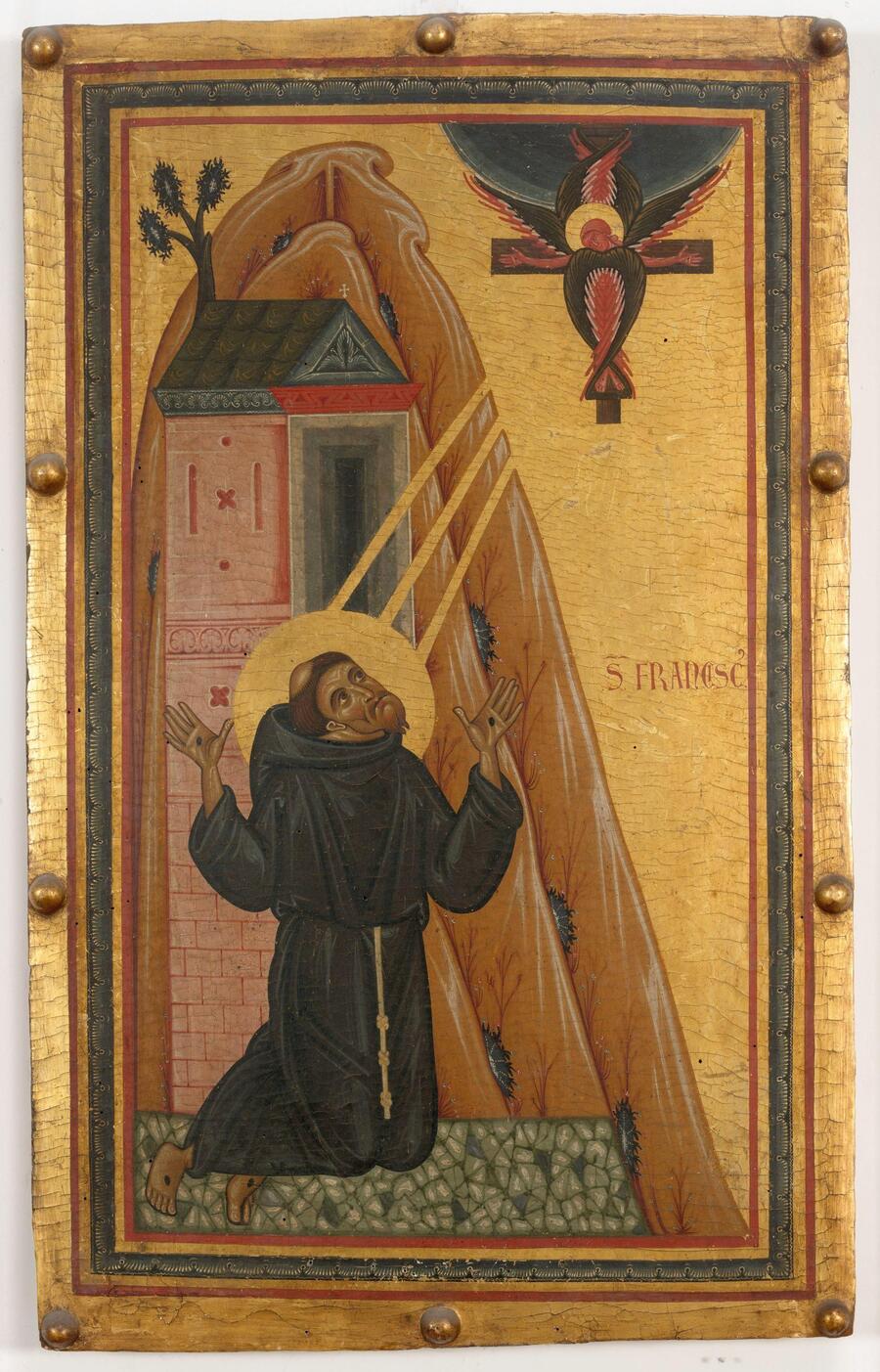
Cross Master No. 434. «Stigmata of Saint Francis, ” 1240–1250. Tempera on wood. Uffizi, Florence.
The year 1224. Mount La Verne
According to the Franciscan tradition, during prayer and fasting on Mount La Verna, Francis saw a seraph whose form was that of the crucified Christ. Following this vision, wounds appeared on the saint’s body, mirroring the wounds of the Crucifixion.
This event became one of the most important episodes of his life.
In hagiographical tradition, this event is linked to Francis’s stay on Mount La Verna in 1224. Bonaventure’s «Major Life» describes the vision of the seraph resembling the crucified Christ, after which wounds appear on Francis’s body. For the analysis of painting, it is crucial to distinguish between the historical-religious narrative and its visual construction: the artist is not simply illustrating the text, but chooses precisely what to depict simultaneously—the vision, the impact of the rays, the appearance of the wounds, or the witness’s reaction.
The Unseen Event
Stigmatization presented a unique challenge for the artist. It was necessary not only to depict the heavenly vision but also its effect on the human body.
The spiritual experience itself cannot be shown directly. Therefore, the painting turns to visible signs: the figure of Christ, light, rays, Francis’s gestures, and the appearance of wounds.
The event itself cannot be directly observed; the image must make visible what the narrative classifies as a miraculous experience. This creates a specific artistic problem. The painter constructs the relationship between the source of the influence and Francis’s body so that the viewer can trace the causal link. This can be indicated by rays, gestures, the direction of gaze, the spatial arrangement of figures, or the repetition of bodily signs. Consequently, the composition functions not as a neutral container for the plot, but as a tool for visual explanation.
The Body as Testimonial
In this narrative, the human body acquires profound significance. It simultaneously belongs to the earthly realm while becoming a locus for divine manifestation. Francis’s wounds do more than merely inform the viewer of a miracle—they establish a visual connection between the saint’s body and the body of the crucified Christ. In this iconography, Francis’s body functions as a character, a surface upon which the miracle is displayed, and evidence of its effect. Therefore, analysis demands close attention to posture, silhouette, the placement of hands and feet, the openness or closure of the body, and the clarity with which the wounds are depicted for the viewer. One cannot automatically interpret every outstretched arm as a sign of ecstasy; its function must be determined in relation to the other elements of the composition. This approach allows for a precise description of the plasticity without substituting specific observation with general terms of spirituality.
The stigmatization of Francis is visualized through a system of compositional and plastic correspondences between the heavenly image of Christ and the body of the saint. Directed rays, the spatial juxtaposition of figures, gestures, body positioning, and the depiction of wounds allow the invisible religious event to be presented as an observable process of Francis’s resemblance to Christ. The working hypothesis is that Italian artists visualize stigmatization through various methods of organizing the relationship between the heavenly vision and the saint’s body. In some works, this connection is emphasized by directed rays; in others, it is shown through the parallel between the bodies of Christ and Francis, gestures, or the arrangement of scenes within a cycle. The hypothesis does not assume that one technique is consistently present in all monuments. On the contrary, the study investigates which means recur, which vary, and how their combination alters the perception of the event.
The study includes Italian paintings from the 13th–16th centuries that directly depict Saint Francis receiving the stigmata.Images of the saint with already established stigmata, scenes of his death, burial, and post-mortem glorification are not considered primary objects of analysis—they belong to other stages of the narrative.The body of work is limited to Italian painting from the 13th–16th centuries and works that illustrate the moment of receiving the stigmata. This limitation is necessary so that the comparison does not devolve into an overview of all depictions of Francis. Key examples analyzed include an early panel from the Uffizi, the Taddio Gaddi cycle, 15th-century works, and the 1596 painting by Cigoli.
Master of the Cross Artwork No. 434, dated 1240–1250, belongs to the earliest known depictions of stigmata. It is executed in tempera on wood and is held in the Uffizi Gallery.
The Uffizi catalog description allows us to rely on specific details: three rays illuminate Francis’s face, nail heads are indicated on his hands and feet, and the background shows the rocks of La Verna and the chapel. This information is important not as a list of attributes, but as confirmation that the artist integrates the site of the event, its divine cause, and the physical result within a single composition.
Master of the Cross No. 434. «Stigmata of Saint Francis, ” 1240–1250. Tempera on wood. Uffizi, Florence.
Francis is depicted kneeling, with his arms outstretched. His posture simultaneously expresses a prayerful appeal and openness to the vision occurring.
In the early work, it is particularly important to examine how clearly the cause-and-effect relationship is presented to the viewer. The celestial figure is positioned above Francis, and rays directed toward him connect the upper and lower sections of the composition. The bodily signs confirm that the influence has already taken hold. Thus, the narrative can be read as a sequence: manifestation—connection—bodily transformation.
The saint’s figure occupies the lower part of the composition and is directly integrated with the surrounding mountainous space.
Francis’s figure takes up the main space in the lower half of the composition and is rendered in a clear, easily recognizable silhouette. His open arms expand the figure horizontally, making his body visually receptive to external influence. The kneeling posture keeps the figure grounded in the earthly realm, while his gaze is directed toward the heavenly apparition. This contrast between vertical and horizontal orientations creates a simple yet potent structure: the body remains on the earth, while attention and semantic impulse are directed upward.
Above Francis, there is a seraph associated with the image of the Crucifixion. The celestial figure is not merely a symbol of God’s presence; it becomes the immediate source of the event unfolding. The combination of the seraph and the cross merges the motif of a heavenly apparition with the image of the suffering Christ. The heavenly apparition in the early panel is not dissolved into abstract radiance; the seraph is linked to the cross and presented as a concrete figure. This choice makes the source of the event tangible and recognizable. The viewer sees not only Francis’s reaction but also the image toward which his gaze is directed. It is important, however, not to confuse the seraph with a standard angel; the museum description emphasizes specifically the seraphic angel connected to the cross. This iconographic specificity helps anchor the scene’s meaning without requiring extensive narrative context.
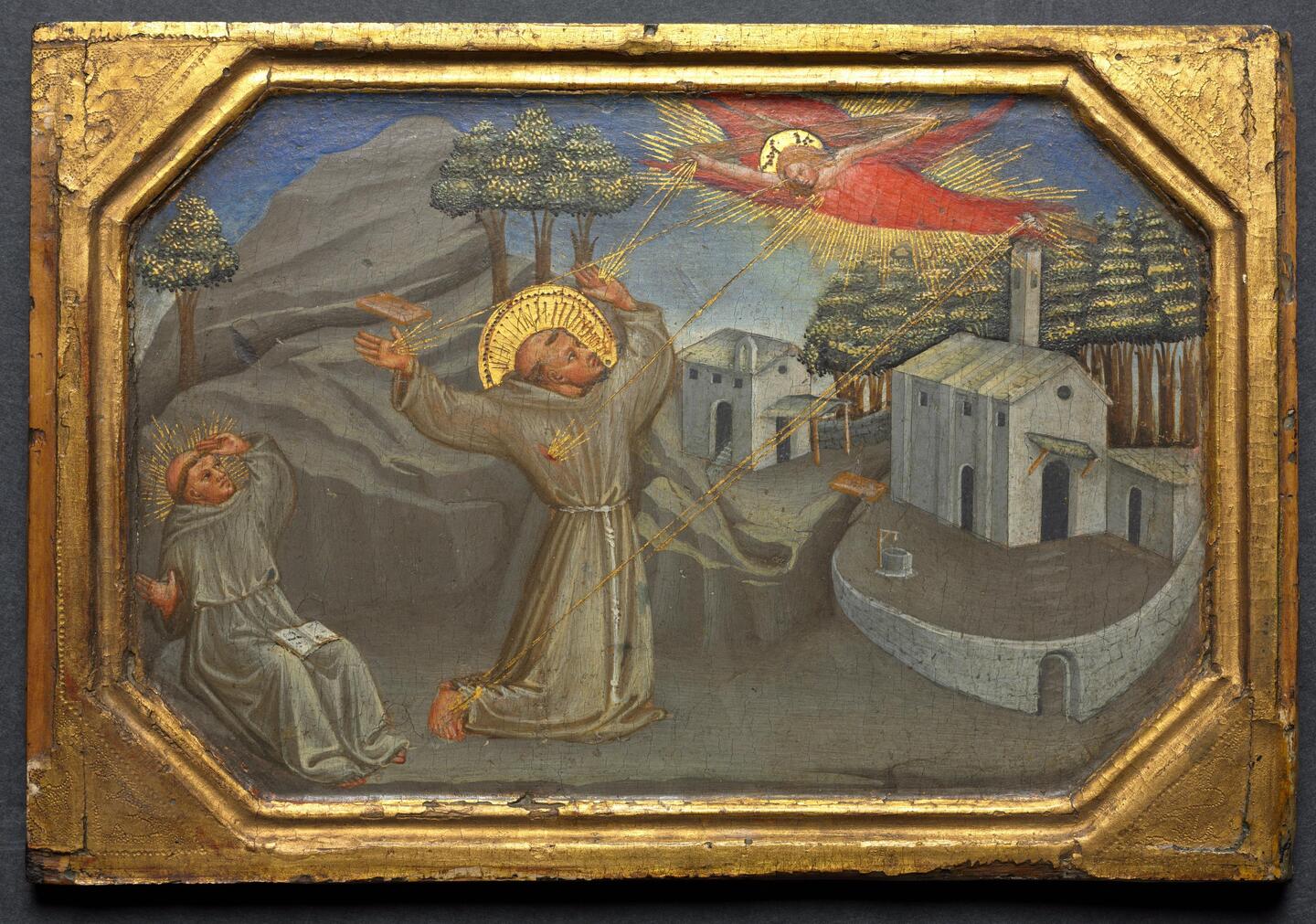
Three rays emanate from the celestial figure, directed toward Francis. They illuminate his face, symbolizing the interplay between the vision and the saint’s body.
The number of rays in this particular work should be noted as a specific feature of this panel. In research, it serves as a starting point for comparison, not as a universal rule. Later variations appear where the rays might be more numerous, thinner, or organized differently.
The rays become one of the primary visual devices of the narrative—through them, the viewer can trace the direction of divine influence.
The connection between the two areas of the painting is established primarily through the mutual orientation of the figures: Francis is turned toward the apparition, and the heavenly image is located within his field of vision. This visual connection does not necessarily have to be understood as a physical beam if it is indistinguishable in a reproduction. Methodologically, it is crucial to describe only the visible lines and directions. In the early version, the connection is created through compositional proximity and the direction of the heads and arms; in other works, it may be reinforced by linear trajectories.
On Francis’s hands and feet, nailheads are visible, connecting to the depiction of the stigmata. Thus, the outcome of the miracle is signified not only through rays but also through specific physical marks.In the early work, it is particularly important to consider how clearly the cause-and-effect relationship is presented to the viewer. The heavenly figure is positioned above Francis, and the rays directed toward him link the upper and lower parts of the composition. The physical marks confirm that the impact has already taken place. Consequently, the narrative can be read as a sequence: phenomenon—connection—bodily transformation.In one composition, the cause of the event and its physical consequence are unified.The wounds on the hands and feet are not a minor detail, but the visual result of the event. Their placement references the wounds of Christ, but in the early image, they also serve an identifying function: they allow the viewer to understand why the episode is called stigmation. The analysis must take into account the scale of the marks relative to the body and their legibility for the viewer. If the wounds are small, the viewer perceives the narrative through the totality of attributes; if they are emphasized, the body becomes the primary carrier of narrative information.
The rocky landscape denotes La Vern—the location where the event occurred, according to the hagiography. A chapel, connected to the early history of the monastic retreat, is situated on the rock behind Francis.
The landscape and the chapel function to localize the scene while simultaneously emphasizing Francis’s solitude. He is situated in a natural environment, distant from everyday life, and is turned toward an event that no one else shares. This intensifies the scene’s nature as a personal religious experience.
The natural surroundings do not merely fill the background; they anchor the religious narrative in a specific space.
The landscape of La Vern is significant not only as a backdrop indicating the setting. The rocks and mountainous environment separate the scene from ordinary space and create a sense of secludedness. However, one should not assign symbolic meaning to every rock without additional sources. In formal analysis, it is sufficient to determine how the contours of the landscape frame the figure, limit the depth, and direct the viewer’s gaze toward the central event. The landscape helps localize the miracle but does not displace the figures of the participants from the composition.
The fresco underscores the exceptional nature of this work among known 13th-century depictions: it presents a specific episode from the life of Francis.
When considering this piece, one must account for its medieval character: the space does not necessarily adhere to the unified perspective system common in later painting. Therefore, it should not be analyzed based on its naturalism but on how coherently the composition links the characters and thematic focal points.
REPRODUCTION IN THE MUSEUM CATALOGUE
Click the link below
The viewer is invited to see not only the saint, already marked by the stigmata, but the very moment they appear.
In early iconography, the stigmata can be interpreted as a mark that remains on the saint’s body even after the vision ends. However, this depiction of the moment of receiving the wounds organizes time differently: it unites the source of the impact and its result within a single visual field. Thus, analysis requires distinguishing between two types of imagery—Francis as a saint already bearing the stigmata, and Francis in the moment of stigmata acquisition. This study prioritizes the latter, as it allows for an investigation into the visual methods used to convey action.
In the lower right corner of the painting is an inscription with the name Francis. The Uffizi draws attention to the fact that this helps unambiguously identify the figure in the image.
In the early work, it is particularly important to examine how clearly the cause-and-effect relationship is presented to the viewer. The celestial figure is positioned above Francis, and rays directed toward him connect the upper and lower parts of the composition. The corporeal signs confirm that the influence has already taken place. Thus, the narrative can be read as a sequence: phenomenon—connection—bodily change.
This is especially relevant for the unconventional subject matter, where the saint is not presented in the usual static form, but within a complex religious event.
The recognizability of the scene is formed by a combination of several elements: Francis’s monastic habit, his characteristic pose, the heavenly vision, and the corporeal signs. None of these elements alone exhausts the narrative. For example, the image of the monk with wounds may signify Francis as a bearer of stigmata, but it does not necessarily depict the moment they were received. Therefore, the attribution of the subject must be based on the totality of features and the museum identification of the work.
Space as a Medium for Transmitting Divine Influence
In the stigmatization images, the space between Christ and Francis becomes an active part of the narrative. It not only separates the characters but also explains how the celestial event relates to the earthly body.
When comparing different paintings, one cannot automatically assume that all rays are identical. Their number, color, thickness, and direction vary. Therefore, in each case, it is necessary to describe the specific solution before comparing it to other works. This approach prevents drawing overly generalized conclusions about fixed iconography.
II. Space in the stigmatization scenes does not merely denote the setting. It distributes the relationship between the celestial and the earthly, defines the distance between the characters, and establishes the path of the viewer’s gaze. In this section, space is examined as an active compositional tool. The analysis includes vertical and diagonal axes, the boundaries between planes, the placement of figures relative to the center, and methods of conveying connection through empty space. Particular attention is paid to the rays, but they are not interpreted as the sole means of depicting the miracle.
Light as a visual trajectory
Rays establish a trajectory along which the viewer can trace the connection between two figures. Their function is not limited to depicting light; they transform the picture space into a visual channel for transmitting stigmas.
The spatial organization of the scene is particularly telling because the miracle itself implies a transition between two levels of reality. The celestial vision does not reside in the same physical space as Francisco, yet the image must make their interaction comprehensible. This task is resolved through vertical placement, directional lines, gesture, and gaze.
This is why rays can be regarded as one of the main compositional mechanisms of the narrative.
A ray in the image can perform several functions simultaneously: indicating direction, linking two figures, denoting influence, and helping the viewer interpret the causal relationship. However, it is important not to label every thin line as a ray without verification against the reproduction and museum description. The study must distinguish between direct golden lines, luminous bands, and conventional graphic trajectories. Their function is determined by where they originate, where they terminate, and what elements of the body or image they connect.
Light and Optics
Researcher Genevieve Colfield connects the variation in ray depictions within scenes of stigmatization to the evolution of medieval concepts of vision and optics, particularly the theory of perspectiva.
Crucially, it is not just the source of the rays, but also the point to which they are directed. If the lines terminate at the hands, feet, or flank of a saint, they indicate specific locations of the stigmata. The space between the figures ceases to be a void but rather a graphically organized zone where the viewer perceives the connection itself.
This allows the rays to be viewed not merely as a religious symbol, but as a visual explanation of the cause-and-effect relationship between the celestial image and the saint’s body.
Genevieve Colfield’s article proposes examining the changing iconography of the rays through the lens of medieval theories of vision and optics—perspectiva. This research is particularly relevant to the subject because it bridges an artistic technique with the intellectual environment of the Franciscan order. However, this interpretation should be utilized as a research model, not as definitive proof that every artist consciously illustrated a specific optical theory. The phrasing must remain cautious: the optical context helps illuminate the possible logic behind the visualization.
Two Levels of Space
In compositions featuring stigmatization, celestial and earthly planes are often distinguished. The source of vision is positioned on one plane, while Francis and his surrounding landscape are on the other. By comparing different paintings, one cannot automatically assume that all rays are identical. Their number, color, thickness, and direction vary. Therefore, in each case, it is necessary to describe the specific solution before comparing it to other works. This approach prevents drawing overly general conclusions about static iconography. This division helps the viewer recognize the distinction between the spiritual and material worlds, yet the rays and gestures simultaneously connect them. In many compositions, the celestial and earthly zones differ not only in placement but also in mode of depiction. The celestial figure may inhabit a cloud or an idealized space, whereas Francis is placed within a recognizable landscape. An intermediary zone arises between them, illustrating the connection. The artist’s visual task is to make this connection comprehensible without undermining the distinction between the earthly and the celestial. This is precisely why lines, gestures, and directions of gaze become particularly significant.
Tadeo Gaddi: Image within a loop