Art is currently experiencing a paradox: the less understandable it is to the viewer, the higher its market value. The question of what exactly we are buying when we acquire a piece of art—the object itself or a fragment of the myth surrounding its creator—sounds more acute now than ever. In an era where a banana taped to a wall sells for a huge sum, and an invisible sculpture finds its owners, the boundaries between artistic value, market worth, and the artist’s personal brand are finally blurring.
In the contemporary art market, an artist’s name sometimes carries more weight than the canvas itself, and the price tag can exceed the objective labor involved by tenfold. This raises two interconnected questions: how does the artist’s biography and public image influence a piece of art, and can celebrity status justify a lack of artistic merit while allowing for exorbitant pricing?


Mauricio Cattelan, «Comedian, ” 2019. Salvatore Garau, „Io Sono, ” 2021.
The influence of the creator on a work begins long before the piece enters auction catalogs. If a viewer perceives the artist as a genius, they tend to imbue their work with depth, excusing technical flaws. This is especially evident in conceptual art. Research by K. Chistopolskaya, which examined the shift in representation [3], demonstrated that intellectual titling and the context established by the author provoke an «aha moment"—a sudden transition from incomprehension to insight.

When we look at Duchamp’s urinal, we don’t see a plumbing fixture—we see a philosophical manifesto, because the artist’s identity and reputation are already built into our perception. Without knowing WHO exhibited it, the object remains merely an object, not a work of art.Marcel Duchamp, Fountain, 1917.
The mechanism of transforming personality into capital is most fully described in Isabel Graff’s book, «The High Price: Art Between the Market and Celebrity Culture» [2]. Graff argues that art is a commodity unlike any other. Unlike luxury goods, a genuine work possesses «symbolic value”—a social weight that cannot be directly converted into currency but makes the demand for astronomical sums possible. In the era of art’s dematerialization, the viewer experiences anxiety: what are they paying for? To alleviate this anxiety, the market demands that the artist „produce“ their personality, which becomes the guarantee that what we are seeing is not merely an object, but a „unique vessel“ of existential experience.
Can a renowned artist do whatever they wish and set any price for their work, regardless of artistic value? The answer is twofold.

From a marketing perspective—yes. The case of Mauricio Cattelan’s banana or Damien Hirst’s shark proves that institutional weight allows for the sale of a pure concept. In this scenario, the mechanism described by Grav at work applies: the artist’s celebrity adds artistic value to the work.Damien Hirst, The Physical Impossibility of Death in the Mind of Someone Living, 1991.
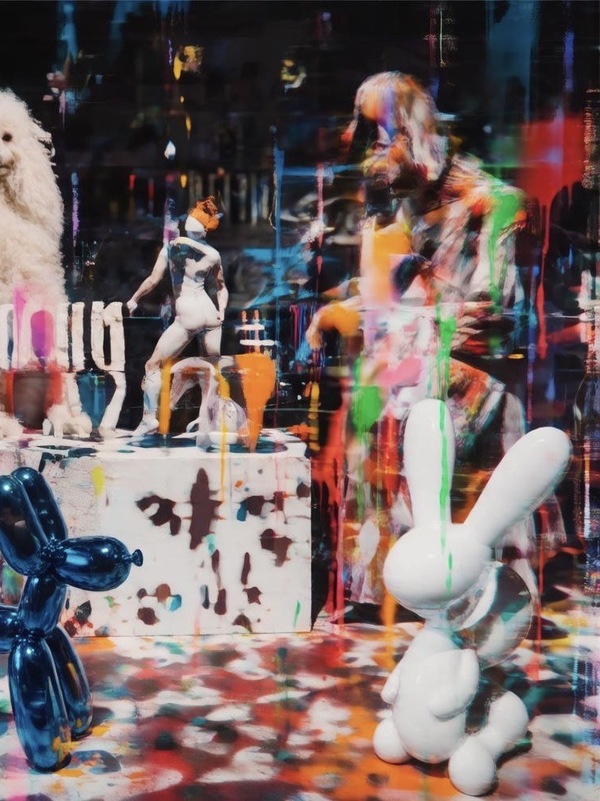
However, from a long-term strategy perspective—no. Economists from Saint Petersburg State University confirmed Roland Barthes’ idea that the meaning of a work is determined by the viewer, not the author [1]. The analysis showed that the market value of a painting is influenced not only by the materials and technique used but also by its public history—specifically, its inclusion in exhibitions and mentions in media, literature, and other sources. The more frequently a work is shown in museums and discussed publicly, the higher its cultural significance and, generally, its price. The art market is extremely rational in its irrationality. It buys liquidity, not a personality. An artist who becomes a captive of their own brand loses freedom. To maintain a high price, they are obligated to be consistent. If collectors buy a «Koons rabbit» or a «Koons dog, ” they expect new, similar works.


Jeff Koons «Rabbit», 1986. Jeff Koons «Balloon Dog», 1990s.
Any deviation, any attempt at sincerity or stylistic shift is perceived by the market as brand devaluation. A well-known artist can set any price, but only if the viewer agrees to support it.
In conclusion, it can be argued that the creator’s persona remains the most critical catalyst initiating the evaluation process, but it ceases to be the sole content of that process, transforming instead into a valuable, yet volatile, asset. It serves as a necessary interface for legitimizing art in the public eye, yet it is merely one of many statistical factors for the auction algorithm. The creator’s freedom in the era of late capitalism is limited only by their ability to persuade the system of the significance of their gesture. However, this freedom is illusory in the long run. If the work lacks resonance, if it fails to become a mirror for the «reader"—the viewer, the critic, the descendant—it is doomed to devaluation.