Concept
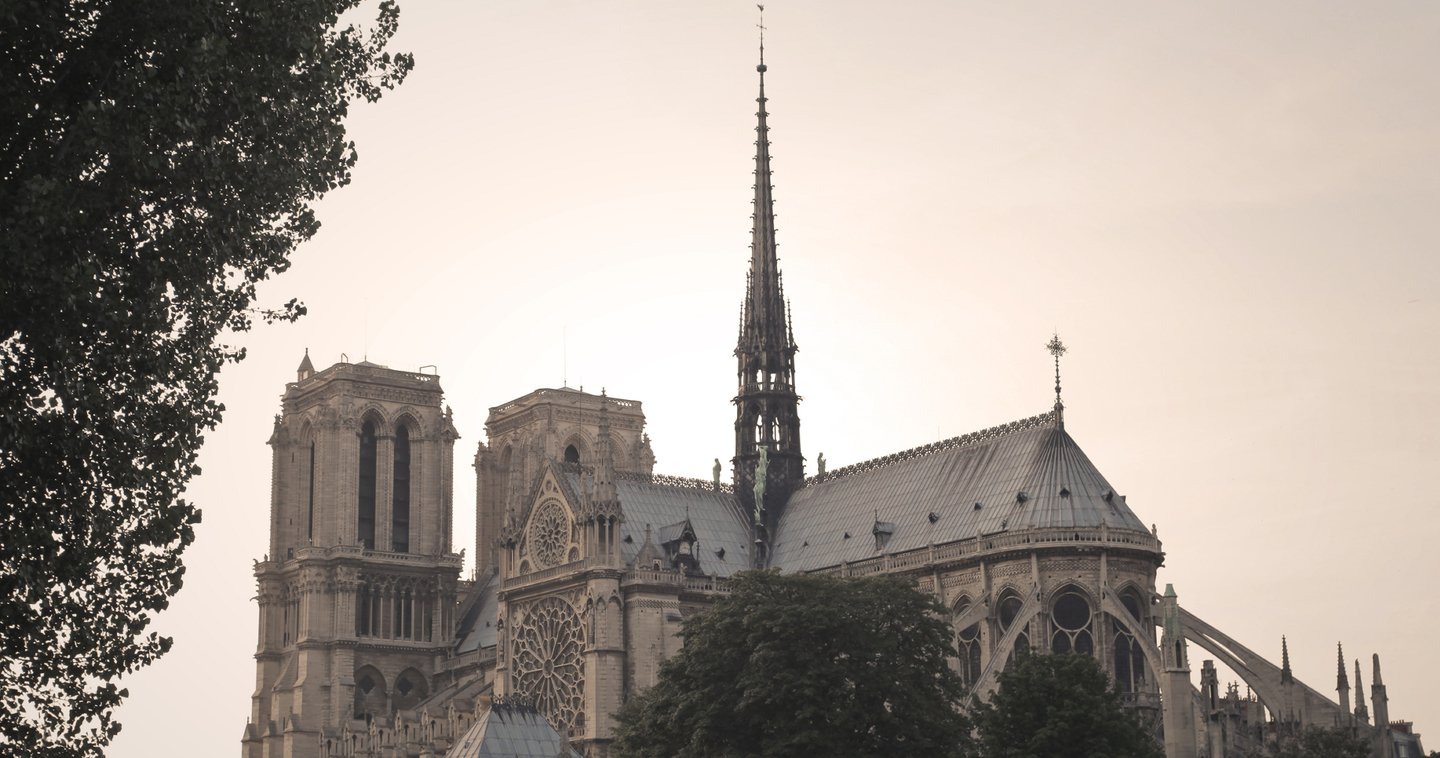
In Medieval Christian sacred architecture, light held a sacred significance and was not confined to merely utilitarian or decorative functions. Drawing from biblical texts, where Jesus Christ was called the «light of the world» (John 8:12), theologians and architects perceived light as a visible representation of God to humankind. Of particular interest in this context is the comparison between two periods: the Early Byzantine era (6th–7th centuries) and High Gothic (12th–13th centuries). While both cultures guided themselves by the vision of light as part of the divine image, a casual observation reveals fundamental differences in their architectural expressions.
But what are the differences in the interpretation of light itself? How were the authors' ideas ultimately expressed?
Christian architecture is undoubtedly relevant today given the scale of the religious community. Similarly, the significant influence of High Gothic and Early Byzantine periods on architecture is undeniable: beyond the aesthetic beauty of the structures, the principles established in both periods (for example, Gothic stained glass or the cross-dome system of Byzantine churches) are still applied in the planning and construction of buildings, especially sacred ones. Studying these religious structures from the specified periods allows one to see in detail the cultural characteristics and worldview of people from those times, and how the boundary between the material and spiritual worlds was conceived then—this is precisely why I decided to delve deeply into this topic. Furthermore, comparing different historical periods will help reveal the evolution of religious views through architectural expression and highlight the differences in possibilities and principles over time.
My key question is this: How was the unified concept of «divine» light ultimately interpreted in fundamentally different ways—through light reflection in early Byzantine architecture and its transmission in Gothic architecture?
For the comparative analysis within the visual study, benchmark buildings from two distinct eras were selected—periods where the studied concept is most pronounced. To represent early Byzantine architecture, we selected the Hagia Sophia in Istanbul, where the system of dome-supported illumination developed, alongside the basilicas of San Vitale and San Apollinare in Classe in Ravenna; the latter allow for a closer examination of architectural details due to their smaller scale. On the high Gothic side, we examined the Abbey Church of Saint-Denis as the «cradle» of the style, along with the Cathedrals of Amiens and Chartres, as these structures pushed the area of stained glass to its maximum capacity given the structural system capabilities of the era.
The visual exploration is divided into four chapters for a more cohesive study of architectural structures.
In the first chapter, the general origin of the «light-image» idea—the concepts of Pseudo-Dionysius of Areopagus—is analyzed, along with how these ideas were adapted in Byzantium and France. The second chapter compares the engineering methods used in the structures of the two periods to admit light into the interior space. The third chapter focuses on studying surfaces, such as mosaic and stained glass, which shape the necessary atmosphere in Early Byzantine and Gothic interiors in terms of light and color. Finally, the fourth chapter concludes by examining the influence of light on the chosen buildings, specifically on how the architecture is perceived by humans.
Chapter 1. Theology, Origin, and Embodiment of the Idea.
Pseudo-Dionysius the Areopagite greatly influenced the perception of light in Christianity—an unknown author who wrote a collection of theological treatises around the 5th or early 6th century. He wrote as if he were an Athenian from the 1st century, whom the Apostle Paul, based on mentions, converted to Christianity, because his works held considerable authority within the religious community. By merging Neoplatonism with the definition of God as the indescribable «Father of Lights» (James 1:17), the author promotes the idea that illumination emanates from God. Pseudo-Dionysius the Areopagite believes that divine light is everywhere, and even when it weakens, it does not lose its connection to the general «hierarchy of light.»
In the theology of the early Byzantine era—roughly the same period as the writing of Pseudo-Dionysius the Areopagite—the light, stemming from the author’s ideas, was interpreted as divine energy. Its presence within a church was considered a sacred event, augmenting the space and establishing it as a point of connection with the Creator. This is discernible in the atmosphere of religious structures of that time:
Hagia Sophia, Istanbul, 532–537 AD
The lighting created in the Hagia Sophia is evenly distributed throughout the space, minimizing contrast. This evokes a sense of pervasive light and, consequently, divinity.
Saint-Denis Basilica, Paris, 1122–1281
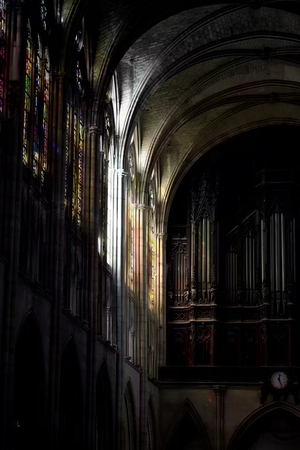
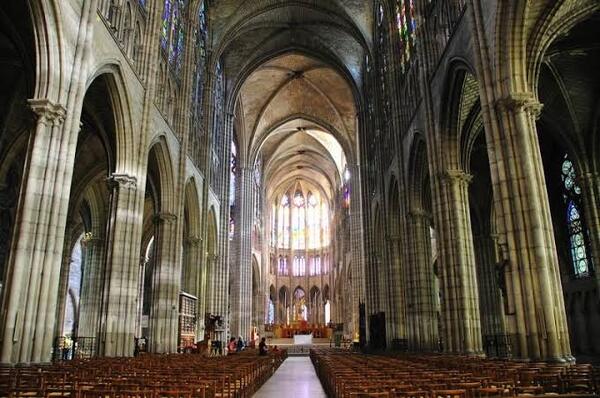
In the twelfth century, however, during the rebuilding of Saint-Denis Basilica, compositions received a different interpretation, which spread thanks to the work of Abbot Suger. The central idea became spiritual elevation and the «resurrection» of the soul; light could help a person transcend material values and bring them closer to the divine. Looking at the light within the Abbey Church of Saint-Denis, its sources are easier to discern, and the light becomes more visible against darker areas. Thus, one can see the embodiment of light as a guide—by looking upward, toward its source, the person directs their gaze toward divine forces.
While Pseudo-Dionysius the Areopagite’s text in Byzantium interpreted light as the pervasive presence of sacred power, in France light aided in achieving enlightenment because it gained significant emphasis in architecture.
It appears that the interpretation of theological texts during the early Byzantine period and the High Gothic period differs significantly depending on what precisely it focuses on. The ubiquity of early contemplation versus the specific direction of later focus reveals an almost opposite viewpoint in the religious societies of those eras, and architecture embodies this transformation.
Chapter 2. Light Incidence and Distribution.
Differences in theological interpretations directly influenced the atmosphere within temples that was achieved through light, as has already been established. Naturally, this also means that design decisions for temples—such as their size or the placement of windows—were shaped by the ideas of that era.
The Dome of Hagia Sophia Cathedral, Istanbul
In the Hagia Sophia Cathedral in Constantinople (present-day Istanbul), architects constructed a system that creates the optical illusion of a «floating dome.»
The main dome, exceeding thirty meters in diameter, rests upon half-domes, buttresses (exedrae), and concealed pylons. Forty windows line the perimeter of the dome’s base. When sunlight penetrates through the windows, it visually severs the connection between the dome and the arches. This creates a sensation as if the dome is «suspended» and generates its own emanating light.
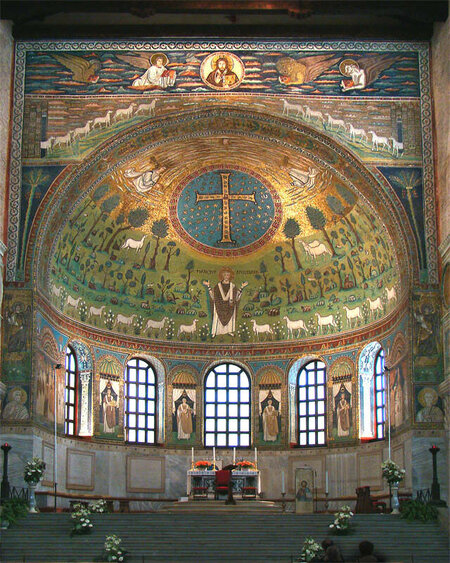
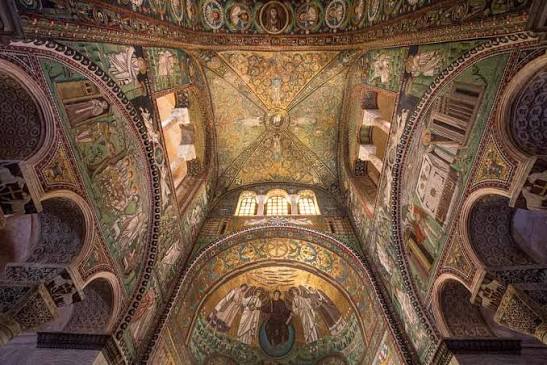
San Apologius Basilica and San Vitale Basilica, Ravenna, second quarter of the 6th century and 527–548.
In the basilicas of Ravenna, architects achieved this effect through large semi-circular windows and a clerestory made of translucent alabaster panels. These panels diffuse direct sunlight, creating uniform, soft illumination without harsh shadows.
Chartres Cathedral, Chartres, 1194–1260
In High Gothic architecture of the 12th–13th centuries, structural elements began to project beyond the interior space of religious structures. The first success in moving away from heavy walls and unifying them into a single light passage was achieved during the reconstruction of Saint-Denis; this principle was fully realized in the construction of the Cathedrals of Chartres and Amiens. At the Chartres Cathedral, the traditional four-tiered wall structure was replaced with a three-tiered one, where the height of the upper tier’s windows equaled the height of the lower arcade.
Notre-Dame Cathedral in Amiens, Amiens, 1220–1269
In the Amiens Cathedral, the stained glass allowed the upper section of the central nave to be entirely glazed. Unlike in Byzantine architecture, where light primarily enters through the dome from above, Gothic architecture focuses on the walls, filling the space with light through tall windows.
Early Byzantine architecture uses light to create a sense of «lightness» in the structure and an internal source of light, whereas the Gothic system, with its skeletal frames and windows, significantly reduces the mass of the walls, and natural sidelight helps emphasize the monumentality and «ascent» of the buildings.